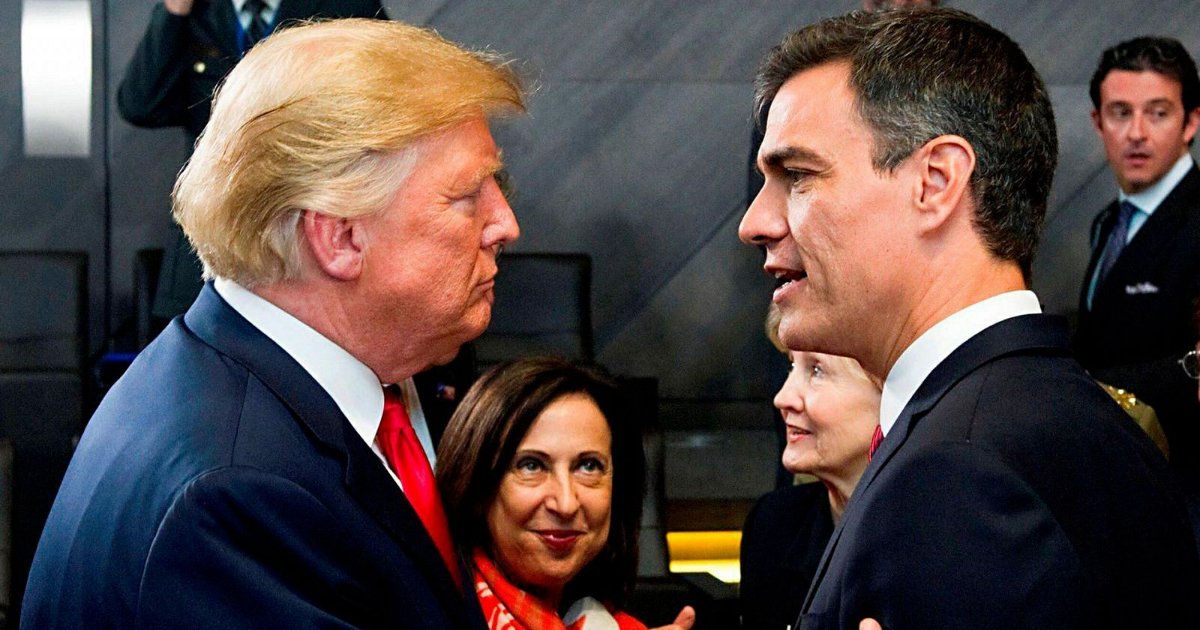
The recent spotlight on Ceuta and Melilla by a committee within the U.S. House of Representatives has reignited a particularly sensitive geopolitical debate for Spain and, by extension, Europe.
Though not an official stance of the U.S. administration, this legislative text questioning the "Spanishness" of both cities and suggesting Washington's mediation in the dispute with Morocco introduces a novel factor into the international arena: the possibility of leveraging a historic conflict amidst broader tensions between the United States and the government led by Pedro Sánchez.
U.S. Involvement Sparks International Dimension
The mention, found within a report by the Appropriations Committee, notes that Ceuta and Melilla, "administered by Spain," reside on Moroccan territory and are part of Rabat's longstanding claims.
The document supports Secretary of State Marco Rubio's efforts to foster diplomatic dialogue between Morocco and Spain regarding the cities' future status.
This stance, albeit formally nuanced, marks a departure from Washington's conventional caution on an issue Spain considers resolved and non-negotiable.
Historical Context and Strategic Recalibration
Ceuta and Melilla have been integral to Spanish territory for centuries, fully incorporated into the nation's constitutional framework. For Madrid, any external challenge to its sovereignty is deemed an unacceptable intrusion. However, the topic's appearance in a U.S. congressional document suggests the debate is gaining a broader international scope.
International media have interpreted this inclusion as a sign that the United States might be willing to wield sensitive territorial issues as tools of diplomatic pressure.
The reference to the "historic alliance" between the U.S. and Morocco—formalized in 1786—reinforces the notion that Washington might be recalibrating its strategic priorities in North Africa, a region crucial due to its proximity to Europe, its role in migration routes, and its security significance.
Analyzing Broader U.S. Diplomatic Pressure
The move recalls recent precedents, such as the acknowledgment of Moroccan sovereignty over Western Sahara during the initial Trump administration, a decision that disrupted regional diplomatic balance and strained relations with European partners. In this context, including Ceuta and Melilla in the report can be seen as an extension of this geopolitical logic.
The broader implications of this gesture must be viewed within the wider context of U.S.-Spain relations under Donald Trump's presidency. Tensions have escalated recently due to several strategic disagreements, particularly Spain's refusal to allow the use of military bases in Rota and Morón for "Epic Fury" operations targeting Iran.
Impact on Spain's International Position
Spain finds itself in a precarious position, facing indirect challenges to its territorial integrity in North Africa and potential U.S. sanctions affecting its economic interests in Cuba. This dual pressure could necessitate a recalibration of Madrid's foreign policy. However, altering its stance on Cuba would entail political and diplomatic costs, especially within the European Union.
Currently, the reference to Ceuta and Melilla does not signal an immediate shift in official U.S. policy, yet its symbolic value is considerable. These gestures, amidst accumulated tensions, could further strain bilateral relations.
The upcoming G7 summit is poised to be a critical platform for gauging these tensions. Meanwhile, pressure on Cuba remains a central focus of U.S. foreign policy, with repercussions extending to actors like Spain.
FAQs on U.S. Involvement in Ceuta and Melilla Dispute
Why is the U.S. interested in Ceuta and Melilla now?
The U.S. involvement appears to be part of a broader diplomatic strategy, leveraging territorial issues as tools of pressure amidst tensions with Spain and recalibrating strategic priorities in North Africa.
What are the implications for Spain's foreign policy?
Spain may need to reassess its foreign policy, balancing its stance between maintaining territorial integrity and responding to potential U.S. sanctions affecting its economic interests, particularly in Cuba.
How does this relate to past U.S. foreign policy actions?
This move is reminiscent of previous actions, like recognizing Moroccan sovereignty over Western Sahara, indicating a pattern of using geopolitical leverage to shift diplomatic balances.