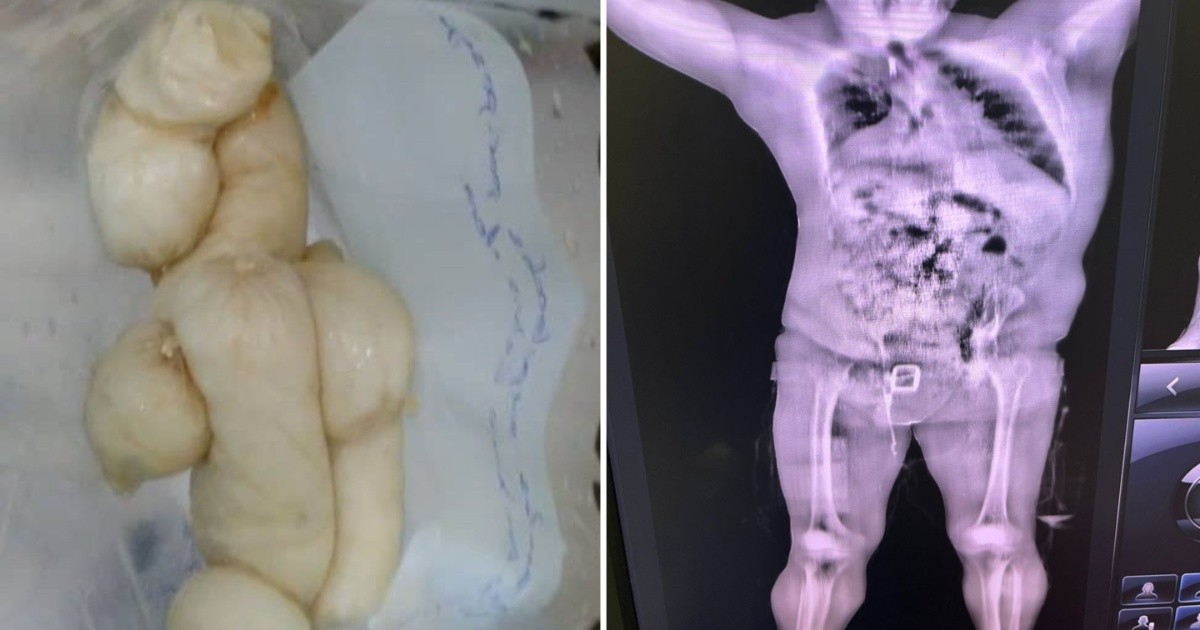
Over the weekend, Cuban authorities revealed that a passenger attempting to enter Cuba through Havana's José Martí International Airport was found with 48 ingested cocaine capsules. The discovery was announced by the General Customs of the Republic of Cuba.
William Pérez González, the First Deputy Chief of the General Customs of the Republic, shared the news on his official X account.
"Passenger detected smuggling ingested drugs through Havana Airport, with 48 capsules of cocaine seized thanks to effective Risk Analysis by Cuban Customs and the anti-drug agency. This showcases our strength in this fierce border battle," the official stated.
The accompanying images depict the extracted capsules—organic in appearance and wrapped—as well as an abdominal X-ray confirming their presence inside the detainee's body.
Smuggling Method and Increasing Sophistication
This incident involves the smuggling technique known as "mule" or human courier, where the carrier swallows the drug-filled capsules to bypass customs inspections.
This method is not new at Havana's airport; in 2014, authorities seized 35 capsules from a passenger, while in 2019, 36 capsules of liquid cocaine were found on a foreign traveler. A 2017 court case documented a traveler with 82 ingested capsules.
Since 2025, Cuban authorities have observed a rise in the complexity and frequency of airborne drug trafficking attempts. So far in 2026, at least six operations have been thwarted, employing increasingly diverse tactics.
Recent Drug Trafficking Incidents
Recent cases include methamphetamine hidden in a rice package detected in April, and drugs disguised in cereals and instant drinks sent from the United States, also in April.
In July 2025, customs officials discovered over a kilogram of cocaine hydrochloride concealed inside an Eleguá statue at the same airport. In August of that year, attempts to smuggle drugs in scented candles and modeling clay pots were foiled.
Authorities have also warned about the rise of "blind mules," individuals who transport packages without knowing their contents in exchange for money, yet are equally liable under Cuban law.
Detection Techniques and Legal Consequences
Detection at José Martí Airport involves traveler risk profile analysis, X-ray technology, and intracorporeal bodyscans.
Under current legislation, drug trafficking penalties in Cuba can reach up to 15 years of imprisonment.
Understanding Drug Trafficking at Havana Airport
What is the "mule" method of drug smuggling?
The "mule" method involves a person ingesting drug-filled capsules to evade customs checks and smuggle substances across borders.
How do Cuban authorities detect drug smuggling at the airport?
Detection methods include risk profile analysis of travelers, X-ray screenings, and intracorporeal bodyscanning.
What are the legal penalties for drug trafficking in Cuba?
Drug trafficking in Cuba can lead to severe penalties, including up to 15 years of imprisonment.