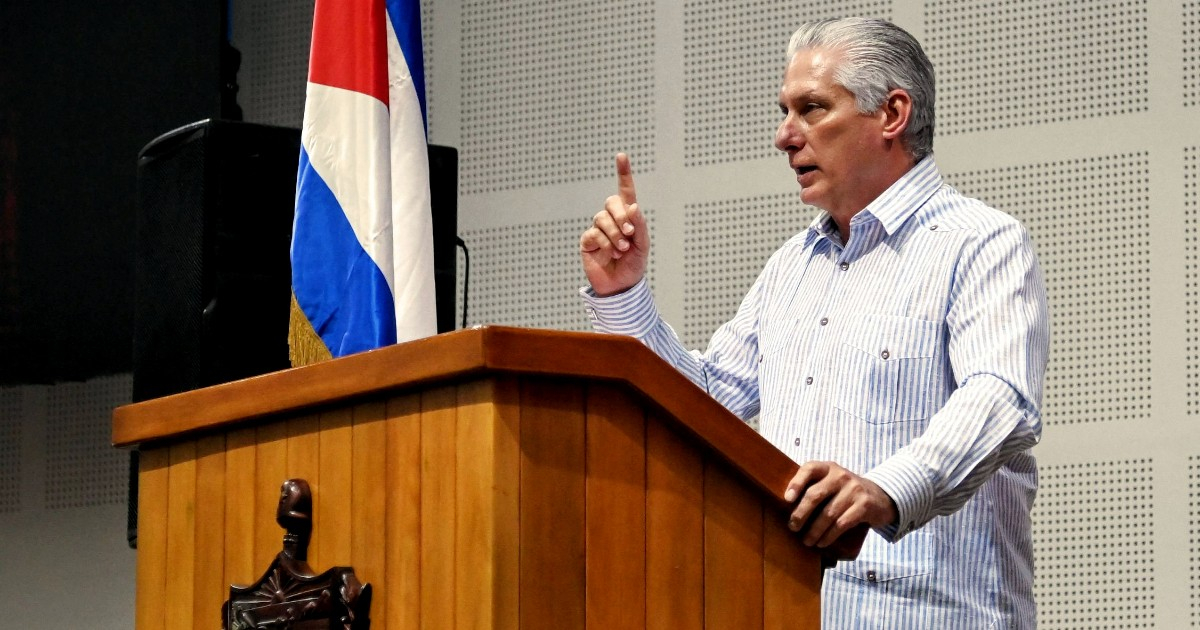
On Saturday, Cuban leader Miguel Díaz-Canel, addressing a gathering of 766 international delegates at the Havana Convention Palace, expressed bewilderment over why the United States perceives Cuba as an "extraordinary and unusual threat" to its national security.
"I ask myself that question every day," said Díaz-Canel, who also serves as the first secretary of the Communist Party of Cuba, suggesting that perhaps it's the "example of Cuban people's resilience and creativity" that the U.S. finds threatening.
The comment was made during the International Solidarity Meeting with Cuba titled "For a World Without Blockade: Active Solidarity on the Centennial of Fidel," serving as the regime's propagandistic response to Executive Order 14380, signed by President Donald Trump on January 29.
This order, which declared a national emergency due to the threat posed by the Cuban regime, implemented an energy embargo that has slashed Cuban crude imports by 80% to 90%, exacerbating the daily blackouts suffered by the population due to the collapse of the energy infrastructure.
A Web of International Ties
Washington's arguments are specific and well-documented. Russia maintains its largest foreign intelligence base in Cuba, located less than 100 miles from U.S. shores.
The Center for Strategic and International Studies (CSIS) has identified at least 12 Chinese signal intelligence facilities on the island, with satellite images confirming expansions in 2024 and 2025.
On April 28, Secretary of State Marco Rubio bluntly stated, "Cuba has welcomed U.S. adversaries to operate within Cuban territory against our national interests, with complete impunity."
The regime's alliances with Iran, Hamas, and Hezbollah, along with the recruitment of up to 25,000 Cuban mercenaries to fight for Russia in Ukraine—with at least 54 identified Cuban casualties in Russian ranks—add to the concerns.
Internal and External Contradictions
Additionally, 32 Cubans perished serving in the personal guard of Nicolás Maduro in Venezuela, a fact Díaz-Canel highlighted in his farewell speech as an example of sacrifice, contradicting his narrative of a "peaceful nation."
Internal repression completes the picture: with over 800 active political prisoners, the highest number in the Americas according to human rights organizations, and 359 detainees from the July 11 protests still imprisoned with sentences up to 22 years.
The "peaceful Cuba" narrative promoted by Díaz-Canel and Foreign Minister Bruno Rodríguez Parrilla clashes with the regime's military doctrine.
In the same event, Rodríguez Parrilla declared that "Cuba would become a hornet's nest; Cuba would be a death trap" against any aggression, invoking the "War of All the People" doctrine.
Heightened Tensions and Mixed Messages
The regime's victimhood strategy hinges on presenting itself as a defenseless nation while maintaining an active doctrine of total armed resistance.
The immediate context of the speech is one of high tension. On May 1, a day earlier, Trump signed a second executive order extending sanctions against Cuban officials responsible for repression, and in a private dinner in West Palm Beach, he threatened to send the USS Abraham Lincoln aircraft carrier "100 meters off the Cuban shore."
Díaz-Canel retorted on social media that "no aggressor, however powerful, will find surrender in Cuba," while at Saturday's event, he reiterated that the island poses no threat.
The contradiction in these messages encapsulates the regime's dual narrative: an outwardly defenseless victim, yet an internally combative force.
In October 2025, Cuba saw its worst performance in three decades in the UN vote on the embargo, signaling the waning international support for a regime that has endured over 67 years of dictatorship and faces a humanitarian crisis it can no longer solely blame on Washington.
Understanding the U.S.-Cuba Tensions
Why does the U.S. consider Cuba a threat to national security?
The U.S. views Cuba as a threat due to its alliances with adversarial countries like Russia, China, Iran, Hamas, and Hezbollah, as well as the presence of foreign intelligence facilities on the island.
What are the consequences of the U.S. embargo on Cuba?
The U.S. embargo has led to a significant reduction in Cuba's crude imports, exacerbating energy shortages and daily blackouts due to the country's failing infrastructure.
How does Cuba respond to U.S. sanctions and threats?
Cuba's leadership, including Díaz-Canel, publicly denounces U.S. sanctions and threats, asserting the nation's resilience and refusal to surrender, while promoting a narrative of being a peaceful and defenseless victim.