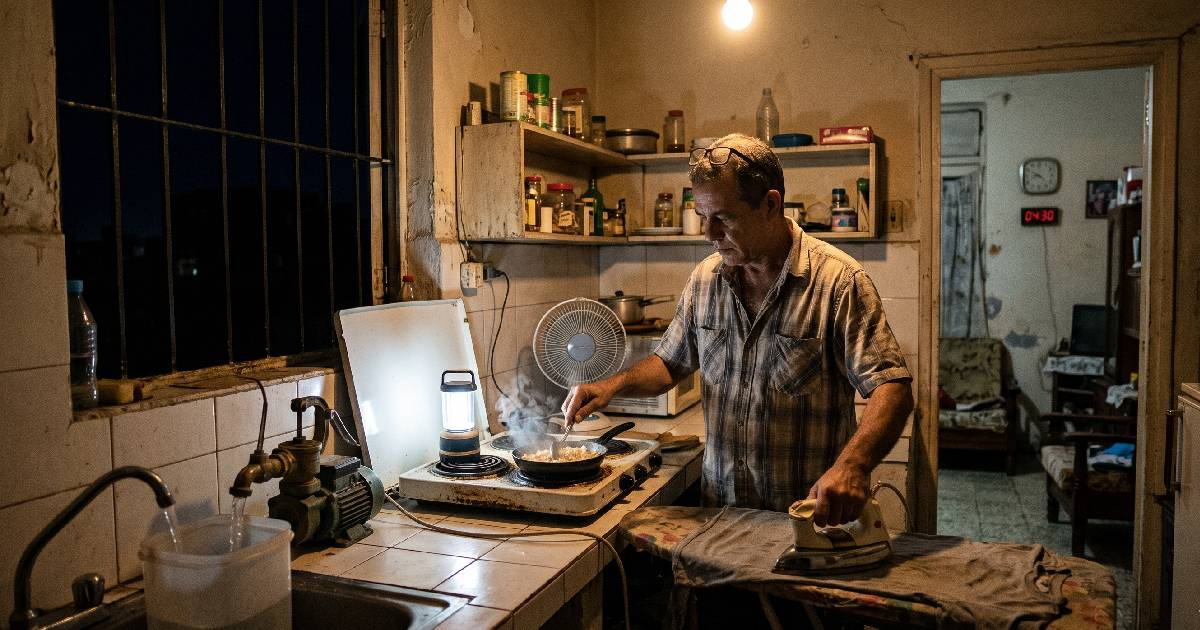
Ricardo Vilahomat, a Cuban professor, has shed light on the harsh reality of everyday life in Cuba, emphasizing how power outages, severe shortages, and inadequate wages dominate the daily experience. He places the blame squarely on the political system rather than external factors.
In a recent conversation with journalist Orlando Petinatti on the show "La Entrevista," Vilahomat painted a vivid picture of life dictated not by sunrise, but by the sporadic arrival of electricity. "Your day starts when the lights come on," he explained, highlighting the narrow window between 4:00 a.m. and 5:00 a.m. when essential tasks like cooking, laundry, and fetching water must be completed.
This fleeting opportunity sets the tone for the entire day. With electricity, water, and food in short supply, daily life transforms into a series of mounting hardships. Children head to school hungry, workers struggle to reach their jobs due to a lack of transportation, and wages fail to cover even a week's basic food needs.
Vilahomat is candid in his assessment, labeling the income as "terrible." Statistics back up his claims, showing that Cuban teachers earn between 4,000 and 9,400 pesos per month, which amounts to roughly eight to 20 dollars, against a cost of living that exceeds 40,000 pesos.
Another educator, Adhy Toledo, had previously highlighted this disparity by demonstrating that her salary could scarcely cover a package of coffee, four eggs, a pound of beans, and a kilogram of rice, underscoring the complete erosion of purchasing power.
However, Vilahomat's account extends beyond economics to touch on human endurance. He described fanning his child with cardboard amidst sweltering heat and mosquitoes due to the lack of electricity. "My arm can't get tired because that's my child there," he said, illustrating the physical and emotional toll of daily survival.
The despair, he noted, is not sporadic but relentless and cumulative, reaching a level of suffering that words fail to fully convey. From this perspective, Vilahomat dismantles the official narrative blaming the U.S. embargo for the crisis. He recalled that during the years of Soviet subsidies, when Cuba received resources with no real repayment pressure, a functional economy was never established. Instead, funds were diverted to export the political model and finance conflicts in other regions.
"What would Cuba be without the blockade? The same as in the '80s," he asserted, referring to a system of structural scarcity even in times of greater external financing. His conclusion points directly to the core issue: a political model that prioritizes control over any form of openness. "They don't want to lose an inch of control over the people," he stated.
To strengthen this point, he quoted Raúl Castro himself, who, after the rapprochement with the Obama administration, admitted, "We should have done more," a statement that, in today's context, reveals the absence of real reforms and the persistence of the same structural limitations.
Vilahomat's testimony starkly contrasts with a high school teacher in Morón who, just last March, told her students she wished everyone could enjoy the conditions present in Cuba today, denying the existence of a dictatorship.
Repercussions continue for those who dare to challenge the official discourse. Roberto Viña Martínez, a professor, was expelled from ISA in January, and Abel Tablada was removed from CUJAE in March, both for voicing criticisms online.
The Cuban Observatory for Human Rights reported in April that 89% of Cuban families live in extreme poverty and 97% have lost access to basic food supplies, while power outages persist, with blackouts lasting up to 24 continuous hours in various provinces.
Understanding Cuba's Ongoing Crisis
What are the main challenges faced by Cubans in their daily lives?
Cubans confront numerous daily challenges, including frequent power outages, severe shortages of food and water, and wages that do not meet the cost of living.
How does the political system in Cuba impact the economy?
The political system in Cuba prioritizes control over economic openness, resulting in a lack of reforms and a structurally deficient economy, even during periods of external financial support.
What is the current economic situation of Cuban teachers?
Cuban teachers earn between 4,000 and 9,400 pesos monthly, equivalent to eight to 20 dollars, which is insufficient against a monthly cost of living beyond 40,000 pesos.