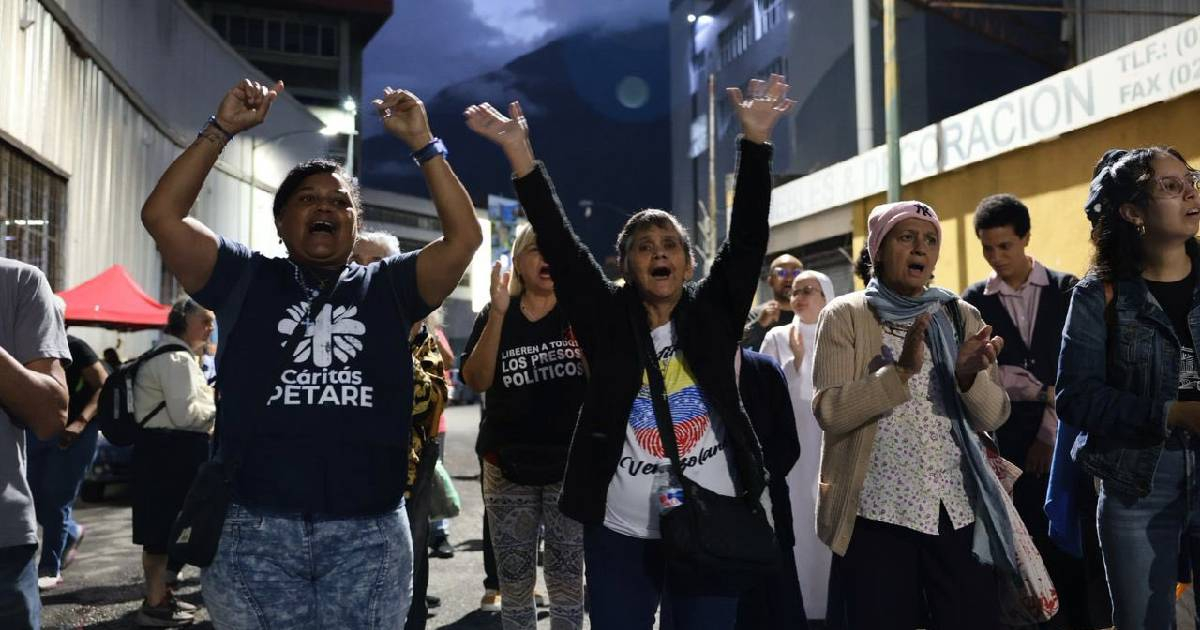
Former political prisoners in Venezuela have come forward to publicly expose the brutal torture and inhumane conditions they endured at El Helicoide, the headquarters of the Bolivarian National Intelligence Service in Caracas. These testimonies were shared through Telemundo.
Among these accounts, a former congresswoman and history teacher highlighted her experiences in a windowless cell, while a journalist recounted his four-year detention at the facility, sharing the intense conditions he survived.
Víctor Navarro, a journalist and former political prisoner, spent five months in El Helicoide. He vividly described his ordeal: "He started loading the gun, put in three bullets. He loaded it and shoved it into my mouth."
Former Congressman and political prisoner Rosmit Mantilla was unequivocal in his statement: "Torture is a state policy in Venezuela."
The documented methods of torture at El Helicoide include beatings, electric shocks, suffocation with insecticide bags, suspension by limbs, prolonged stress positions, and submersion of faces in bags with feces. These practices have been reported by Human Rights Watch, Amnesty International, and the United Nations.
Several political prisoners have died at this facility, such as opposition figure Fernando Albán and General Raúl Isaías Baduel.
The case of Óscar Castañeda, detained after the July 28, 2024 elections, underscores the severity of the aftermath. After nearly two years in El Helicoide, upon his release in February 2026, he was unable to walk or recognize his family.
Current Political Detentions and Amnesty Concerns
These revelations come at a time when Foro Penal reported approximately 500 political prisoners still held in Venezuela, while the organization Justicia, Encuentro y Perdón claims the number is 676 detainees.
The political context exacerbates the issue: on April 25, interim President Delcy Rodríguez announced the end of the Amnesty Law while hundreds of political prisoners remained incarcerated, drawing criticism from human rights organizations and families of detainees.
Foro Penal has verified around 800 actual releases since January 2026, a stark contrast to the over 8,146 releases reported by the government. Independent organizations have repeatedly highlighted this discrepancy between official and verified figures.
Global Call for Justice and Freedom
In response, María Corina Machado, the 2025 Nobel Peace Prize laureate, has called for a global demonstration today in more than 120 cities under the hashtag #QueSeanTodos, with a key gathering point in Caracas directly in front of El Helicoide.
"They and their families need our voices, they need our strength, and that is why we will raise our voices this Sunday, May 3, so the entire world hears the cry for freedom, justice, and democracy," Machado declared in her call to action.
Since 2014, Foro Penal has documented 19,079 political arrests in Venezuela, with over 11,000 individuals under restrictive measures, establishing the chavista regime as one of the region's most repressive in recent decades.
Understanding Venezuela's Political Prisoner Crisis
What is El Helicoide?
El Helicoide is the headquarters of the Bolivarian National Intelligence Service in Caracas, Venezuela, known for detaining political prisoners under harsh and inhumane conditions.
Who is María Corina Machado?
María Corina Machado is a Venezuelan opposition leader and the recipient of the Nobel Peace Prize in 2025, who has been actively advocating for the release of political prisoners in Venezuela.
What organizations have reported on the conditions at El Helicoide?
Human Rights Watch, Amnesty International, and the United Nations have all reported on the torture and inhumane conditions at El Helicoide.