In response to criticism directed at President Donald Trump for his recent announcement regarding potential action on Cuba, a Cuban activist raised an intriguing question this Saturday: Where was international law when the Cuban regime forcefully exported its revolution across the globe for decades?
The video, shared on X under the alias VozDeVerdad, directly addresses those who predict that the international left will invoke international law to oppose any intervention in Cuba.
This morning, Trump, speaking at a private dinner of the Forum Club in West Palm Beach, declared that the United States would "take Cuba almost immediately" after concluding its operations in Iran, and mentioned plans to dispatch the USS Abraham Lincoln aircraft carrier to a point just 100 meters off the Cuban coast to incite the regime's surrender.
"Where was international law when Cuban communism itself started spreading revolution across the Americas and Africa in the 1960s, starting wars?" the activist questions in the video.
This query is not merely rhetorical: Since 1959, Cuba has provided military support to guerrilla movements in Latin America and Africa, training fighters and financing armed groups. The First Conference of Tricontinental Solidarity, convened in Havana in January 1966, formalized this policy with 500 delegates from 82 countries in attendance.
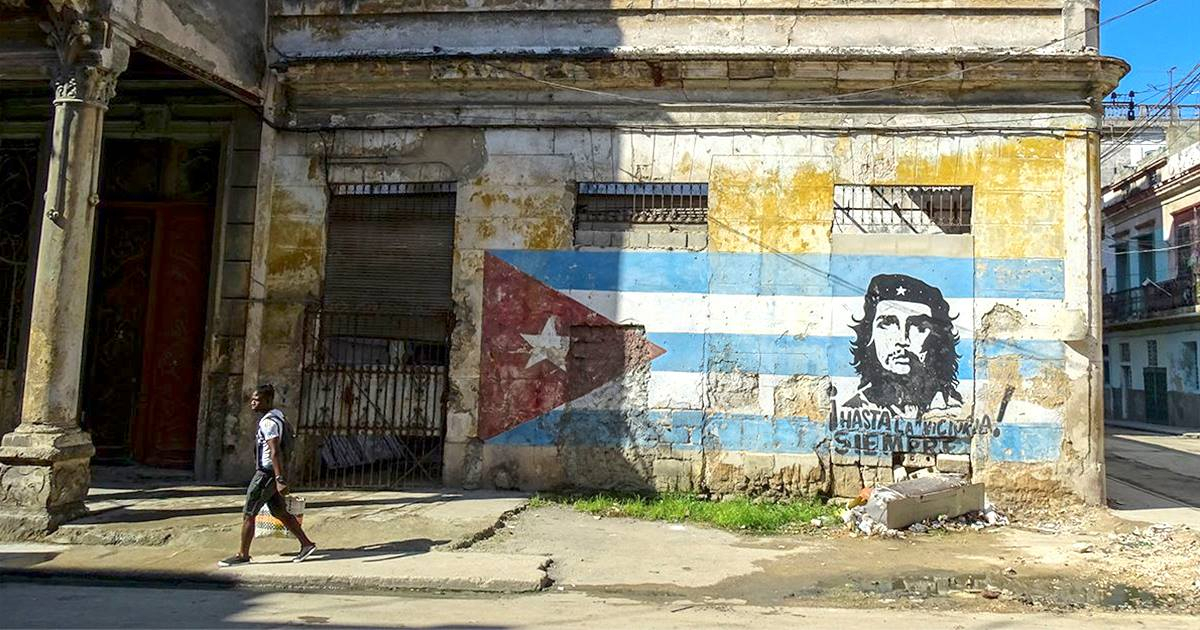
The argument spans decades of documented violations. Che Guevara, as the head of La Cabaña from January to July 1959, oversaw between 79 and 180 executions in summary trials.
He openly acknowledged this before the United Nations on December 11, 1964: "Executions, yes, we have executed, we are executing, and we will continue to execute as long as necessary." Between 1965 and 1968, the Military Units to Aid Production (UMAP) confined around 30,000 individuals—religious figures, dissidents, intellectuals—in forced labor conditions within Cuba.
"Where is the justice for those beaten on July 11, 2021? Where is the justice for more than a thousand Cuban political prisoners? Where is the justice for Jonathan, a Cuban teenager?" the activist continues.
The July 11 protests resulted in over 1,500 arrests and sentences of up to 14 years. By April 18, the organization Justice 11J documented 775 political prisoners in Cuba, 338 of whom were linked to those protests.
The case of Jonathan David Muir Burgos, 16, exemplifies the ongoing repression. Detained on March 16 after participating in protests in Morón over blackouts lasting more than 26 hours, he was transferred without notice to the maximum-security Canaleta prison.
Jonathan's father voiced his despair following a call at 1:45 a.m. on April 23, during which his son pleaded, "Dad, please, get me out of here, I can't take it anymore." The Inter-American Commission on Human Rights granted precautionary measures on April 24, which Cuba ignored.
This situation unfolds a day after the Trump administration enacted new executive sanctions against Cuba, including asset freezes on foreigners supporting the regime, restrictions on foreign banks, and embargoes on energy, mining, and defense sectors.
Cuban Foreign Minister Bruno Rodríguez condemned these actions as "illegal and abusive collective punishment," while the Communist Party declared there would be "no surrender."
The U.S. Senate rejected a Democratic resolution to limit Trump's actions on Cuba by a vote of 51 to 47 last Wednesday.
The activist concludes with a direct warning to those opposing any action: "If you want to have a different opinion about a military or humanitarian intervention in Cuba, you can. But don't use international law as an excuse, because the Cuban people have the right to live in freedom."
Frequently Asked Questions on International Law and Cuba
Why is international law being questioned in the context of Cuba?
Critics question the application of international law because the Cuban regime has historically exported its revolution through force, which many view as a violation of international norms. This history is now being cited in discussions about potential interventions in Cuba.
What actions did Cuba take to export its revolution?
Since 1959, Cuba has supported guerrilla movements in Latin America and Africa, providing military training and financial backing. The 1966 First Conference of Tricontinental Solidarity in Havana formalized these efforts, involving delegates from numerous countries.
What are the recent developments in U.S. policy towards Cuba?
The Trump administration recently imposed new sanctions against Cuba, targeting foreign assets, banks, and sectors like energy and defense, while the U.S. Senate rejected a resolution to limit these actions.