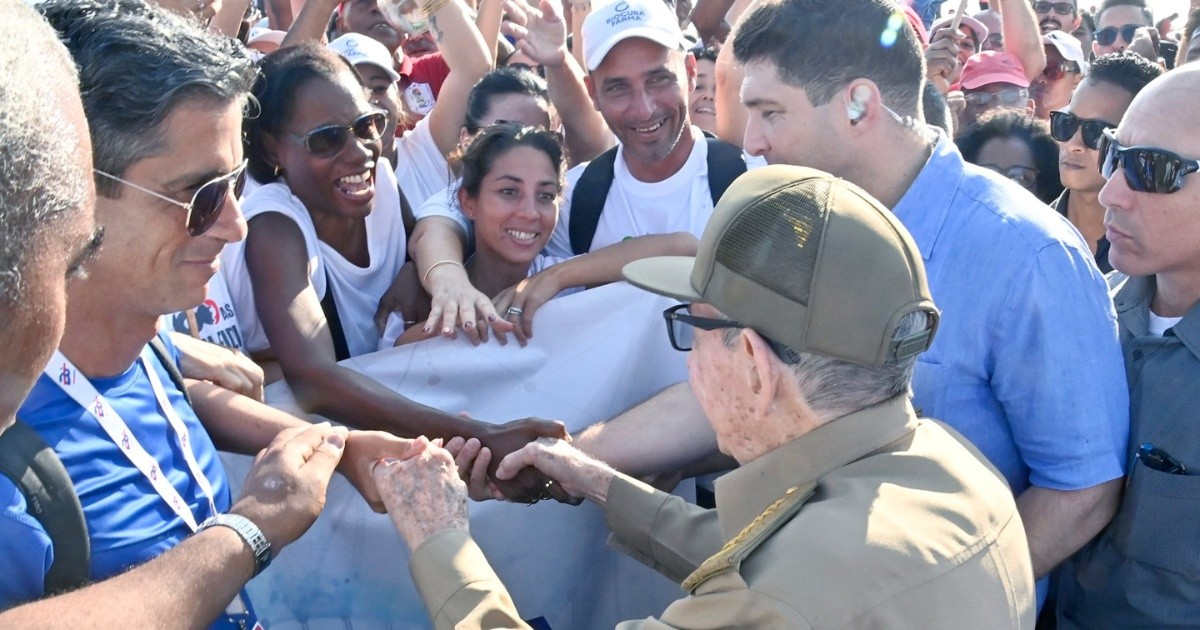
On Saturday, Cuban Prime Minister Manuel Marrero Cruz took to his X account to portray the May Day mobilization as the Cuban regime’s robust response to the latest sanctions imposed by the United States.
Marrero declared, "In light of the new coercive measures from the U.S., our answer is firm: an extraordinary mobilization across the nation for #MayDay, with over half a million Havana residents led by the General of the Army, and more than 6 million signatures for peace."
These comments from the Prime Minister follow a day after Donald Trump signed a new executive order that extends sanctions against Cuba. This measure aims to freeze assets in the U.S. belonging to individuals connected to sectors such as energy, defense, mining, financial services, and security.
On the same day, Trump threatened to deploy the aircraft carrier USS Abraham Lincoln near Cuban shores, asserting that the U.S. would "seize Cuba almost immediately."
The new executive order is built upon Executive Order 14380, issued on January 29, 2026, which declared a national emergency, citing the Cuban government as an "unusual and extraordinary threat" to U.S. national security.
Since January 2025, the Trump administration has enforced more than 240 sanctions against the Cuban regime and intercepted at least seven oil tankers bound for the island, leading to an 80% to 90% reduction in energy imports.
This year's main May Day event in Havana was relocated from the Plaza de la Revolución to the Anti-Imperialist Tribune José Martí, located across from the U.S. Embassy, citing "austerity" and an "energy blockade" as official reasons.
Mobilization Amidst Crisis
The regime organized the event under the slogan "The Homeland is Defended," as part of the "Year of Preparation for Defense." However, independent media reported low spontaneous turnout and forced mobilization, with a heavy security presence during the event.
On the day prior, students were pulled from schools in San Miguel del Padrón and Santiago de Cuba to participate in marches leading up to the event.
During the proceedings, Díaz-Canel received a book containing signatures from the "My Signature for the Homeland" campaign, which reportedly gathered 6,230,973 signatures since its launch on April 19, 2026. This campaign coincided with the 65th anniversary of the victory at Playa Girón.
Regional Participation and Economic Hardships
Marrero led the parade in Matanzas, where the regime claimed over 230,000 participants were present. In Camagüey, official figures suggested 320,000 attendees. The event also marked the centennial of Fidel Castro's birth.
The regime's warlike rhetoric stands in stark contrast to the harsh realities faced by the Cuban people: blackouts lasting up to 25 hours a day in more than 55% of the country, and a projected economic contraction of 7.2% for 2026, according to The Economist Intelligence Unit.
In the weeks leading up to the event, Marrero had already been employing war rhetoric to rally the population ahead of May Day, set against an unprecedented crisis for the dictatorship.
Understanding the Impact of U.S. Sanctions on Cuba
What were the new sanctions imposed by the U.S. on Cuba?
The new sanctions, part of an executive order signed by Donald Trump, target Cuban assets in the U.S. and individuals linked to sectors such as energy, defense, mining, financial services, and security.
How has the Cuban government responded to these sanctions?
The Cuban government organized a large-scale mobilization for May Day as a show of defiance, with significant participation across the country and a campaign to collect millions of signatures for peace.
What impact have the U.S. sanctions had on Cuba's energy imports?
The sanctions have led to an 80% to 90% reduction in energy imports due to the interception of oil tankers, exacerbating the energy crisis on the island.