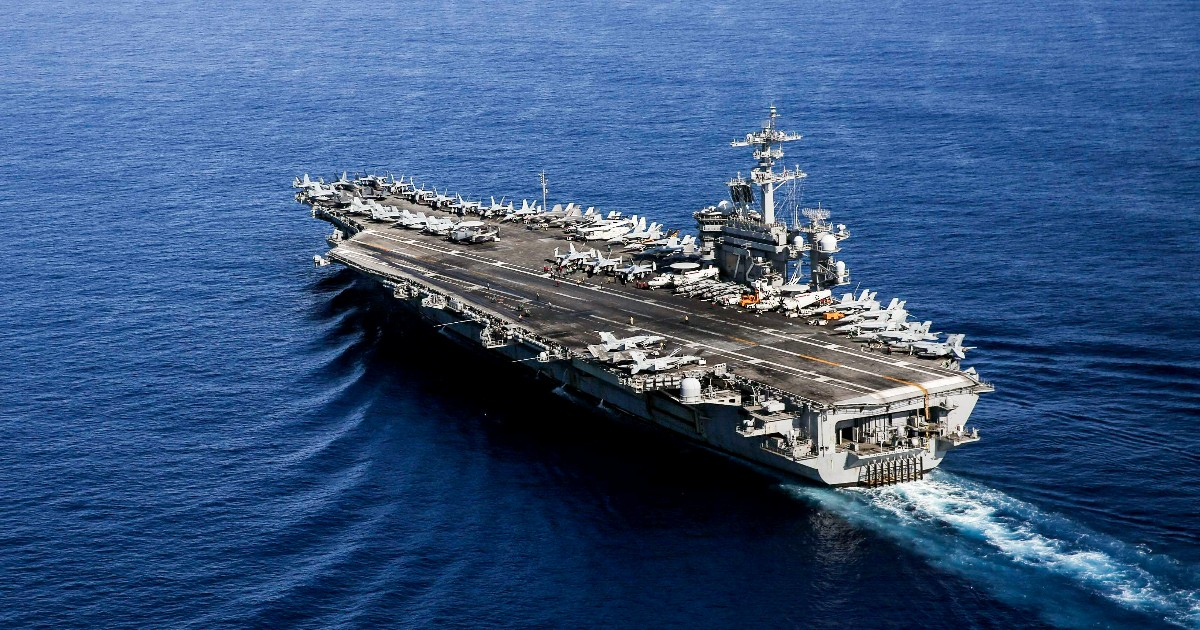
During a private dinner at the Forum Club in West Palm Beach, Florida, President Donald Trump announced his potential plan to dispatch the aircraft carrier USS Abraham Lincoln near Cuba, once the military operations in Iran have concluded.
In a casual tone, Trump painted a picture where the massive ship would anchor just 100 yards from the Cuban shore, pressuring the regime into submission.
“On its way back from Iran, we might have one of our largest, perhaps the USS Abraham Lincoln, the largest in the world, stop about 100 yards off the coast, and they'll say: Thanks a lot, we surrender,” Trump declared amid laughter from the attendees.
Understanding the USS Abraham Lincoln
What exactly is the vessel Trump mentioned? The USS Abraham Lincoln (CVN-72) is the fifth Nimitz-class aircraft carrier in the United States Navy, commissioned on November 11, 1989. Built by Newport News Shipbuilding, it cost approximately $2.24 billion, equivalent to $6.82 billion in 2024.
Measuring 332.8 meters in length and weighing 104,300 long tons when fully loaded, it stands as one of the largest warships ever constructed. Nuclear-powered with two Westinghouse A4W reactors, the carrier drives four steam turbines generating 260,000 shaft horsepower, enabling speeds over 30 knots and virtually unlimited range for 20 to 25 years without refueling.
The ship carries around 5,680 personnel: 3,200 crew members for the vessel and 2,480 for the embarked air wing. It can accommodate up to 90 fixed-wing aircraft and helicopters, including F/A-18E/F Super Hornets, fifth-generation F-35C Lightning IIs, EA-18G Growlers for electronic warfare, E-2D Hawkeye early warning aircraft, and MH-60 Seahawk helicopters.
Its defensive arsenal comprises Sea Sparrow missiles, RIM-116 missiles, and two Phalanx CIWS point-defense artillery systems.
A History of Combat and Operations
The Abraham Lincoln has been active in combat for over three decades. It participated in Operation Desert Storm in 1991, Operation Enduring Freedom in Afghanistan targeting Al-Qaeda and Taliban forces, and flew more than 16,500 combat sorties during the Iraq War.
On May 1, 2003, President George W. Bush delivered his famous "Mission Accomplished" speech aboard the Abraham Lincoln, marking the end of major combat operations in Iraq.
Currently, the carrier is stationed in the North Arabian Sea as part of Operation Epic Fury, a joint U.S.-Israel military campaign launched on February 28, 2026, aimed at dismantling Iran's military infrastructure.
U.S. Strategy and Cuban Defiance
In April, three American aircraft carriers, including the Abraham Lincoln, operated simultaneously in the Middle East for the first time since 2003. Trump emphasized that any move towards Cuba would occur only after completing operations in Iran: "I like to finish a job first," he stated.
The Cuban regime responded defiantly. Foreign Minister Bruno Rodríguez Parrilla asserted that Cuba "will not be intimidated," while Miguel Díaz-Canel declared that "no aggressor" would break the island's resolve.
Trump's threat surfaces amidst heightened pressure on Havana: over 240 new sanctions have been imposed since January 2026, at least seven oil tankers have been intercepted, and Cuba's energy imports have been slashed by 80% to 90%.
Secretary of State Marco Rubio summed up Washington's stance on April 27: "The Cuban regime has only two destinies: neither is good."
Frequently Asked Questions About USS Abraham Lincoln and U.S.-Cuba Relations
What is the USS Abraham Lincoln?
The USS Abraham Lincoln is a Nimitz-class aircraft carrier, one of the largest warships in the world, serving in the U.S. Navy since 1989.
Why might the USS Abraham Lincoln be sent to Cuba?
President Trump suggested sending the carrier to pressure the Cuban regime into submission, as a demonstration of U.S. military might.
What has been Cuba's response to Trump's threat?
Cuba has responded defiantly, with officials stating they will not be intimidated by such threats and asserting their resilience against aggression.