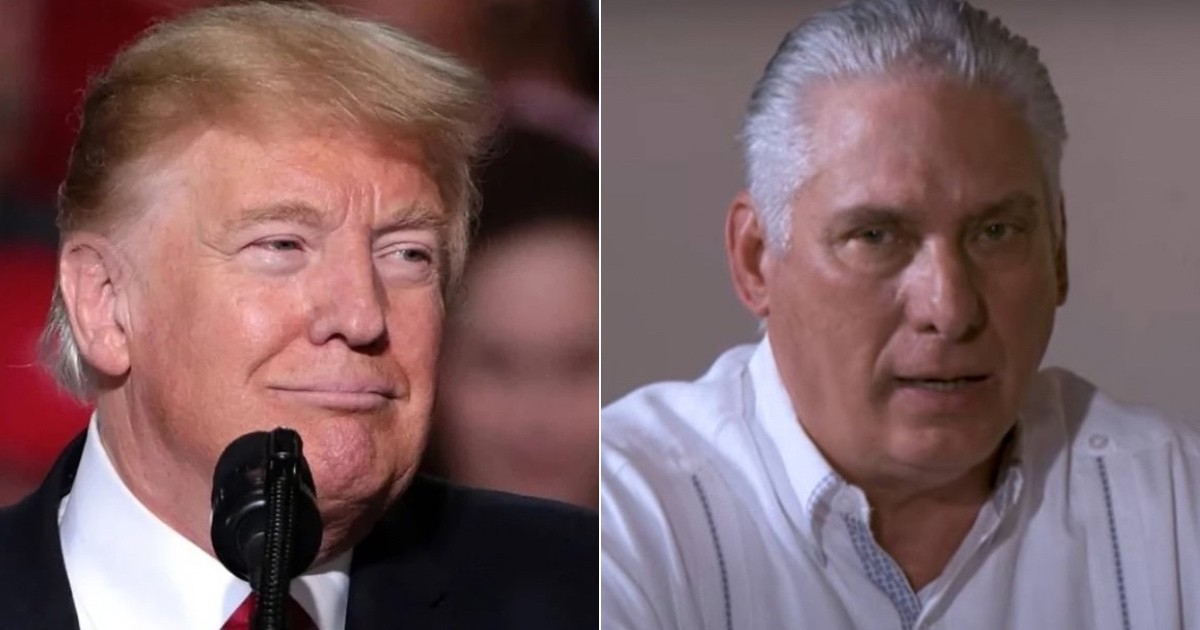
On Saturday, Miguel Díaz-Canel responded defiantly to President Donald Trump's military threats through a bold statement on his Facebook account. He declared that "no aggressor, regardless of their might, will ever find surrender in Cuba," and emphasized that any attacker "will face a determined people ready to defend sovereignty and independence at every inch of national territory."
Using the hashtag #LaPatriaSeDefiende, Díaz-Canel's message was posted mere hours after Trump's provocative remarks at a private dinner at the Forum Club in West Palm Beach, Florida. During this event, Trump threatened to deploy the aircraft carrier USS Abraham Lincoln to Cuban shores to force the regime's capitulation.
Trump, outlining his priorities, stated, "Once our operations in Iran are complete, the United States will move swiftly on Cuba." He described his plan, saying, "Returning from Iran, we'll have one of our great... perhaps the largest aircraft carrier in the world, the USS Abraham Lincoln. We'll bring it close, stop it about 100 meters from the shore, and they'll say, 'Thank you very much. We surrender.'"
Díaz-Canel condemned these threats, calling them an escalation to "a dangerous and unprecedented scale." He urged the international community and the American public to take a stand: "The global community must take note and, alongside the people of the U.S., decide if such a drastic criminal act will be allowed to satisfy the interests of a small yet wealthy and influential group hungry for revenge and domination."
In tandem with his verbal threats, Trump signed a new executive order on Friday, intensifying sanctions against Cuba by freezing regime assets and imposing secondary sanctions on foreign banks linked to the Cuban government.
Cuban Foreign Minister Bruno Rodríguez condemned these actions as "collective punishment on the Cuban people," labeling them as "illegal and abusive." Meanwhile, Díaz-Canel criticized the "moral poverty" of the United States following the executive order's signing.
This rhetoric of resistance is not new for the Cuban leader amidst rising tensions. Back in April, during an interview with Newsweek—his first with a U.S. outlet since 2023—Díaz-Canel warned, "If a military aggression occurs, we will counterattack, fight, and defend ourselves."
On April 16, commemorating the anniversary of the Bay of Pigs invasion, he called upon the Cuban populace to brace for combat, invoking the doctrine of "war of the entire people."
Trump's threats have been escalating steadily since the start of his second term. In February, he claimed "taking Cuba would not be difficult"; by March, he told CNN that "Cuba will fall quite soon"; and on March 27 in Miami Beach, he declared that "Cuba would be next." Secretary of State Marco Rubio added on April 27 that Cuba "only has two destinations: neither good."
Since January 2025, the Trump administration has imposed over 240 sanctions on the Cuban government, including re-listing the island as a state sponsor of terrorism on January 20, 2026, and issuing Executive Order 14380, which declared Cuba an "unusual and extraordinary threat" to U.S. national security.
Understanding the Tensions between the U.S. and Cuba
What prompted Díaz-Canel's defiant response?
Díaz-Canel's response was triggered by Trump's threats to deploy military force against Cuba, including the potential use of the USS Abraham Lincoln to coerce the regime into surrendering.
How has the U.S. administration escalated actions against Cuba?
The Trump administration has intensified pressure on Cuba through over 240 sanctions, re-listing the nation as a state sponsor of terrorism, and implementing executive orders that label Cuba as a security threat to the United States.
What was the international reaction to Trump's threats?
The international community, alongside segments of the American public, has been urged by Díaz-Canel to oppose the drastic measures outlined by Trump, viewing them as acts of aggression driven by narrow interests.