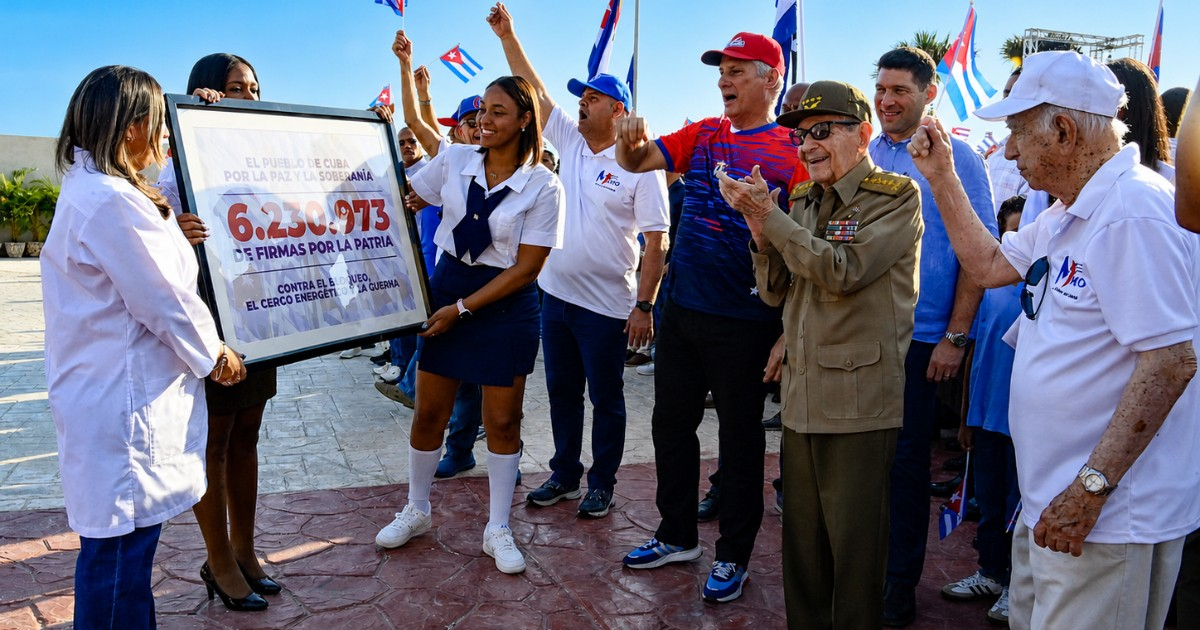
In a symbolic gesture during the May Day event held in front of the U.S. Embassy in Havana, the Cuban regime presented two books containing over 6.2 million signatures from the "My Signature for the Homeland" campaign to Raúl Castro and President Miguel Díaz-Canel.
The official account of the Cuban Presidency reported that "6,230,973 Cubans expressed their will" in this campaign, which was portrayed as a spontaneous initiative by civil society. However, analysts and opposition figures have exposed it as a centrally orchestrated effort by the Communist Party of Cuba (PCC), describing the act as an emergency propaganda move in response to the intense pressure from Washington.
However, the reported number doesn't hold up to scrutiny. With a population of fewer than 11 million people, counting children and the elderly, the 6.23 million signatures represent more than 56% of all Cubans. Critics argue that this proportion is unachievable without massive coercion, which has been documented in workplaces, schools, and through the Committees for the Defense of the Revolution (CDR).
Evidence collected in Matanzas confirms this coercion: “Signing is mandatory at workplaces; if you don’t sign, you know what happens—out on the street.”
State company managers were forced to secure at least 80% of signatures from their employees under the threat of dismissal. The pressure extended to stores, hospitals, universities, and other institutions through the CDRs.
Despite the pressure, there was resistance. The viral poem "I Will Not Sign" by José Martínez, calls from opposition leader José Daniel Ferrer García (UNPACU) to boycott the campaign, and documented cases of Cubans standing up to their CDRs and refusing to sign with a simple argument: "My dignity is not for sale."
The event coincided precisely with Donald Trump’s signing of a new executive order significantly expanding sanctions against the regime, including secondary sanctions on foreign financial entities trading with Havana. This move is part of a pressure campaign initiated in January 2026, which has imposed over 240 new sanctions and intercepted at least seven oil tankers bound for Cuba, slashing energy imports by 80-90%.
The result is an island facing power outages lasting up to 25 hours daily in more than 55% of the territory and a projected GDP contraction of 7.2% for 2026.
Amid this crisis, Raúl Castro's appearance, at 94, marked his first public presence in five months. Díaz-Canel had previously described him in April as "alive but retired for health reasons" and "frail with age." Castro was absent even from the 9th Congress of the PCC in March.
Images from the event show a visibly deteriorated Raúl Castro holding one of the signature books. The first visible signature is that of Raúl Castro Ruz himself, followed by Díaz-Canel, Roberto Morales Ojeda, and Salvador Valdés Mesa, indicating that regime leaders spearheaded the list of what they presented as a citizen initiative.
The image campaign didn't stop there. On Saturday, Díaz-Canel’s digital communication advisor, Leticia Martínez Hernández, posted a Facebook album titled "Raúl with our signatures," featuring photos edited with Photoshop to mask the general's physical decline. Journalist Mario J. Pentón highlighted the manipulation by comparing the original images with the edited ones.
The "My Signature for the Homeland" campaign was launched on April 19, coinciding with the 65th anniversary of the Bay of Pigs invasion, as a show of support for the "Girón is today and always" declaration, where the regime asserted that "Cuba will not be a star"—a reference to a potential annexation by the United States.
Foreign Minister Bruno Rodríguez Parrilla claimed that 81% of the population had signed the letter condemning the embargo, the "energy blockade," and "war threats." If true, this figure would mean nearly every adult Cuban signed under pressure or without any real choice.
On March 30, Trump succinctly summarized his outlook on the regime: "Cuba will fail shortly," and the United States "will be there to help."
Cuban Regime's Signature Campaign Amidst U.S. Sanctions
What is the "My Signature for the Homeland" campaign?
The "My Signature for the Homeland" campaign is a government-led initiative in Cuba, presented as a civil society effort, collecting over 6.2 million signatures purportedly in support of the regime and against U.S. sanctions.
Why are the reported signature numbers questioned?
The reported figures are questioned because they imply that over 56% of the Cuban population signed, a number deemed impossible without documented coercion in various sectors.
How have U.S. sanctions affected Cuba?
U.S. sanctions have drastically reduced Cuba's energy imports, leading to widespread power outages and a significant economic downturn, with a projected GDP contraction of 7.2% for 2026.