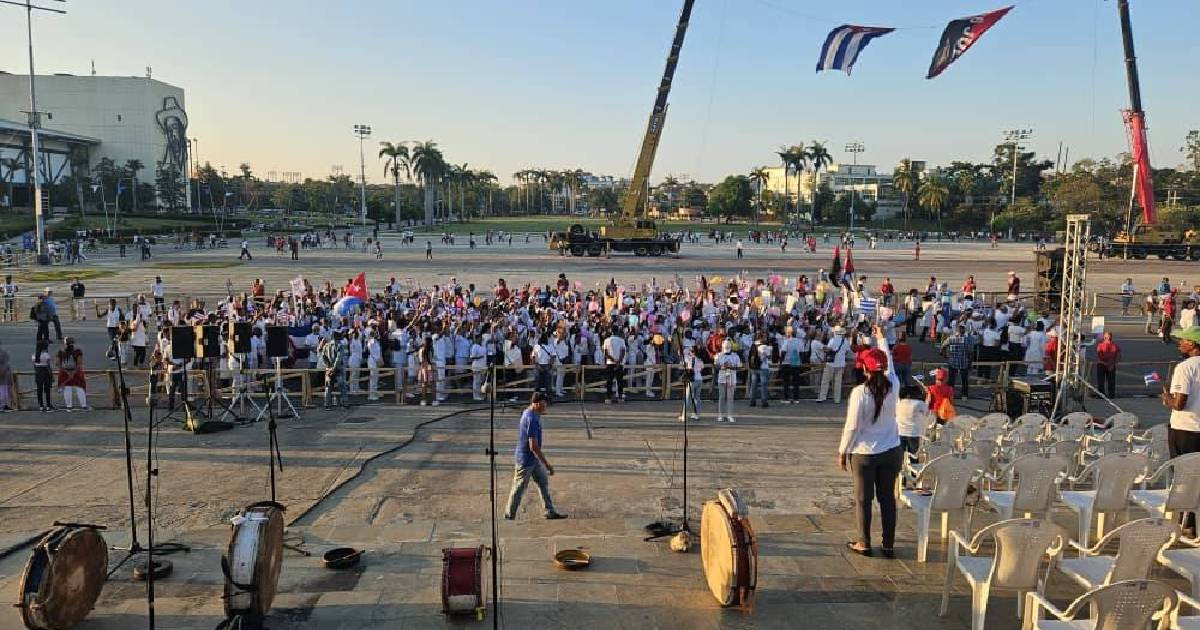
A Cuban residing in Spain has publicly criticized his father, Ernesto Marcos Montoya, who works for the state-run Empresa de Telecomunicaciones de Cuba S.A. (Etecsa). This comes after Montoya was seen parading with a drink in hand during May Day celebrations at the Antonio Maceo Plaza in Santiago de Cuba, while financially relying on his son abroad.
The incident was brought to light by independent journalist Yosmany Mayeta Labrada through a Facebook video titled, "My cup isn't crystal, but my son's money is."
In the video, Montoya appears in high spirits, defiantly stating, "This is my cup. My cup isn't crystal, just like my heart. This is for my son in Spain... There's joy here. Long live a free Cuba!"
Montoya, who is involved in the inspection of submarine fiber optics in Siboney, also issued a direct challenge to the U.S. government, declaring, "Let the beast come, we're waiting for it."
Son's Heartfelt Response
The son responded through Mayeta Labrada, expressing a mix of sorrow and frustration. "Absolutely heartbroken. I wake up at 5:30 a.m. to messages that only care about financial help and seeing this now, it's disheartening. They even said I'm the family's disappointment. But the requests for money never stop."
Despite his disappointment, the son allowed the video to be shared with a telling statement: "Even if he's my blood, post it, Mayeta."
Father's Justification and Public Reaction
The father attempted to defend himself in writing, arguing that "walking in a conga line doesn't mean there's no hunger," claiming not to be a communist but a patriot, while stating, "in the meantime, we're going to drink beer and enjoy."
The May Day parade in Santiago de Cuba faced reports of coerced participation. Dozens of recently released prisoners were forced to march under threats of losing legal benefits or returning to jail, and children were taken from schools to swell the ranks.
The central event in Havana was led by 94-year-old Raúl Castro and the current leader, Miguel Díaz-Canel, in a nation grappling with power outages lasting over 20 hours daily and an economic contraction projected at 7.2% by 2026.
Social media reacted swiftly and indignantly. "Many live off those abroad and defend those here, hypocrites, two-faced," wrote Sabina P. Rabel.
Martha Ruiz was more straightforward, asserting, "No more remittances, no more combos, let him sustain himself with his own revolutionary poison."
Other users highlighted a deeper issue. "The problem is they're trained and threatened by the tyranny," pointed out Yudel López Rojas, while Ruben Salmon compared the situation to those with "Stockholm syndrome" who nonetheless keep asking for recharges and remittances.
Recurring Phenomenon
This isn't a new occurrence. In 2019, Cuban Yashell Uranga from Dallas, Texas, showcased how he lifted tires for three hours to earn the $20 or $30 needed for a recharge to Cuba.
In December 2025, another Cuban in the U.S. went viral showing his frozen hands shoveling snow while explaining the true value of each peso sent to the island.
Approximately 223,000 Cubans currently reside in Spain, with 77% of Cuban emigrants sending some form of financial aid to their families on the island, according to the National Office of Statistics and Information.
"Even if he's my blood, post it, Mayeta," the son said. A sentiment that, for thousands of Cubans abroad supporting their families from afar, encapsulates a contradiction more painful than any blackout.
Exploring the Dynamics of Cuban Remittances
Why did the Cuban son in Spain criticize his father?
The son criticized his father for participating in May Day celebrations in Cuba while financially relying on his son, who sends him money from Spain.
What was the father's defense for his actions?
The father claimed that participating in a conga line doesn't negate the presence of hunger and asserted that he is a patriot, not a communist, while choosing to enjoy life in the meantime.
What was the public's reaction to the father's actions?
The public reacted with indignation, labeling behavior like the father's as hypocritical and two-faced, and some suggested stopping remittances as a consequence.