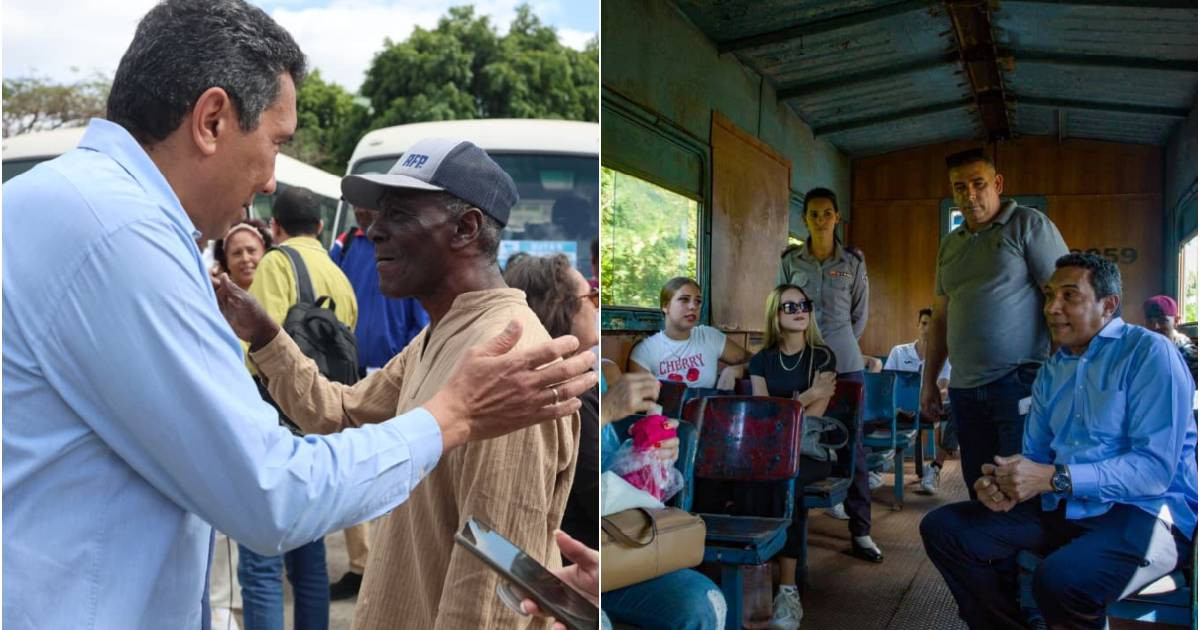
On Thursday, Cuba's Minister of Transport, Eduardo Rodríguez Dávila, made an unexpected stop with his official vehicle at a bus stop on Vía Monumental, near the Pan American Village in Havana. He offered a ride to five individuals who were waiting for transportation to work or medical appointments, as reported by a witness, Geny Andres Bará, on Facebook.
The event took place at 7:45 AM, when a white van marked with the insignia of the Ministry of Transport (Mintrans) came to a halt at the stop. Rodríguez leaned out of the window and invited the waiting passengers to hop in, eliciting immediate reactions from those present.
"It's remarkable that a minister voluntarily stops his car at a crowded bus stop at 7:45 in the morning, filled with people desperate to reach work or medical appointments, in a country facing an energy crisis and with public transport nearly at a standstill," Bará noted.
This action sharply contrasts with the usual behavior observed at that bus stop, as described by the witness. "Often, government vehicles capable of alleviating the crisis ignore pleas to stop, even when flagged down by inspectors, as they ferry directors or managers who completely disregard the public's needs," Bará added.
Such a paradox is stark, as the individual leading the ministry responsible for the transportation system that leaves many stranded for hours is seen picking up passengers at a bus stop.
The sector's collapse is profound. Bus production plummeted from 473 units in 2019 to a mere 12 projected for 2026, a drastic 97.5% decrease. Furthermore, state passenger transport dropped by 93% from January to September 2025.
Dismal State of Public Transportation
In March, Rodríguez himself acknowledged on the official program "Mesa Redonda" that national buses run only once a day, trains operate every eight days, and the ferry service to the Isla de la Juventud is limited to two trips per week.
In Ciego de Ávila, only two out of 135 bus routes function with minimal and irregular frequency. In Las Tunas, nearly all bus services have been suspended, leaving just a single night service to Havana.
On February 6, urban transport in Havana came to a complete halt, as no routes operated that day due to fuel shortages.
Rodríguez's Public Image
Despite presiding over this disastrous situation, Rodríguez has been known to travel in shared taxis and ride crowded buses like any other passenger, according to Bará.
This image of approachability has earned him unusual support among Cubans. A survey conducted by around twenty independent media outlets, open until May 1, identified him as the government official with the most residual support, receiving 43 favorable mentions in an open-ended question.
In the same survey, 94% of participants stated they do not trust anyone in the Cuban government, with one respondent describing Rodríguez as "the only one who stands out."
At the start of 2025, the Transport Minister posted on Facebook admitting that the previous year "was not what we dreamed of," acknowledging that "some" targets in his sector were not met.
Yesterday's gesture on Vía Monumental, praised on social media, does not alter the harsh reality faced by millions of Cubans who continue to wait at empty bus stops.
FAQs on Cuba's Transport Crisis
What was the symbolic gesture made by Cuba's Transport Minister?
Eduardo Rodríguez Dávila, the Transport Minister, stopped his official vehicle at a bus stop and offered a ride to five people waiting for transportation.
How severe is the collapse of Cuba's transport sector?
The transport sector in Cuba is facing a profound collapse, with a 97.5% decrease in bus production and a 93% drop in state passenger transport as of 2025.
How has Rodríguez's public image been affected by his actions?
Despite the transport crisis, Rodríguez's approachable actions, such as riding in shared taxis, have earned him unusual support among Cubans.