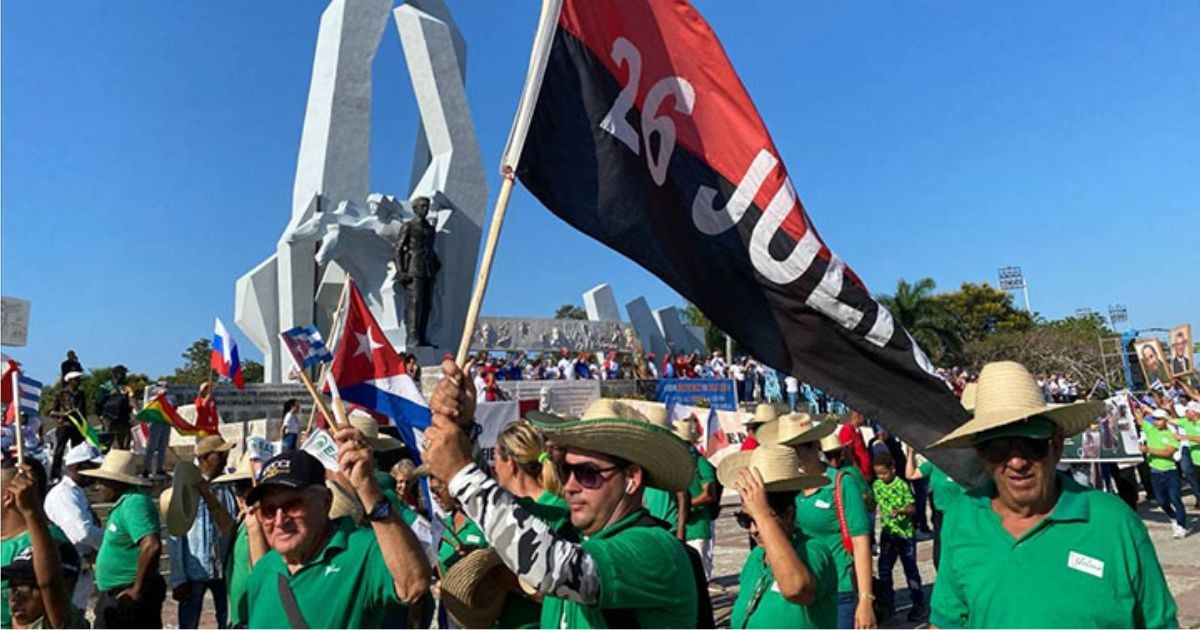
On Friday, Cuba’s state-run news agency, Agencia Cubana de Noticias (ACN), heralded the May Day parade in Camagüey as a display of "unity and efficiency," noting the "massive participation of workers from all sectors" at the Plaza de la Revolución Mayor General Ignacio Agramonte Loynaz. However, the stark contrast between this portrayal and the harsh realities faced by these workers outside the parade grounds is hard to overlook.
The official report highlighted participation from labor groups such as the Beverage and Soft Drink Company (Ember), the Projects and Engineering Company (ENPA), the Select Fruits Company, and the Agroindustrial Grain Company. These groups marched alongside small private businesses and other non-state entities, all presented as evidence of the "progress in productive chains." The parade's theme, "The Homeland is Defended," was dedicated to the centenary of Fidel Castro's birth and the 65th anniversary of the Bay of Pigs invasion.
ENPA's director, Luis Norberto Díaz Gómez, told ACN that "thanks to productive chaining, the company is currently able to solve various problems related to equipment maintenance and energy deficits." This assertion is particularly striking given that the province experiences power outages lasting 12 to 20 hours daily, crippling basic services and everyday activities.
Behind the Facade of Efficiency
The "efficiency" touted by the regime's media is set against a backdrop where, as recently as February, the province managed just a single bus to Havana due to a diesel shortage, with other interprovincial transport suspended. Telecommunications towers operated for only two to six hours daily due to fuel scarcity, cutting off phone and internet access to areas like Minas, Senado, Lugareño, and Redención.
Jenry Puentes Rodríguez, the provincial general secretary of the Central de Trabajadores de Cuba (CTC), adopted a combative tone, proclaiming that "facing imperial threats, the fighting spirit grows in the fields, classrooms, hospitals, power plants, scientific centers, and every space where solutions are sought, innovations are made, and resources are rationalized." Yet, he failed to mention that just weeks prior, the CTC implored workers to address the energy shortcomings themselves, effectively shifting the burden of a crisis born from 67 years of dictatorship onto the workers.
Symbolic Participation and Underlying Struggles
Participation in these parades is nominally "voluntary," though in practice, it's mandatory for state workers. This year, the regime enlisted schoolchildren to swell the May Day ranks, a tactic that undermines any notion of genuine popular spontaneity.
Joining the Camagüey parade were Deputy Prime Minister Jorge Luis Tapia Fonseca, Governor Jorge Enrique Sutil Sarabia, and Yudí Rodríguez Hernández, a member of the Central Committee of the Communist Party of Cuba (PCC).
The grim realities cast a shadow over the spectacle. The average state salary in Cuba is 6,930 pesos per month—about $15 at the informal exchange rate—while the basic cost of food for one person exceeds five full salaries. In April, the UN acknowledged the need for humanitarian aid in 60 Cuban municipalities, with five provinces suffering from extreme food insecurity, according to that month’s food monitoring report.
Nationally, the central May Day event moved from the Plaza de la Revolución to the Anti-Imperialist Tribune José Martí—across from the U.S. Embassy on Havana’s Malecón—under the guise of "austerity." The regime, which summoned a war-toned march amid its worst economic crisis, found no better way to honor Cuban workers than to reiterate the tired narrative that the "empire" is to blame for everything. A story that few still believe.
Understanding Cuba's Current Situation
What is the significance of the May Day parade in Camagüey?
The May Day parade in Camagüey is portrayed by state media as a demonstration of unity and efficiency, featuring participation from various sectors. However, it contrasts starkly with the daily struggles of workers facing severe power outages and shortages.
How does the regime justify the economic difficulties in Cuba?
The Cuban regime often attributes the country's economic woes to external factors, particularly blaming the United States, referred to as "the empire," for the ongoing crisis.
Why is the portrayal of efficiency in Camagüey considered misleading?
The portrayal of efficiency is misleading because the province suffers from extensive power outages and transport issues, contradicting claims of problem-solving and productive advancements.