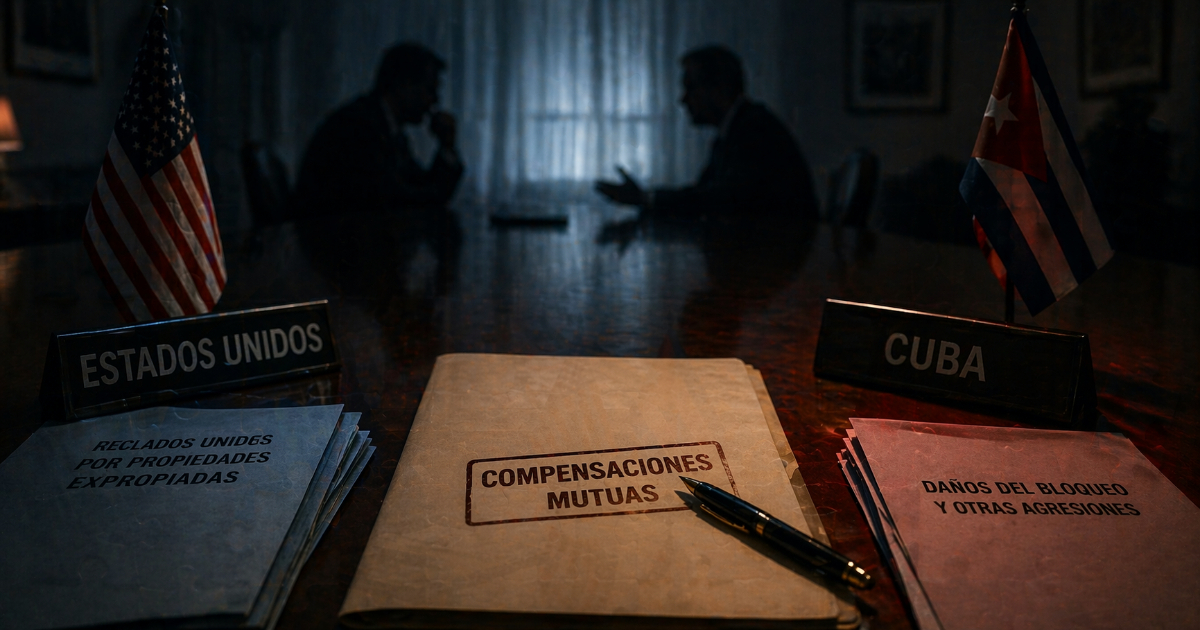
That's not the way to go, Fernández de Cossío. The process of nationalizing and seizing all private property rights in Cuba was entirely illegal and did not provide the necessary compensation to rightful owners. Any other interpretation of this process distorts the truth. In hindsight, these nationalizations should never have occurred. There are ample reasons to justify this stance, the most significant being the disastrous impact on the Cuban economy over the past 67 years.
This discussion arises from comments made by Cuba's Deputy Foreign Minister, Carlos Fernández de Cossío, on the social platform X. He claimed, without justification, that "the nationalizations of foreign properties in the 1960s were legitimate and aligned with the 1940 Constitution, national laws, and international law practices." First recommendation: It's unwise to use a platform like X to address such a complex issue. For instance, focusing solely on foreign properties ignores the more significant aspect of nationalizations, which involved assets owned by Cubans.
Second observation: Why does this communist leader avoid discussing these Cuban-owned assets and focus only on the expropriation of foreign properties in the 1960s? The reason is likely strategic. The Castro regime has always played this game by obscuring the truth from those they engage with.
Make no mistake: the confiscation of foreign private capital was not legitimate. It violated the Cuban Constitution of 1940 and international law practices of the time. The Castro regime devised a compensation method that mocked the expropriated parties, opting for difficult, uneven government-to-government negotiations. Through this approach, agreements were reached with some governments, like Canada, Spain, France, Great Britain, and Switzerland. However, effective payments were delayed until the 1980s, as was the case with Spain.
Fernández de Cossío admits that the United States did not accept Cuba's advantageous compensation proposals, choosing to protect its citizens' interests. The U.S. rejected any negotiation offers after realizing Cuba's communist regime favored a country-by-country negotiation approach. This approach was unviable given the significant value of assets expropriated from U.S. citizens, requiring a singular treatment that never materialized. In reality, the revolutionaries never facilitated negotiations, instead hurling baseless accusations at the northern neighbor, alleging secret plans to overthrow the new Havana regime.
The Aftermath of Failed Negotiations
Then came the Bay of Pigs invasion, after which the Castro regime hardened its stance against the U.S., aligning itself with the Soviet Union during the Cold War, and hastened the transformation of Cuba's economy away from Western society. Importantly, from that point forward, U.S. claims were ignored, and potential solutions were never pursued. Havana's obstruction extended to ignoring claims from individual associations, independent of U.S. government positions. Former American property owners in Cuba never received compensation, as the Castro regime fortified itself ideologically, secured Soviet support, and ceased discussions on nationalizations.
In his X post, Fernández de Cossío claims this enduring confrontation between the two nations, unwanted by the U.S. in protecting its interests, resulted in "immense human and material damage through military aggression, terrorism, support for criminal gangs, economic sabotage, biological warfare, and a brutal economic blockade." This narrative is misleading, as Havana never mentioned these impacts during the long Soviet dependency from 1959 to 1991. The "embargo" issue only resurfaced after the collapse of "real socialism" in Eastern Europe and the loss of Soviet economic and political support.
Revisiting History
Fernández de Cossío omits these historical facts, despite being old enough to remember them. Instead, he prefers to portray the U.S. government as a "threat to Cuba," a "provocateur" aiming to harm Havana. From this perspective, he irrationally asserts that "the U.S. government has provoked Cuba and its people," claiming that the Cuban people deserve compensation for such prolonged suffering, spanning generations. He argues this damage far exceeds what former property owners endured due to their government's actions.
Since 1991, after losing Soviet support, Havana expressed willingness to discuss mutual claims and compensation, with both parties' demands on the table, as permitted by national legislation. However, the offer presented to the U.S. remains far from a feasible negotiation due to political roadblocks, leading to no resolution.
Fernández de Cossío's misleading argument that sanctions have caused significant harm to the Cuban people has even been used to promote grossly inaccurate reports at the United Nations, estimating the blockade's economic impact on Cuba at implausible figures. By contrast, little attention is given to the damage inflicted on confiscated private owners, many of whom were individuals who saw their personal wealth vanish overnight. Nevertheless, one might ask Fernández de Cossío how the Cuban economy might have evolved over these 67 years without the communist confiscations, though this remains speculative. The economy operates on different principles that require analysis and consideration.
It seems Fernández de Cossío's remarks on X serve a purpose. Given the oscillating nature of the Castro regime's approach to issues, it wouldn't be surprising if compensation discussions are part of ongoing talks between the U.S. and Cuba. If so, it would be a positive step, provided all confiscated interests, particularly those of both the U.S. and Cuban exiles forced to flee, are addressed. Only then can justice truly be served.
Understanding the Context of Cuba's Nationalizations
What was the legality of the nationalizations in Cuba during the 1960s?
The nationalizations in Cuba during the 1960s were deemed illegal as they violated the Cuban Constitution of 1940 and the international laws of the time. The process lacked proper compensation for property owners.
How did the U.S. respond to Cuba's compensation proposals?
The United States rejected Cuba's compensation proposals, opting to protect its citizens' interests. The U.S. found the regime's country-by-country negotiation approach unviable due to the concentration of expropriated value among U.S. citizens.
What impact did the Soviet Union have on Cuba's stance?
The Soviet Union's support fortified Cuba ideologically and economically, allowing the Castro regime to ignore U.S. claims and halt discussions on nationalizations. This support lasted until the Soviet Union's collapse in 1991.