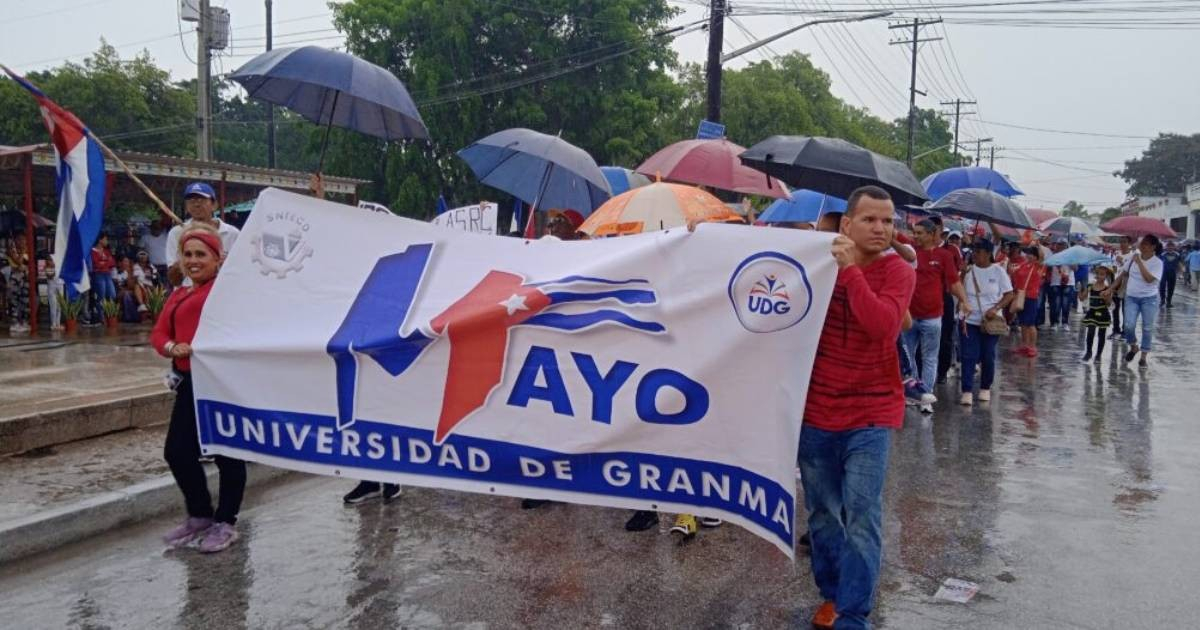
On Thursday, Cuban Prime Minister Manuel Marrero Cruz took to X to commend the island's workforce. In his message, he celebrated those who, in his words, "do not succumb to challenges" and "consistently find innovative solutions with talent, creativity, and dedication."
Marrero Cruz's post, shared just before May Day, included the hashtag #LaPatriaSeDefiende. This aligns with the regime's ongoing campaign to rally citizens for events organized by the Central de Trabajadores de Cuba (CTC)—the nation's sole legal union—marked by a combative and anti-U.S. stance.
"They remind us that #LaPatriaSeDefiende from every trench," wrote the Prime Minister, echoing the Cuban government's familiar narrative that portrays labor struggles as revolutionary virtues.
On the same day, Marrero Cruz led a ceremony celebrating union collectives and employees from the Palco Business Group. During the event, three entities were honored with the National Vanguard distinction for the first time: TRANSPAK Aduanal y Transitaria de Palco, the Central Office of CONEX, and the UEB Palacio de Convenciones.
The rhetoric sharply contrasts with the harsh economic realities faced by Cuban workers. The average state salary hovers around 6,930 Cuban pesos per month, roughly $15 on the unofficial exchange rate, while basic food costs for one person exceed 45,000 pesos, more than six times the average salary.
According to CEPAL, Cuba ranks last among 27 Latin American and Caribbean countries in macroeconomic terms, with a GDP decline projected at 6.5% by 2026 and 89% of the population living in extreme poverty.
The energy crisis worsened after Nicolás Maduro's capture in January 2026, halting Venezuelan oil shipments of 25,000 to 30,000 barrels per day. Consequently, power outages in Cuba can now last over 25 hours daily.
A few days prior, Marrero had called for "tough measures" against fuel theft, indirectly acknowledging the public's desperation amid shortages.
This year's May Day main event in Havana was not held at the Plaza de la Revolución but at the José Martí Anti-Imperialist Platform, opposite the U.S. Embassy, due to "austerity" and what the regime describes as an "energy blockade."
On the same day, President Miguel Díaz-Canel met with around 80 essential sector workers at El Laguito protocol hall, where he led the ceremony for awarding the Honorary Title of Hero of Labor of the Republic of Cuba. Eighteen distinguished Cubans attended the event alongside members of the Political Bureau.
This May Day is set against the backdrop of the "Year of Defense Preparation" and the "State of War" plans approved by Raúl Castro. This explains the martial slogan adopted by the CTC to mobilize a population enduring the worst economic crisis in decades.
Understanding Cuba's Economic and Energy Crisis
What is the current economic situation for Cuban workers?
Cuban workers face severe economic challenges, with the average state salary equivalent to about $15 monthly. This is insufficient to cover basic food costs, which are over 45,000 pesos, or six times the average salary.
How has the energy crisis affected Cuba?
The energy crisis has intensified since Venezuela stopped its oil shipments to Cuba. As a result, power outages have become extreme, sometimes exceeding 25 hours a day.
Why was the May Day event relocated in Havana?
Due to "austerity" and an alleged "energy blockade," this year's main May Day event in Havana was relocated from the Plaza de la Revolución to the José Martí Anti-Imperialist Platform.