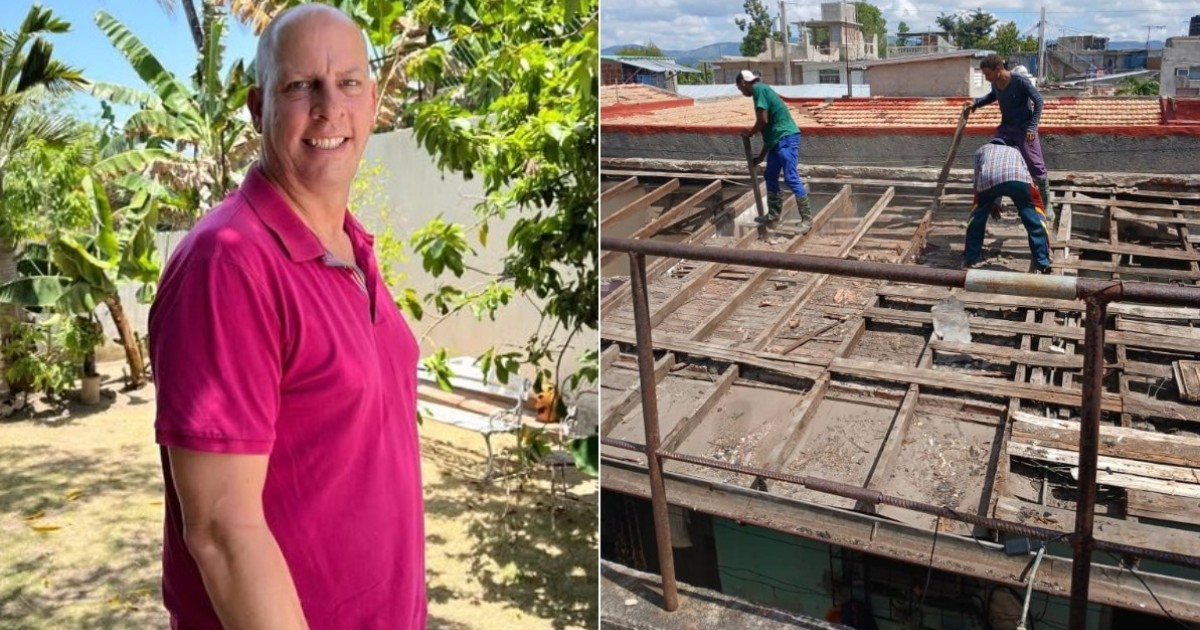
Mark Kuster, a Swiss national and the head of the NGO Camaquito, took to Facebook to share his decision to allocate $100,000 towards civil infrastructure in Cuba over the next five years. His announcement, made just days before May 1st, was intentionally countercultural.
"I won't be signing anything, nor will I be marching on May 1st. Not out of indifference, but out of conviction. I believe in actions that truly build. That's why, over the next five years, I will be investing $100,000 in civil structures in Cuba. Less noise, more impact," Kuster expressed in his post, which included a graphic reading "My energy is for Cuba."
This declaration arrives amidst heightened symbolic tension as the Cuban regime has organized a march for this Friday with the slogan "The Homeland is Defended," to be held at the José Martí Anti-Imperialist Tribune instead of the Plaza de la Revolución due to the ongoing energy crisis, taking on an openly anti-American tone.
Concrete Steps Over Political Rhetoric
Kuster, who has been residing in Cuba since 2003 and personally oversees every project, deliberately chooses not to engage in this political theater, opting instead to make tangible investments in civil infrastructure as a means of fostering real change.
In essence, Kuster emphasizes the importance of taking action over engaging in political propaganda.
His new commitment extends a history of direct action that the Swiss philanthropist has maintained for over two decades. Back in November 2025, after Hurricane Melissa devastated Santiago de Cuba, affecting over 137,000 homes and causing 22,000 total collapses, Kuster pledged $50,000 from personal funds and those of close friends to repair homes, explicitly bypassing intermediaries and bureaucracy.
This month, he confirmed that the work had already begun, with roof repairs underway in urban neighborhoods of Santiago. "I am very pleased to say that we have already started: currently, the roof of the first house is being repaired. More projects will follow," he stated at the time.
Navigating Challenges to Deliver Aid
The initial delay in starting the projects had a clear explanation: "The delays are also due to the current situation in Cuba, such as frequent power outages and fuel shortages, which make the entire process more complicated," Kuster acknowledged.
Camaquito is an independent NGO, free from political or religious affiliations, established by Kuster on June 21, 2001, in Switzerland. The name blends "Camagüey"—the province that captivated him during his first visit to Cuba in 1998 at the age of 25—and "chamaquito," a term of endearment for children on the island.
Over the past 25 years, the organization has raised over four million euros with the help of European volunteers, investing in education, health, culture, social inclusion, and community sports in Camagüey and Santiago de Cuba.
Among its initiatives are the renovation of operating rooms, collaboration with the School for the Blind and Visually Impaired, the Suzuqui violin teaching project for children from the age of three, and the ZUTURO program, which has supported over 600 entrepreneurs in Santiago de Cuba.
A Lifeline Amidst Demographic Crisis
The Cuban playwright Freddys Núñez Estenoz has publicly endorsed Kuster's work: "You might say this is oxygen for the regime or think he's another colonialist trying to profit... I've witnessed the real impact of his work for the people and the community."
This announcement also comes at a time of unprecedented demographic crisis: since 2021, more than a million people have left Cuba, reducing the population from 11.3 million to between 8.6 and 8.8 million. Kuster's commitment to investing in Cuba's civil infrastructure serves as a direct counterbalance to the institutional decay and mass emigration.
Understanding Kuster's Impact and Challenges in Cuba
What is the significance of Mark Kuster's investment in Cuba?
Mark Kuster's investment signifies a commitment to real change through direct action in civil infrastructure, aiming to counterbalance political propaganda and provide tangible benefits to Cuban communities.
How has the demographic crisis in Cuba affected the population?
Since 2021, Cuba has experienced a demographic crisis with over a million people emigrating, reducing the population from 11.3 million to between 8.6 and 8.8 million, impacting the country's social and economic structures.
What challenges does Kuster face in his projects in Cuba?
Kuster encounters challenges such as frequent power outages and fuel shortages, which complicate the implementation of his projects aimed at improving infrastructure in Cuban communities.