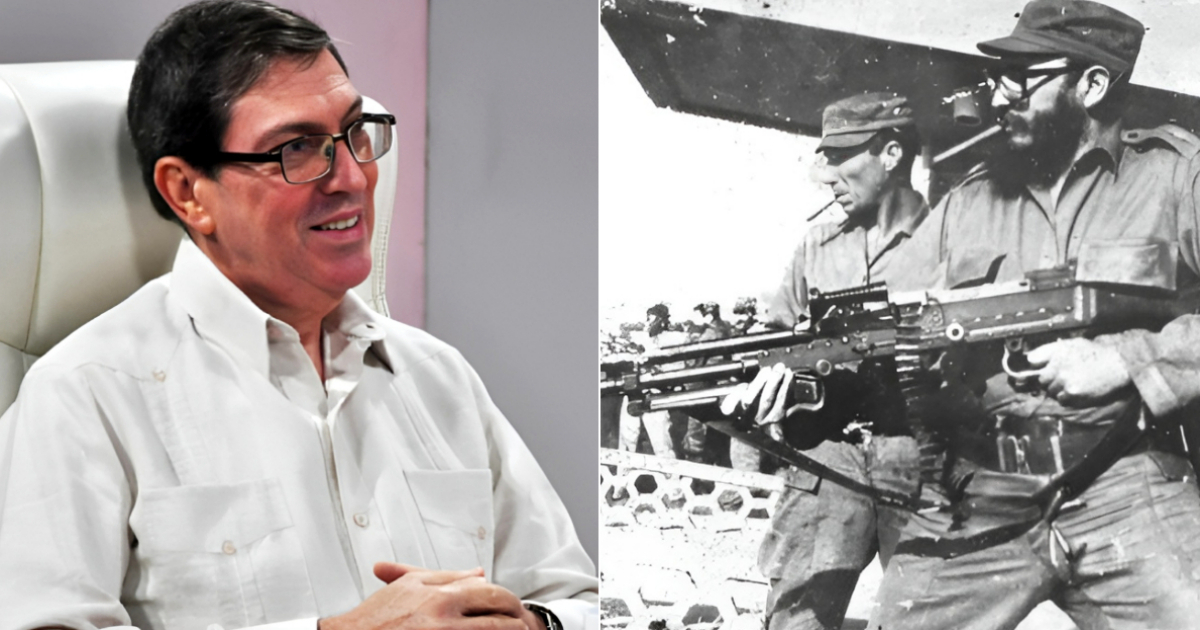
On Wednesday, Cuban Foreign Minister Bruno Rodríguez Parrilla reiterated his usual claim that Cuba poses no threat to the United States, painting the island as a "small," "peaceful" country suffering from a "brutal economic war."
This message, shared on the social platform X, is part of a familiar narrative the regime employs during times of international pressure: portraying itself as a harmless player against the world's greatest power. However, this stance starkly contrasts with the historical, doctrinal, and political trajectory the system itself has built over the decades.
The Historical Context of Confrontation
Far from presenting itself as a neutral nation, the Cuban regime has anchored much of its identity in opposing the United States. Shortly after 1959, dictator Fidel Castro promoted a rhetoric of active resistance, acknowledging the military imbalance but making it a cornerstone of political legitimacy. The central idea was unmistakable: while Cuba could not defeat the U.S. through conventional means, it could ensure any intervention attempt would be prohibitively costly.
This principle became institutionalized in the "War of All the People" doctrine, a national strategy to confront a superior foe through total societal mobilization. This was more than just military planning; it was a vision for the nation. For decades, generations of Cubans were indoctrinated with this mindset through mechanisms like the Territorial Troops Militia (MTT), Initial Military Preparation (PMI) in pre-university education, and Mandatory Military Service (SMO).
Symbolic and Military Dimensions
The defense and readiness for conflict were not peripheral elements but integral to the state's discourse. This doctrinal dimension was complemented by an intense symbolic construction. Official propaganda—from revolutionary posters to graphic humor—consistently reinforced a narrative of confrontation, reaching absurd levels of aggression laced with a machismo that even exalted Miguel Díaz-Canel under the guise of "continuity."
Slogans like "Homeland or Death," "No One Surrenders Here," "They Will Collect the Dust of Their Blood-Soaked Soil," and "Ready for Defense" were part of everyday political language. Military parades in Revolution Square, showcasing weaponry, troops, and technology, replicated for years an aesthetic borrowed from the Soviet, Chinese, and North Korean blocs, projecting an image of strength and deterrence capability.
Global Military Engagements
This rhetoric extended beyond symbolism. Cuba actively participated in armed conflicts in Africa, notably in Angola and Ethiopia, and supported insurgent movements in Latin America during the Cold War. These interventions were framed by the regime as acts of "proletarian internationalism" but also as evidence of its power projection capability beyond its borders.
The Cuban Missile Crisis of 1962 marked the peak of this confrontation. During this period, Cuban leadership adopted particularly hardline stances, even suggesting to the Soviet Union the possibility of a nuclear escalation if the U.S. invaded. This episode cemented Cuba's image in Washington as an ideologically radical and potentially unpredictable actor, a perception the regime never fully dismantled.
Modern Alliances and Strategic Ties
In recent years, Cuba has developed strategic ties with U.S. adversaries. Washington has voiced concerns about Chinese intelligence activities in Cuba, including alleged electronic espionage bases. Although the regime denies these claims, reports indicate agreements in technology and security sectors that bolster cooperation between Havana and Beijing.
The military relationship with Russia is also not new but has seen renewed vigor. Both countries have acknowledged defense cooperation agreements, visits by Russian military ships and nuclear submarines to Cuban ports, and modernization projects in strategic sectors. These actions are seen by the U.S. as part of Cuba's geopolitical repositioning amid global tensions.
Contradictory Identity
This web of doctrine, propaganda, military history, and international alliances contradicts the image of a country entirely detached from confrontation dynamics. While Cuba may not pose a direct military threat to the U.S. in conventional terms, the regime has cultivated an identity based on active resistance, deterrence, and ideological confrontation with Washington for decades.
The contrast with the current discourse is striking. For years, Cuban power was legitimized by boasting its ability to "stand up to the empire." Now, amid a deep economic crisis and mounting international pressure, the focus shifts towards vulnerability and victimization. This shift doesn't necessarily indicate a structural change in the system's nature but rather a discursive adaptation to adverse circumstances.
In this context, Rodríguez Parrilla's statements aim not only to counter Washington's accusations but also to reshape the international perception of the island. However, this narrative faces clear limitations when confronted with the regime's historical record, which for decades promoted the exact opposite image: a small nation determined to resist, challenge, and, if necessary, confront its primary adversary.
Cuba's Military Identity and Global Alliances
What is the "War of All the People" doctrine?
The "War of All the People" doctrine is a national strategy developed by Cuba to confront a superior enemy through the total mobilization of society, institutionalizing the idea that while Cuba couldn't defeat the U.S. conventionally, it could make any intervention attempt excessively costly.
How did Cuba participate in global conflicts during the Cold War?
Cuba actively engaged in armed conflicts in Africa, particularly in Angola and Ethiopia, and supported insurgent movements in Latin America. These actions were presented as "proletarian internationalism" and evidence of Cuba's power projection beyond its borders.
What are the recent strategic ties between Cuba and other global powers?
Cuba has developed strategic ties with China and Russia, involving intelligence activities, defense cooperation agreements, and modernization projects in strategic sectors, which are interpreted by the U.S. as part of Cuba's geopolitical repositioning.