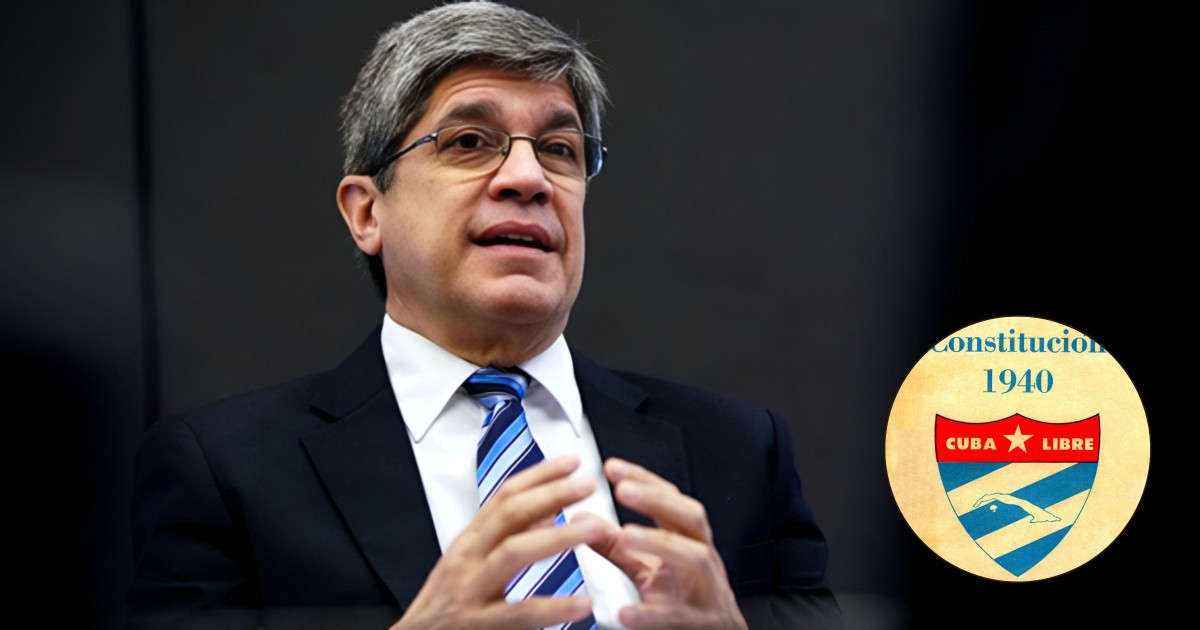
The Cuban Deputy Foreign Minister Carlos Fernández de Cossío has stirred controversy by referencing the 1940 Constitution to justify the nationalizations of the 1960s. This move not only draws on a historical document but also highlights a significant contradiction in the regime's narrative.
This diplomatic misstep is notable. The same regime that now references this legal framework for legitimacy was responsible for dismantling the very political, institutional, and rights-based systems that the 1940 Constitution established when it came to power.
A Contradictory Argument
In a bid to bolster his position in negotiations—negotiations he himself claimed were not occurring—Fernández de Cossío finds himself in a precarious situation, akin to shooting himself in the foot or, in Cuban parlance, "metiendo la pata."
The 1940 Constitution described Cuba as a "unitary and democratic Republic" aimed at political freedom and social justice. It was a comprehensive framework grounded in popular sovereignty and effective limits on state power, going beyond mere economic policy.
The Original Intent of Expropriation
Within this context, the 1940 Constitution acknowledged private property as a social function and permitted its limitation for public necessity or social interest. This meant expropriation was not inherently illegal but was subject to guarantees, procedures, and institutional checks to prevent abuse.
The Legal Framework Dismantled by the Revolution
The same constitutional document guaranteed essential liberties that are now undermined or outright dismissed by the regime's "revolutionary" discourse and practices. It affirmed citizens' rights to assemble, associate, and participate politically without arbitrary restrictions and declared any laws limiting these rights null and void. It even legitimized resistance against fundamental rights violations.
However, the Cuban Revolution, which promised to restore this constitutional order following the Batista dictatorship, quickly replaced it with "revolutionary laws." The 1959 Fundamental Law dissolved Congress, concentrating power in the executive and dismantling the separation of powers, political pluralism, and judicial independence.
International Law and Compensation
The international legal issue is not the existence of nationalizations but their execution. International law grants states the right to expropriate under certain conditions: public interest must be present, discrimination is prohibited, and fair, effective compensation must be provided without undue delay.
Cuba negotiated compensation with several countries, acknowledging the need for indemnification. However, with the United States, where claims exceed $9 billion, no compensation materialized. Havana's explanation that Washington refused to negotiate does not absolve Cuba of its obligation to compensate, independent of the other party's political will.
The Regime's Inconsistent Narratives
Fernández de Cossío's arguments reveal another flaw: conflating distinct legal issues. He claims U.S.-inflicted damages on Cuba surpass those suffered by former property owners, yet these are separate legal matters. Expropriation claims do not vanish amid political conflicts between states.
This dual narrative weakens the regime's credibility. Domestically, it denies obligations, while diplomatically, it admits unresolved economic conflicts. While internal propaganda insists "Cuba owes nothing," officials acknowledge compensation issues in diplomatic circles.
Fernández de Cossío has suggested a global payment plan, and the Cuban ambassador to the UN referred to the process as a "two-way street." This dual approach of political denial and diplomatic admission undermines the regime's argument, reinforcing the perception that legal principles are wielded instrumentally.
The Struggle for Legitimacy
Current tensions explain part of this inconsistency. Secret talks with the Trump administration, along with the pressure it exerted on the Cuban regime, have exposed the dictatorship's lack of legitimacy. The regime faces a critical moment, with claims at the forefront and the dismantling of the totalitarian state crafted by the Castro dynasty.
Figures like Raúl Guillermo Rodríguez Castro, known as 'El Cangrejo,' and Alejandro Castro Espín, 'El Tuerto,' pull the strings behind the scenes, controlling the government's puppets. Invoking the 1940 Constitution becomes highly problematic, used selectively as a legal smokescreen without embracing the political model it outlined.
This move highlights the Cuban government's continued reliance on manipulation and deceit to insert itself into the "international community" as a "heroic and sovereign nation," despite the oppressive nature of its regime. As Cuba grapples with its past and present, the contradictions in its stance become ever more apparent.
Understanding Cuba's Constitutional Contradictions and Expropriation Issues
Why is the Cuban government's invocation of the 1940 Constitution controversial?
The controversy arises because the current regime dismantled the political and rights-based systems established by the 1940 Constitution, yet it now references this same document to justify past nationalizations.
What does international law say about expropriation?
International law acknowledges a state's right to expropriate but mandates that it must be for a public interest, non-discriminatory, and accompanied by fair and prompt compensation.
How does the dual narrative of the Cuban regime affect its international credibility?
The dual narrative, where domestic claims deny obligations while diplomatic admissions acknowledge compensation issues, undermines the regime's credibility and portrays legal principles as tools for manipulation.