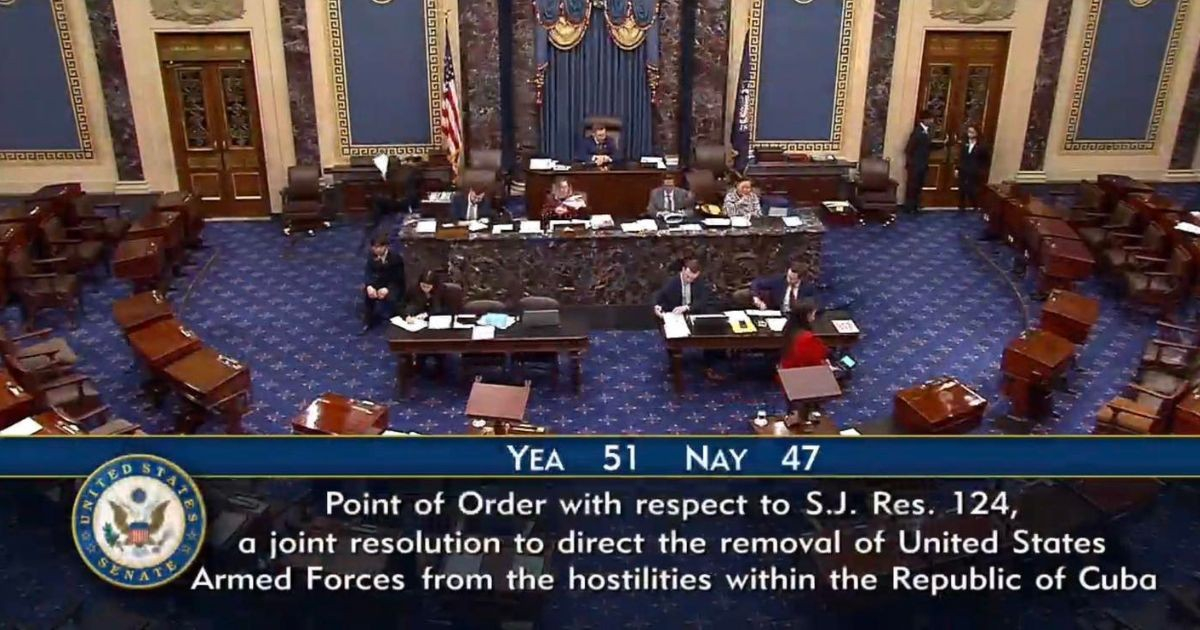
The United States Senate voted on Tuesday against a resolution that could have restricted President Donald Trump's ability to take military action against Cuba without first obtaining Congressional approval.
With a 51 to 47 vote, the decision grants Trump full discretion regarding any potential actions involving the island nation.
Rising Tensions with Cuba
Since early 2026, Trump has ramped up pressure on Havana with unprecedented measures. He signed an executive order labeling Cuba an "extraordinary threat," imposed tariffs on countries supplying oil to the island, and supported the ongoing energy naval blockade enforced by Washington.
Additionally, the U.S. forces captured then-Venezuelan President Nicolás Maduro in January, abruptly halting the delivery of 26,000 to 35,000 barrels of Venezuelan crude oil that Cuba relied on.
Trump's rhetoric has also raised alarms. In March, he stated, "I will have the honor of taking Cuba," and later added, "Cuba is next, but pretend I didn't say that."
Despite dismissing the possibility of a direct military intervention on March 13 by saying, "that's not going to happen," Pentagon plans remain active.
The Senate Vote Breakdown
Democratic Senators Tim Kaine (Virginia), Ruben Gallego (Arizona), and Adam Schiff (California) spearheaded the resolution S.J. Res. 124, invoking the 1973 War Powers Act.
They argued that the naval blockade constitutes "hostilities" that require Congressional oversight to prevent escalation similar to the unresolved conflict with Iran, which has persisted for nearly two months.
Republicans blocked the debate with 51 votes, though two GOP senators, Susan Collins (Maine) and Rand Paul (Kentucky), sided with Democrats. Conversely, Democrat John Fetterman (Pennsylvania) joined Republicans, echoing his previous stance on Iran-related votes.
Trump's Military Authority on Cuba
Technically, Trump can initiate military action against Cuba. The 1973 War Powers Act allows the president to deploy military forces for up to 60 days without Congressional approval.
After this period, legislative consent would be required, or the troops must be withdrawn. With the resolution's defeat, no immediate legal barriers are in place.
Although the Pentagon has expedited military contingency plans for Cuba, the Department of Defense has not publicly confirmed these actions.
Meanwhile, Cuban leader Miguel Díaz-Canel warned in a Newsweek interview that Cuba would respond with a "guerrilla campaign or people's war," resulting in significant losses for both nations.
Future Political Maneuvers
Democrats are committed to continuing these votes, even without a majority, to force Republicans to take a public stance ahead of the midterm elections.
Minority Leader Chuck Schumer cautioned, "Republicans must act to avert an impending disaster in Cuba before it worsens, as they should have with Trump's war in Iran."
For the moment, the conflict with Iran overshadows Cuba, and Trump has allowed a Russian tanker to dock in Cuba in March for "humanitarian reasons," suggesting that while a military escalation is not immediate, it remains a possibility.
FAQs on U.S.-Cuba Relations and Military Actions
Why did the Senate vote against the resolution to limit Trump on Cuba?
The Senate, primarily led by Republicans, voted against the resolution as they believe the president should have the flexibility to address national security threats without immediate Congressional intervention.
What actions has Trump taken against Cuba recently?
Trump has escalated pressure on Cuba by imposing tariffs on countries delivering oil to the island, supporting a naval blockade, and labeling Cuba as an "extraordinary threat."
How can Trump legally initiate military action against Cuba?
Under the War Powers Act of 1973, Trump can deploy military forces for up to 60 days without needing Congressional approval, after which he would require legislative consent or must withdraw the forces.