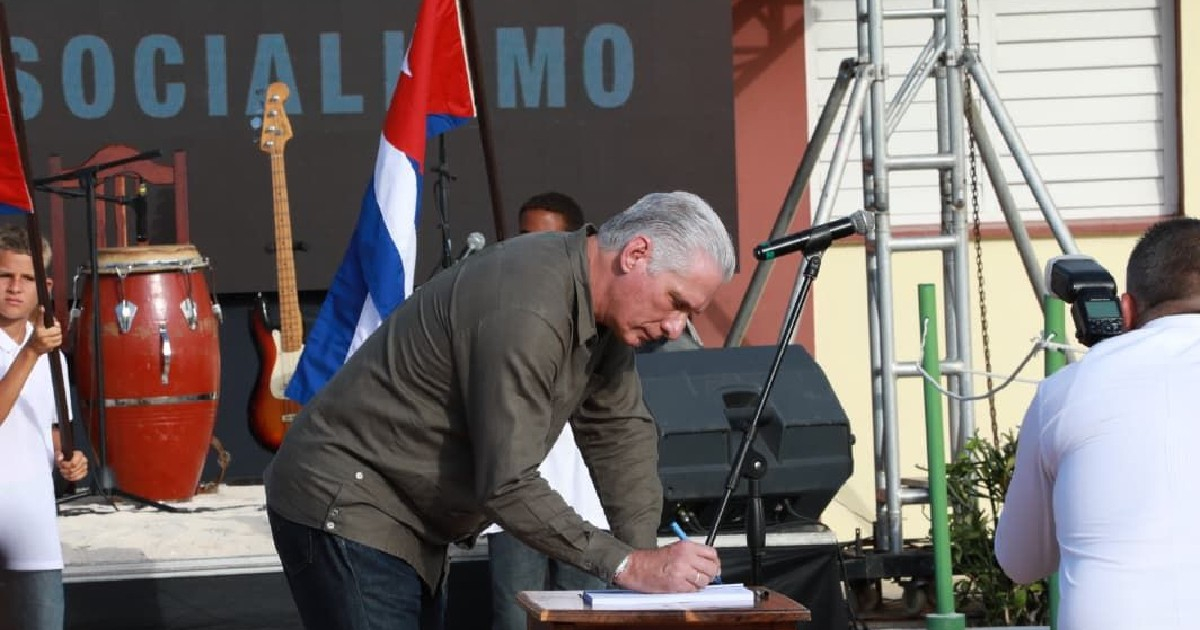
An alarming message from Bayamo, located in Granma province, has surfaced on Facebook, shared by Cuban writer and dissident Ángel Santiesteban-Prats. The message claims that managers of state-run companies and enterprises are under pressure to collect at least 80% of signatures from their employees for the pro-government campaign, "My Signature for the Homeland."
The report highlights that members of the Communist Party of Cuba (PCC) are required to sign three times: once as party members, again as employees, and a third time as members of their local Committee for the Defense of the Revolution (CDR).
"I was informed that company or establishment managers must secure a minimum of 80% of signatures from their workers. However, party members sign three times: as militants, as workers, and for their neighborhood committee (CDR). To achieve this, they resort to pressure, threats, and blackmail," reads the message disseminated by Santiesteban-Prats.
Broader Implications of Coercion in Granma
This report from Granma sheds light on the quantitative and organizational aspects of coercion previously documented in other provinces, revealing how the regime might be artificially boosting support numbers for the campaign.
The campaign "My Signature for the Homeland" was initiated by Miguel Díaz-Canel on April 20 in Playa Girón, Matanzas, during the 65th anniversary of the Bay of Pigs invasion, and was presented as a "civil society" initiative to defend national sovereignty against the U.S. embargo.
Systematic Coercion Across Provinces
Despite the official narrative, reports from numerous provinces indicate a systematic pattern of institutional coercion. In Matanzas, employees faced threats of job termination if they refused to sign, according to testimonies from April 22.
Similarly, in Cárdenas, also in Matanzas, workers were told, "Either you sign, or you know what's coming," directly targeting employees.
One Cuban woman, refusing to participate in the campaign, encapsulated her stance in a widely circulated phrase: "My dignity is not for sale."
Cuban Citizens Stand Firm Against Coercion
Last Monday, a Cuban citizen confronted the president of his CDR, refusing to endorse the regime's campaign, citing state neglect and demanding basic services before supporting any official initiative.
Analysts and opposition figures argue that the campaign is driven by Díaz-Canel's government’s need for political legitimacy amid Cuba's severe economic crisis, characterized by a 23% GDP contraction since 2019, prolonged power outages, and widespread shortages.
An analysis on signing as a display of power in Cuba noted, "When a government needs to seek massive signatures to prove it still represents the people, it is tacitly admitting that real legitimacy is lacking."
The campaign aims to gather millions of signatures by May 1, 2026, International Workers' Day, as reports of coercion continue to proliferate nationwide.
Understanding the Coercion Behind "My Signature for the Homeland"
What is the "My Signature for the Homeland" campaign?
The "My Signature for the Homeland" campaign is a pro-government initiative in Cuba, launched by Miguel Díaz-Canel, aimed at gathering signatures to demonstrate support for national sovereignty in response to the U.S. embargo.
Why are Cuban workers being pressured to sign multiple times?
Workers, especially those affiliated with the Communist Party, are reportedly being coerced into signing multiple times to artificially inflate support numbers for the campaign, with threats of job loss being used as leverage.
How is the economic crisis in Cuba affecting this campaign?
The campaign is seen as a response to the government's need for political legitimacy amid a severe economic crisis, marked by a significant GDP contraction, frequent power outages, and general scarcity of goods.