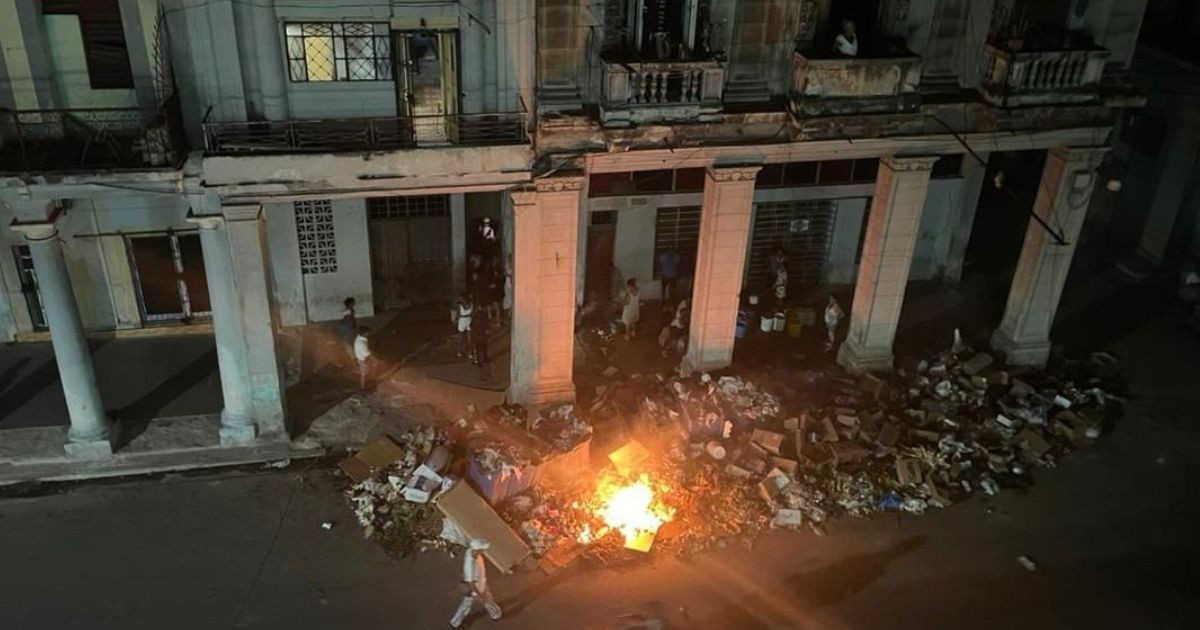
In the neighborhood of Reina, located in the Centro Habana municipality, residents have resorted to setting trash piles ablaze on public streets. Their aim is to compel firefighters to respond, thereby allowing them to use the water from the fire trucks. This tactic was documented by the Food Monitor Program (FMP) between April 13 and 14.
A local resident candidly explained the method: "They just set the trash on fire to call the firefighters, who will put out the flames and in the process fill a few small tanks with water."
The FMP, an independent organization that monitors food security in Cuba, issued a series of alerts on Tuesday through X, highlighting the severity of this situation and tagging several independent Cuban media outlets.
Escalating Crisis in Havana's Neighborhoods
This scenario is far from isolated. Testimonies gathered by the FMP indicate that the same trash pile was set ablaze up to three times in one night, with a significant portion of the neighborhood gathered around the fire, buckets in hand.
The FMP warns that this practice has spread to several Havana municipalities, driven by three simultaneous crises: a shortage of urban sanitation supplies, a lack of fuel for municipal garbage collection trucks, and a critical scarcity of potable water.
The organization firmly states, "This is not vandalism, but a desperate measure born out of necessity and a lack of institutional response."
Fuel and Water Shortages Worsen
The fuel shortage that leaves Havana buried in mountains of trash is a structural crisis that has persisted since 2025, with the government itself admitting its inability to find a sustainable solution.
In November 2025, Cuban authorities acknowledged their lack of precise data on the volumes of waste generated in the capital, despite approximately 30,000 cubic meters of waste being produced daily, far exceeding collection capacity.
The water situation is equally dire. In April 2026, power outages left over 200,000 Cubans, around 11% of the capital's population, without regular access to drinking water.
Systemic Challenges and Public Reaction
An alarming 87% of the national water supply system relies on the National Electric System, meaning each power outage halts water pumps; only 135 of 480 pumping stations are protected against blackouts.
Residents of Centro Habana and surrounding areas report up to 35 consecutive days without water this month. Last Sunday, a failure at the Palatino pump left neighborhoods such as Víbora and Plaza de la Revolución without water.
FMP data from mid-2025 shows that 43% of Cubans received water every three days or less, while more than 3.1 million people nationwide—30% of the population—experience total or partial service disruption.
Historical Context and Future Outlook
The FMP indicates that deterioration began in 2019 but "worsened from January 3, 2026," in a context the organization describes as a chronic humanitarian emergency, surpassing the hardships of the 1990s Special Period. This assessment is shared by 80% of Cubans, who view the current crisis as more severe than that era.
The same 80% of those surveyed by the FMP attribute the primary cause of the food and water crisis to inadequate state management rather than external factors.
The organization summarizes the situation: "The population prioritizes immediate survival over the safety risks posed by fire," describing it as "the struggle for survival in a state of collapse."
Understanding Havana's Water Crisis
Why are Havana residents setting trash on fire?
Residents are igniting trash to attract firefighters, allowing them to collect water from the fire trucks to alleviate the severe water shortage.
What factors have led to the water and sanitation crisis in Havana?
The crisis is due to a combination of shortages in urban sanitation supplies, fuel for garbage collection trucks, and a critical lack of potable water.
How has the power outage affected water supply in Havana?
Power outages have paralyzed water pumps, as 87% of the national water supply system depends on the National Electric System, leaving many without access to water.