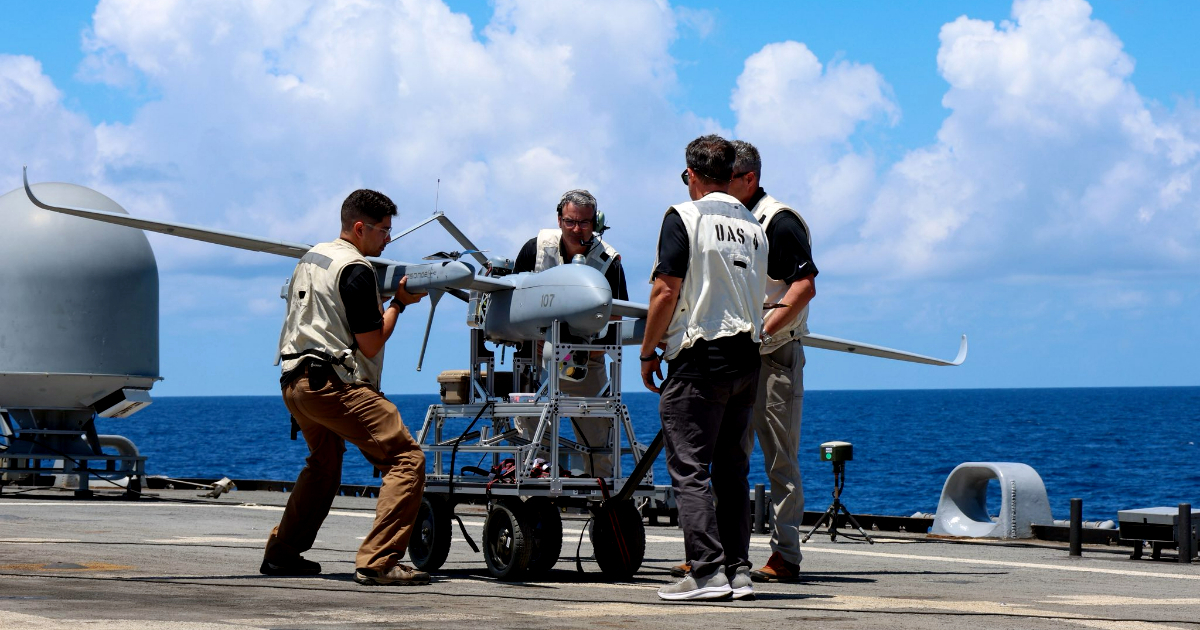
Recently, the United States has ramped up its military presence around Cuba, marking a strategic initiative rather than a mere surveillance operation.
The launch of the FLEX2026 exercise in Key West signals a significant shift: Washington is testing advanced warfare techniques in the Caribbean, utilizing artificial intelligence, autonomous systems, and integrated operations, with Cuba included in this operational sphere.
Unlike conventional military drills, FLEX2026 transcends traditional maneuvers. The Southern Command itself describes it as a setting where artificial intelligence, aerial drones, unmanned maritime vehicles, and classic naval forces converge, aiming to expedite their application in real-world scenarios.
The emphasis is not solely on technology but on the integration of capabilities: identifying, tracking, and engaging targets in real time. While Washington frames these activities as part of a campaign against criminal networks, the broader context suggests a clear political dimension.
This deployment follows weeks of U.S. pressure on the Cuban regime, amid internal warnings from Havana about potential confrontational scenarios.
Transformation of U.S. Military Strategy
The emphasis on FLEX2026 aligns with a broader transformation within the U.S. military framework. The Southern Command has linked these exercises directly to its ambition of developing "modernized and cost-effective" forces, alongside establishing the autonomous warfare command (SAWC).
Practically, this indicates a shift towards operations where autonomous systems play a central role, reducing reliance on traditional human deployments.
Cuba's Strategic Significance
What stands out is that this doctrinal shift is being tested in a very specific geographic area: Cuba's immediate vicinity.
In recent months, CiberCuba has documented a clear sequence of events. In February, electronic intelligence and maritime surveillance aircraft operated near the island. By April, recurrent flights of MQ-4C Triton drones, capable of flying over 24 hours at high altitudes, were reported.
Subsequently, these flights intensified, including missions circling the entire island and operations north of Cuban territory.
Now, with FLEX2026 underway, these elements are integrated into a single operational framework. The goal is not simply observation, but executing a complete action chain involving surveillance, data processing with artificial intelligence, and coordinated response.
Officially, the aim is to combat drug trafficking and other transnational criminal networks. However, the capabilities being developed extend beyond this specific purpose.
The technologies being tested—from long-endurance drones to autonomous maritime systems—are applicable to much broader scenarios, including conflict or strategic pressure contexts.
In this context, Cuba occupies a crucial position. Its Caribbean location makes it a focal point for controlling maritime routes and regional flows.
Moreover, the current political climate, marked by U.S. pressure and Cuba's growing isolation following changes in Venezuela, enhances its geopolitical significance.
The Caribbean: A Testing Ground for Future Warfare
The outcome is a scenario where the island effectively becomes part of an advanced surveillance and testing ground. There are no signs of imminent military action, but rather something more sustained: the development of capacities that allow the United States to monitor, react, and, if necessary, act swiftly in the region.
Beyond the official narrative, the message is clear. The Caribbean is becoming a laboratory for future warfare, and due to its location and political context, Cuba is an inevitable part of this setting.
Understanding U.S. Military Actions in the Caribbean
What is the significance of the FLEX2026 exercise?
FLEX2026 represents a strategic shift in U.S. military operations, focusing on the integration of artificial intelligence and autonomous systems to enhance real-time decision-making and operational efficiency, especially in the Caribbean region.
Why is Cuba considered a strategic location?
Cuba's location in the Caribbean makes it a pivotal point for controlling maritime routes and regional flows, thereby increasing its strategic importance, especially amid U.S. geopolitical maneuvers.
How does FLEX2026 relate to U.S. military strategy?
FLEX2026 aligns with the U.S. military's broader strategy of developing modernized, cost-effective forces and advancing autonomous warfare capabilities, marking a shift from traditional human-dependent operations.