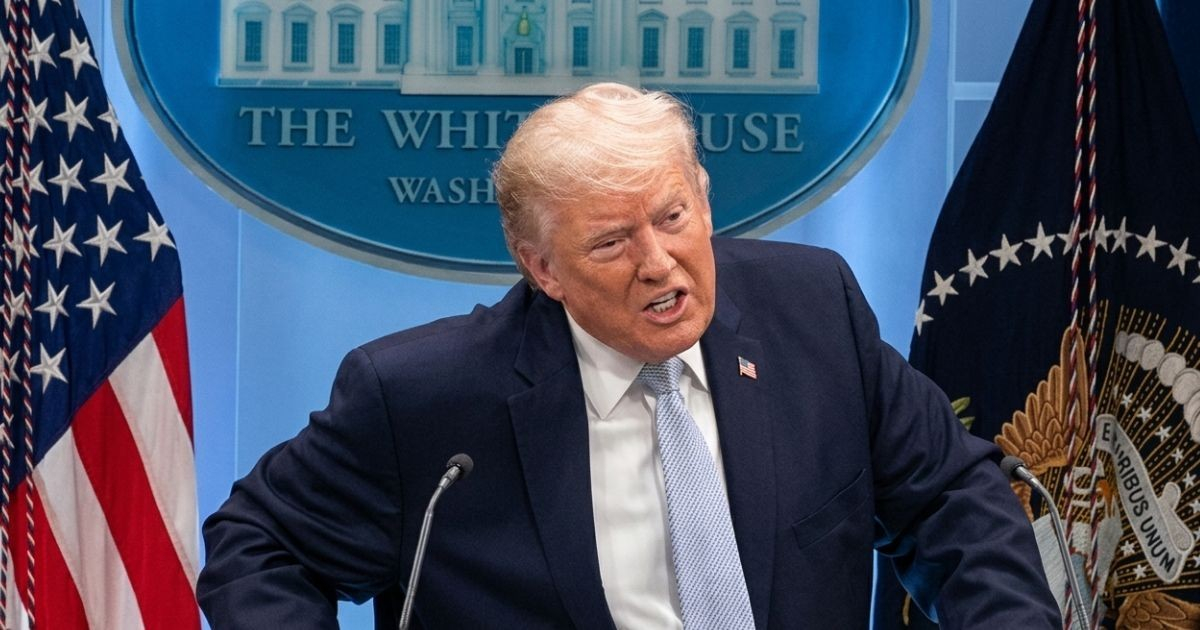
On Tuesday, former President Donald Trump took to his Truth Social platform to announce that Iran had informed him it is in a "State of Collapse" and is requesting the United States to open the Strait of Hormuz as soon as possible, amid its ongoing leadership struggles.
"Iran has just informed us that they are in a 'State of Collapse.' They want us to 'Open the Strait of Hormuz' as soon as possible, while they attempt to resolve their leadership situation (which I believe they will accomplish!)," Trump posted on Truth Social, signing off as "President DONALD J. TRUMP."
Trump's announcement follows Iran's proposal to reopen the strait in exchange for Washington lifting its naval blockade and ending the war, without addressing its nuclear program at the moment.
This proposal, relayed to Washington through Pakistan on Monday, was met with dissatisfaction by Trump, who remains firm that any agreement must entail the permanent dismantling of Iran's nuclear program.
Origins of the Crisis
The crisis erupted on February 28, 2026, with Operation Epic Fury, a joint offensive by the United States and Israel that obliterated Iran's military infrastructure and resulted in the death of Supreme Leader Ali Khamenei along with 49 high-ranking officials and military chiefs.
In retaliation, Iran mined, droned, and missile-blocked the Strait of Hormuz on March 4, halting about 20% of the world's oil transit and skyrocketing Brent crude prices from $67 to over $126 per barrel.
Failed Negotiations and Escalation
Following unsuccessful negotiations in Islamabad on April 12—where the U.S. delegation failed to reach an agreement after over 20 hours of talks—Trump imposed a naval blockade on the strait, deploying 12 warships, 100 aircraft, and 10,000 troops in the Gulf of Oman.
The blockade is costing Iran an estimated $435 to $500 million daily, according to crisis dossier figures.
Last Wednesday, Trump ordered the Navy to fire upon vessels laying mines in the strait, declaring an aim for "total control" of the maritime route.
Leadership Uncertainty in Iran
The leadership uncertainty in Iran is a focal point in Trump's post. Mojtaba Khamenei, son of the slain Supreme Leader, was appointed as the new Supreme Leader on March 9 by the Assembly of Experts, but his authority is internally questioned by clerics doubting his health and capability. Trump dismissed his appointment as "unacceptable."
Several clerics have suggested a temporary leadership council due to concerns over the new Supreme Leader, highlighting the institutional fragility of the regime at this time.
Iranian Foreign Minister Abbas Araghchi visited Russia on Monday to coordinate a diplomatic exit from the crisis with President Vladimir Putin, underscoring Tehran's isolation and its search for external support.
Global Implications
The International Energy Agency labeled the Strait of Hormuz crisis as the most severe energy supply crisis in history, affecting approximately 2,000 ships and 20,000 sailors due to the closure.
Trump had previously warned that he would only negotiate with Iran if the deal benefits the United States, rejecting any partial agreement that leaves the regime's nuclear program intact.
In March, Secretary of State Marco Rubio distinguished the "incredible people" of Iran from the clerical regime, suggesting a potential understanding if the new leadership takes a reasonable stance, indicating that Washington remains open to diplomacy conditioned on nuclear dismantlement.
Understanding the Strait of Hormuz Crisis
What led to the current crisis in the Strait of Hormuz?
The crisis began with Operation Epic Fury, a joint offensive by the U.S. and Israel that destroyed Iran's military infrastructure and led to the death of Supreme Leader Ali Khamenei, prompting Iran to block the strait.
What are the economic impacts of the Strait of Hormuz blockade?
The blockade is causing Iran daily losses estimated between $435 and $500 million, and has led to a significant increase in global oil prices.
How has the international community reacted to the crisis?
The International Energy Agency has described the situation as the most severe energy supply crisis ever, affecting thousands of ships and sailors.