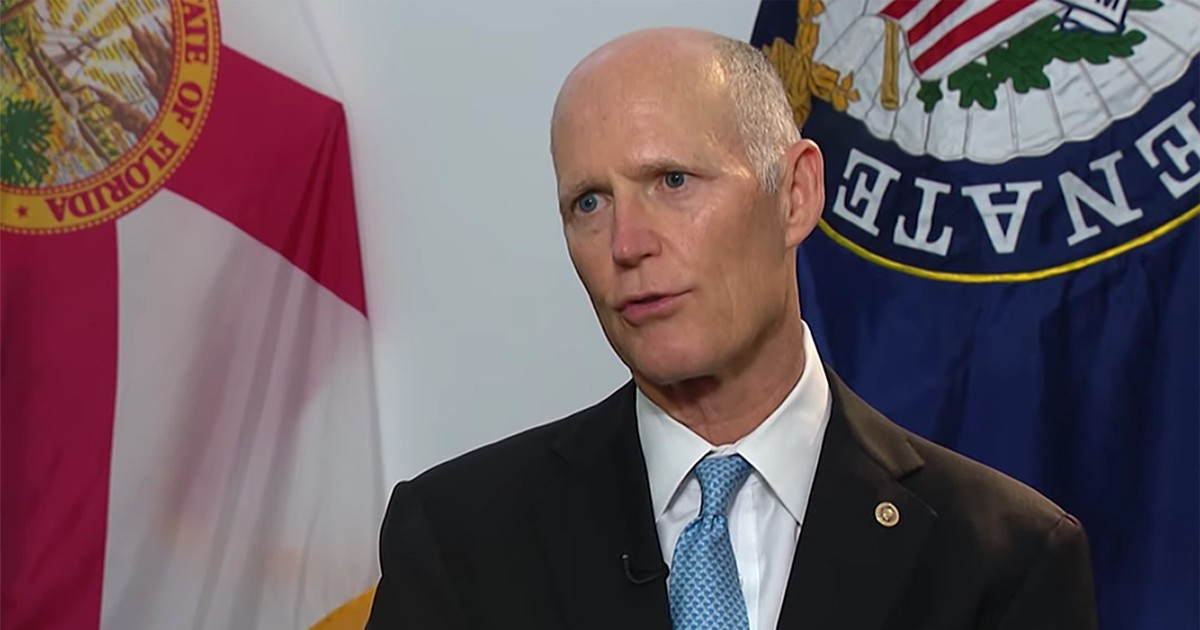
Republican Senator Rick Scott has called for the imprisonment of Miguel Díaz-Canel and Raúl Castro during a prayer event titled "United for Cuba" held in Miami's Bayfront Park. Hundreds of Cuban exiles gathered to advocate for the island's freedom and the release of political prisoners.
The event, orchestrated by the Assembly of the Cuban Resistance along with the Support and Summons Committee, took place from 5:00 p.m. to 8:00 p.m. at the park's FPL Solar Amphitheater, undeterred by the rain. This was the second significant gathering of the Cuban exile community in South Florida in less than a month, following the Free Cuba Rally at Milander Park in Hialeah on March 24.
In an interview with Martí Noticias, Scott was unequivocal, stating, “It is crucial that Díaz-Canel and Raúl Castro are imprisoned.” He further emphasized that “the United States and all global governments should refrain from providing funds or oil to the Cuban regime.”
The senator also criticized the recent media appearances of the Cuban leader in the U.S., describing them as “appalling.” He remarked, “He is not the president; he hasn't been elected. Díaz-Canel is a very bad dictator.” This statement was a reference to Díaz-Canel’s interview on NBC’s Meet the Press on April 12, marking the first of its kind by a Cuban leader since Fidel Castro in 1959, where he denied the existence of political prisoners in Cuba.
The day before that interview, Scott accused NBC of giving a “megaphone” to Díaz-Canel and sent a formal letter to executives at Comcast and NBC News, attaching photographs of Alexander Díaz Rodríguez, a political prisoner from the July 11 protests. He had been released on April 12 in a critical state, weighing only 37 kilograms and suffering from untreated thyroid cancer, hepatitis B, and severe malnutrition after losing over forty kilograms during his imprisonment.
Scott highlighted this prisoner's case at the Bayfront Park gathering as an example of the regime's brutality. “It is vital that all political prisoners are freed… it is important for the people of Cuba to choose their own future,” he stressed.
According to Prisoners Defenders, Cuba had 1,214 documented political prisoners as of late February 2026. On April 2, the regime announced a mass pardon of over 2,000 inmates, which Scott criticized for explicitly excluding political detainees, calling it a “money-saving scheme.”
On April 15, Scott sent a letter to Donald Trump, urging increased sanctions against GAESA and Cuban medical missions abroad, noting that the military conglomerate controls over 18,000 million dollars in liquid assets.
Turning to Venezuela, Scott warned against any relaxation of sanctions that might benefit Nicolás Maduro or other Chavismo figures. “It is essential that elections occur soon in Venezuela, and that the future is not determined by Delcy Rodríguez or Diosdado Cabello,” he asserted. The interview concluded with Scott mentioning the impending arrival of Venezuelan opposition leader María Corina Machado in Miami, following their meeting in March 2026.
Scott also addressed a shooting incident that occurred near the security perimeter of the White House Correspondents' Dinner on Saturday, the first attended by President Trump. “It is evident that the U.S. Department of Homeland Security requires funding, as do the Secret Service, TSA, ICE, CBP, for the protection of America,” he remarked.
Reelected to the Senate in 2024, Scott predicted in January that the Cuban regime might collapse by 2026 or 2027, linking it to the potential fall of Venezuela’s Chavismo. He has since maintained a persistent campaign against the dictatorships in Cuba, Venezuela, and Nicaragua.
Key Issues in Cuban and Venezuelan Politics
Why does Rick Scott believe Díaz-Canel and Raúl Castro should be imprisoned?
Rick Scott argues for the imprisonment of Díaz-Canel and Raúl Castro due to their leadership roles in the Cuban regime, which he describes as oppressive and undemocratic.
What was the significance of Alexander Díaz Rodríguez's case?
The case of Alexander Díaz Rodríguez highlights the severe conditions political prisoners face in Cuba, as he was released in critical health, exemplifying the regime's harsh treatment of dissenters.
How does Scott view recent U.S. media coverage of Díaz-Canel?
Scott criticizes U.S. media coverage of Díaz-Canel, particularly a recent NBC interview, for providing a platform to a leader he deems illegitimate and dictatorial.