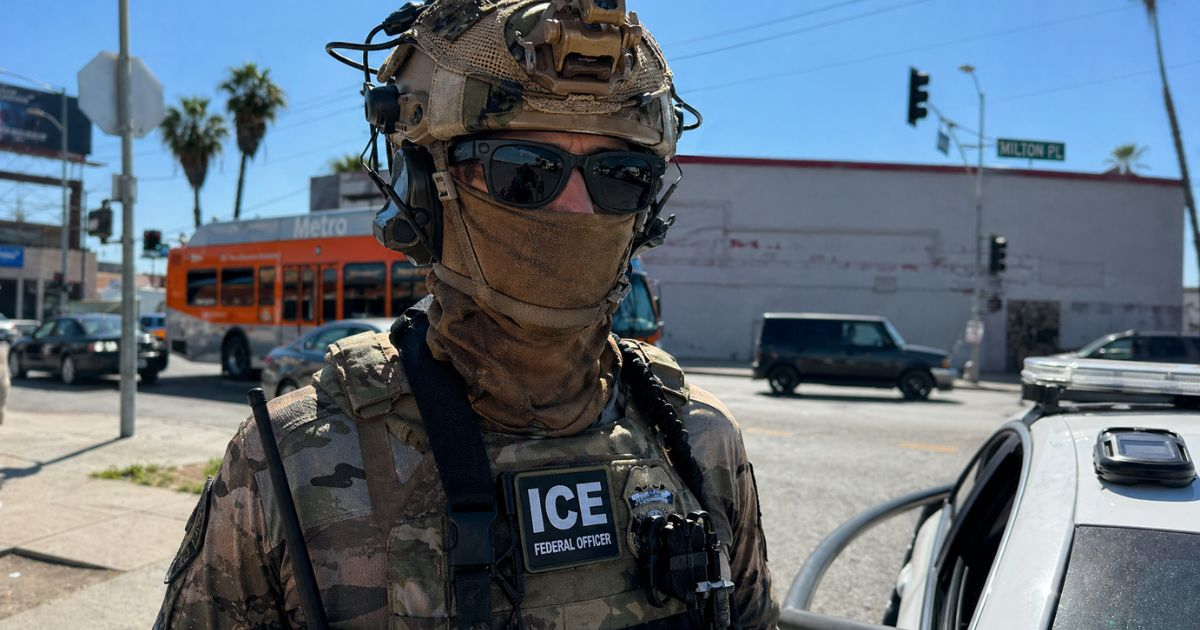
Independent journalist Ken Klippenstein has uncovered budget documents revealing that the U.S. Department of Homeland Security (DHS) is working on developing smart glasses equipped with facial recognition technology for Immigration and Customs Enforcement (ICE) agents. These glasses are designed to identify individuals in real time on the streets.
The leaked documents detail plans for operational prototypes that would allow ICE agents to access extensive federal biometric databases—encompassing facial recognition, gait analysis, and iris scans—targeting individuals who have not been arrested or charged with any crime.
"The project aims to deliver innovative hardware, such as operational prototypes of smart glasses, providing agents with real-time access to biometric identification capabilities in the field," the leaked budget document states.
The initiative is funded with a budget of $7.5 million under the DHS Directorate of Science and Technology's fiscal year 2027 spending plan, with a prototype delivery date set for September 2027.
The smart glasses would interface with the Automated Biometric Identification System (ABIS)
This technology operates bidirectionally: not only identifying individuals by comparing them to existing databases, but also secretly recording them for potential inclusion in new domestic watchlists. An anonymous DHS attorney warned Klippenstein that the project's true scope extends far beyond immigration: "Though it may be portrayed as a tool for identifying undocumented immigrants, the reality is that this advancement affects all Americans, particularly protesters." This concern is underscored by documented incidents. In January 2026, an ICE agent in Maine photographed a legal observer during a deportation operation, telling her, "We have a nice database... you're now considered a domestic terrorist." Such surveillance tactics against activists and legal observers have already raised alarms. In October 2025, the specialized media outlet 404 Media reported that ICE agents were scanning faces on the street to verify citizenship, without warrants or probable cause. ICE currently uses the Mobile Fortify app, enabling agents to access a database of over 1.2 billion facial images in the field. The new smart glasses would represent a significant technological leap by discreetly integrating this capability into the agent's line of sight. This infrastructure has direct military origins. The HIIDE system, used by troops in Iraq and Afghanistan to capture fingerprints, iris scans, and facial photos during patrols and checkpoints, fed into the same ABIS now being repurposed for domestic use in the United States. In January 2026, FBI Director Kash Patel announced that the agency had "doubled intelligence production" at its Threat Detection Center, noting "markedly increased biometric matches," aligning with the expansion of federal surveillance capabilities. Despite Congress being briefed on the project, no lawmakers—including Homeland Security Committee leaders Bennie Thompson, Rand Paul, Andrew Garbarino, and Gary Peters—have made public statements, a silence that concerns civil rights organizations already litigating against DHS for unconstitutional surveillance. On February 23, 2026, the organization Protect Democracy filed the lawsuit Hilton v. Noem et al. against DHS, ICE, and officials like Secretary Kristi Noem, alleging unconstitutional surveillance and First Amendment violations. Klippenstein summed up the situation with a biting remark: "The only joke here is Congress." The smart glasses are intended to enable ICE agents to identify individuals in real time by accessing extensive federal biometric databases, including facial recognition, gait analysis, and iris scans. Civil rights groups are worried that the technology extends beyond immigration control, potentially affecting all Americans, especially protesters, and infringing on constitutional rights through increased surveillance. The technology draws from military systems like HIIDE, which was used in conflict zones to capture and analyze biometric data, now being adapted for domestic use in the U.S.Understanding ICE's Facial Recognition Technology
What is the purpose of the smart glasses being developed for ICE agents?
Why are civil rights organizations concerned about this technology?
How does the smart glasses technology relate to military systems?