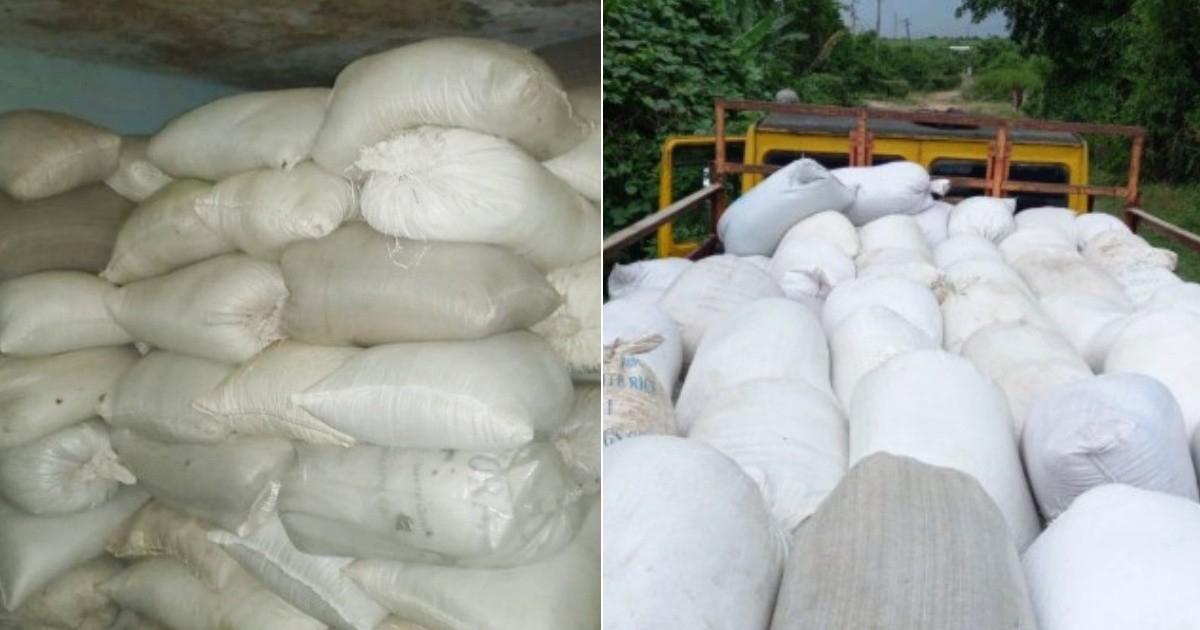
In Santiago de Cuba, law enforcement seized more than 270 sacks of coffee from a house in the locality of Chile, located in San Luis municipality, following complaints from neighbors about a "storage house" in the area.
The Facebook page "Héroes del Moncada," which supports the government, reported that police officers searched the residence and confiscated the coffee sacks. The owners were unable to provide legal documentation for the origin of the product.
Authorities concluded that those involved were engaged in hoarding and speculation, intending to distribute the coffee throughout the province and sell it at inflated prices on the black market.
Public Outcry and Criticism
The coffee seizure has sparked widespread debate on social media platforms. Many Cubans are questioning the rationale behind such actions amid a severe structural crisis that the government itself has not addressed. An online commenter highlighted, "The State fails to provide coffee in official stores but intervenes when someone tries to sell it independently."
Another user remarked, "At least this way, people could have coffee because it's practically unavailable through official channels."
Underlying Issues and Distrust
Critics also point to the root of the issue. "That coffee was likely bought from farmers. If it's not stolen, why is it being seized?" questioned a user. Another added, "Many farmers don't receive timely payments, so they sell independently to survive."
There is also skepticism about what happens to the confiscated coffee. A commentator warned, "That coffee never reaches the people; it ends up elsewhere or at higher prices." Many agreed that "seizures don’t solve the core problem: lack of production and distribution."
Seizure Patterns and Economic Context
This operation closely follows another incident where over 100 sacks of coffee were seized in Las Tunas, hidden among charcoal sacks in a truck from Santiago de Cuba.
Both cases reflect a recurring pattern: coffee, almost absent from state markets, is sourced directly from farmers and redirected to the informal market at prohibitive prices. In this market, coffee can fetch between 1,500 and 1,800 Cuban pesos per 500 grams.
The production context exacerbates public perception. Santiago de Cuba managed only 65% of its coffee plan for the 2024-2025 harvest, and nationally, Cuba met just 23.7% of its target in the first half of 2025, according to the Minister of the Food Industry.
The issues are structural: a mass exodus of young people from mountainous areas, delayed payments to producers, and logistical failures.
Coffee seizures have grown more frequent in recent years. In September 2023, police confiscated 26 sacks from a home in Segundo Frente, also in Santiago de Cuba. In March 2025, two individuals were detained with 1,300 pounds of coffee in a stolen car, and in May of the same year, another pair was arrested for transporting over 1,000 pounds without documentation.
Meanwhile, in the first quarter of 2026, Santiago de Cuba exported 370 tons of coffee worth 72 million pesos, while the product remains absent from local stores. As one internet user succinctly put it, "The real problem is structural: scarcity, low wages, and poor distribution," summarizing the feelings of many Cubans witnessing police operations against coffee that never reaches their cups.
Understanding Coffee Seizures in Cuba
Why is coffee being seized in Cuba?
The government seizes coffee to combat hoarding and speculation, as individuals attempt to sell it at inflated prices on the black market.
What are the underlying causes of the coffee shortage?
The shortage is due to structural issues like mass youth migration from rural areas, delayed payments to farmers, and logistical inefficiencies.
What happens to confiscated coffee in Cuba?
There is public skepticism about the fate of confiscated coffee, with concerns it does not reach the public and is instead sold through other channels at higher prices.