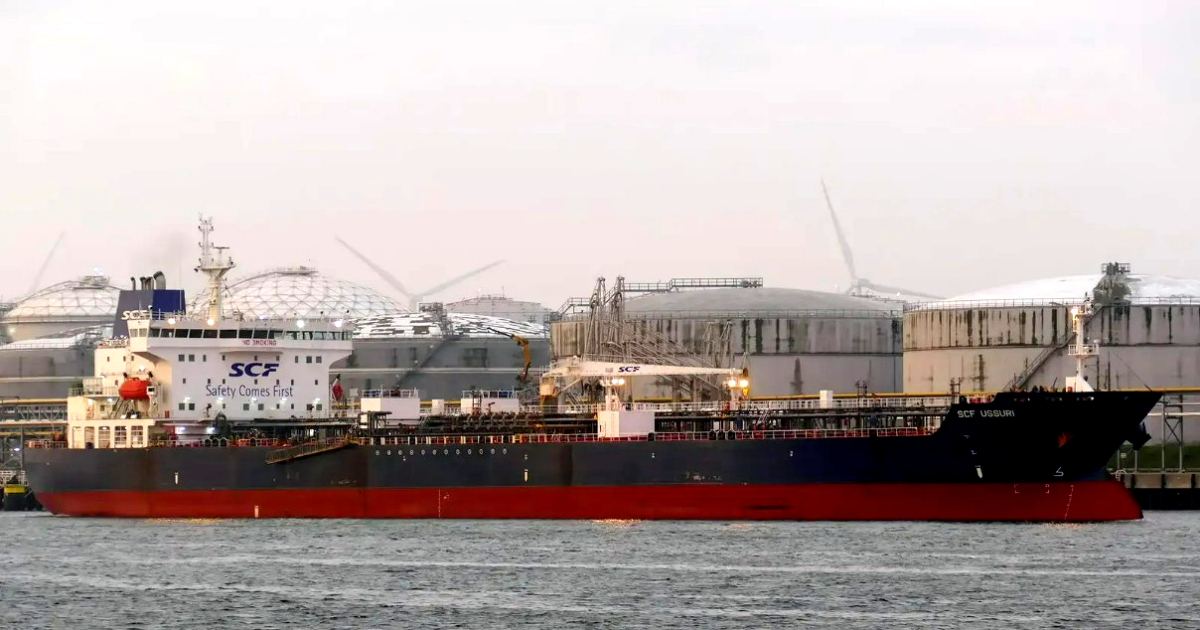
The Russian tanker Universal, which is sanctioned by the United States, European Union, and United Kingdom, has sparked uncertainty as its tracking data adds confusion about its final destination amid an increasingly critical energy situation in Cuba.
According to marinetraffic.com, the tanker was last recorded just 21 hours ago at coordinates 31.077833 N, -51.449000 W, in the North Atlantic. This location places it roughly 3,175 kilometers (1,714 nautical miles) from Havana, suggesting several days of travel remain before reaching the island.
However, what's drawing more attention is not just the tanker’s location but its course. The AIS system shows the Universal traveling at 3.4 knots (about 6.3 km/h) on a heading of 323 degrees, indicating a northwesterly path with a slight northern tilt.
This trajectory does not directly lead to the Caribbean or Cuba, suggesting a path that, for now, diverges from a direct route to the island.
If the vessel were to adjust its heading to sail straight to Havana at a constant 3.4 knots, it would hypothetically cover the approximately 1,714 nautical miles in about 504 hours, translating to around 21 days of continuous navigation. This is a speculative estimate, not accounting for speed changes, ocean currents, or typical operational maneuvers during such voyages.
Geopolitical Tensions and Energy Supply Questions
This course alteration or ambiguity emerges at a pivotal time. Russian authorities have recently reiterated their commitment to sending oil to Cuba, confirming that the Universal carries a second shipment following the Anatoly Kolodkin's arrival in March.
Despite this, energy experts have noted that these shipments only meet seven to ten days of the island's consumption, significantly below actual needs.
Moreover, earlier estimates predicted the Universal's entry into the Caribbean—and potentially Cuba—around April 29, a timeline now in question given its current course and reduced speed, raising doubts about meeting that schedule.
Potential Geopolitical Influences
Considering recent U.S. regulations, a geopolitical factor might be influencing the uncertainty surrounding the Universal's destination. OFAC's General License 134A explicitly prohibits Cuba from engaging in transactions involving Russian oil under U.S. jurisdiction, and past incidents like the Sea Horse's diversion suggest indirect pressure from Washington may influence maritime routes.
Although the Trump administration temporarily allowed the Anatoly Kolodkin's arrival for humanitarian reasons, this was a specific political decision and not a broader change in sanctions policy.
Some analysts speculate that the United States may have sent signals—direct or indirect—to halt or condition the Universal's offloading, potentially explaining the lack of a declared destination and its erratic behavior in the Atlantic.
Cuba's Deepening Energy Crisis
Meanwhile, Cuba's energy crisis has worsened to unprecedented levels. The government admits to having fuel to meet only 50% of demand, while blackouts continue to affect millions of citizens.
The island's near-total reliance on Russian crude, following Venezuela's supply collapse and Mexico's sales suspension, has left the country in an extremely vulnerable position.
Additionally, the recent drop in Russian oil production, the largest in six years, could threaten Moscow's ability to sustain these shipments over time.
In this context, the Universal's behavior becomes strategically significant. The absence of a declared destination, its slow speed, and a route not clearly directed at the Caribbean fuel doubts about whether the tanker is indeed heading to Cuba, adjusting its course for operational reasons, or facing some form of maritime pressure or restriction.
At present, the tanker's path remains an open question. For Cuba, each hour of uncertainty in the Atlantic translates to increased pressure on an unyielding energy crisis.
Key Questions on the Universal Tanker's Journey
Why is the Universal's course raising concerns?
The Universal's current heading does not align with a direct route to Cuba, raising suspicions about its final destination amid Cuba's severe energy crisis.
What are the potential geopolitical factors influencing the Universal's journey?
U.S. sanctions and regulations, particularly OFAC's General License 134A, may be impacting the Universal's course, possibly due to indirect pressure from Washington.
How does the Universal's cargo impact Cuba's energy situation?
The Universal carries Russian oil, which is crucial for Cuba given its current energy shortages, but the shipment covers only a fraction of the island's needs.
What challenges could affect the timely arrival of the Universal in Cuba?
The ship's slow pace, uncertain heading, and geopolitical pressures could delay its arrival, potentially exacerbating Cuba's energy crisis.