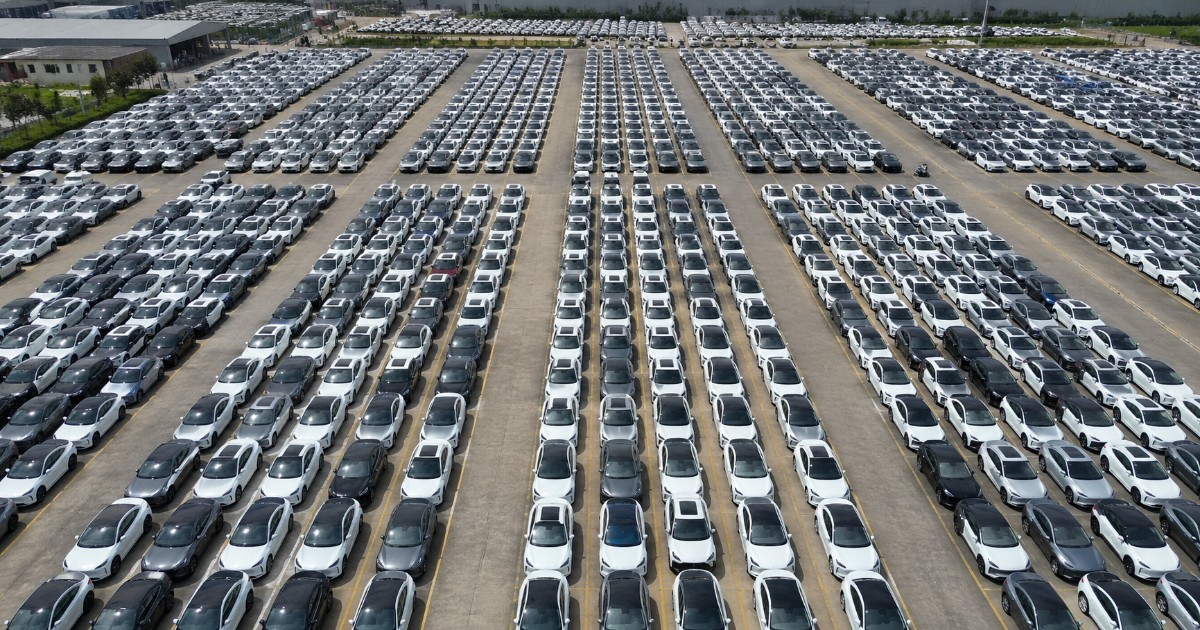
For the first time in history, China is on the verge of surpassing the 60% threshold in monthly penetration of new energy vehicles. According to the China Passenger Car Association's estimates released this Monday, retail sales of these vehicles are anticipated to hit about 860,000 units in April, marking a record-breaking 60.6% penetration rate.
This statistic is striking not because of a booming market, but quite the opposite: total passenger car sales in April are estimated at just 1.42 million units, a 13.8% decline from March. In essence, the rise in electric and plug-in hybrid vehicles is not driven by market expansion, but rather by the quicker decline of internal combustion engine cars.
The association candidly acknowledged this trend, stating, "The moderate macroeconomic recovery has not immediately translated into a strong rebound in high-value goods consumption, and the upward pressure on oil prices continues to strain the combustion vehicle market."
Market Trends and Auto China 2026
The first quarter of 2026 already hinted at this pattern: total passenger car sales dropped 17.4% year-on-year to 4.226 million units, despite a 5% growth in China's GDP during the same period.
This market milestone coincides with the Auto China 2026 event in Beijing, the largest auto show globally by scale, setting a record with 380,000 square meters across two venues, showcasing 1,451 vehicles, and featuring 181 world premieres.
Over 80% of the vehicles displayed at the show are new energy models, a clear indication of the industry's direction. BYD showcased its four brands, demonstrating rapid charging capabilities from 20% to 97% in just 12 minutes under freezing conditions. The Dongfeng and Huawei alliance introduced the Yijing X9, a luxury electric SUV with native Huawei ecosystem integration. Xiaomi presented the SU7 Ultra and its Vision Gran Turismo concept.
Shifting Competitive Landscape
The focus of competition is dramatically shifting in the Chinese automotive market, moving away from price wars to product strength, according to the association. This shift is being felt in Europe as well. Consultancy firm Horváth reports that Chinese brands now hold over a 10% market share in Norway, the UK, and Italy, and account for nearly 14% of the European battery electric vehicle market. "One in two European consumers is open to purchasing a Chinese car as their next vehicle," noted Georg Mrusek, an automotive expert at Horváth during the show.
The interest in electric vehicles is not limited to China. Tensions with Iran have heightened interest in electric vehicles in the United States, where rising fuel prices are driving consumers toward alternatives.
China’s trajectory is undeniable: from a 6.3% penetration rate in 2020, to 47.9% annually in 2024, surpassing the 50% monthly mark in July of that year, and now aiming to close 2026 with an annual penetration rate near 60%, with domestic new energy vehicle sales projected between 16 and 16.5 million units.
The Auto China 2026 event opens its doors to the public this Tuesday, April 28.
FAQs on China's Electric Vehicle Market
Why is there a decline in total car sales even though electric vehicle sales are increasing?
The increase in electric vehicle sales is primarily due to the faster decline of internal combustion engine vehicles, rather than an overall market growth.
What factors are influencing the shift from price-based competition to product strength in the Chinese automotive market?
The shift is influenced by the growing demand for technologically advanced and more environmentally friendly vehicles, as well as the need for differentiation beyond price.
How are Chinese automotive brands performing in the European market?
Chinese brands have captured over 10% of the market share in countries like Norway, the UK, and Italy, and represent nearly 14% of the battery electric vehicle market in Europe.