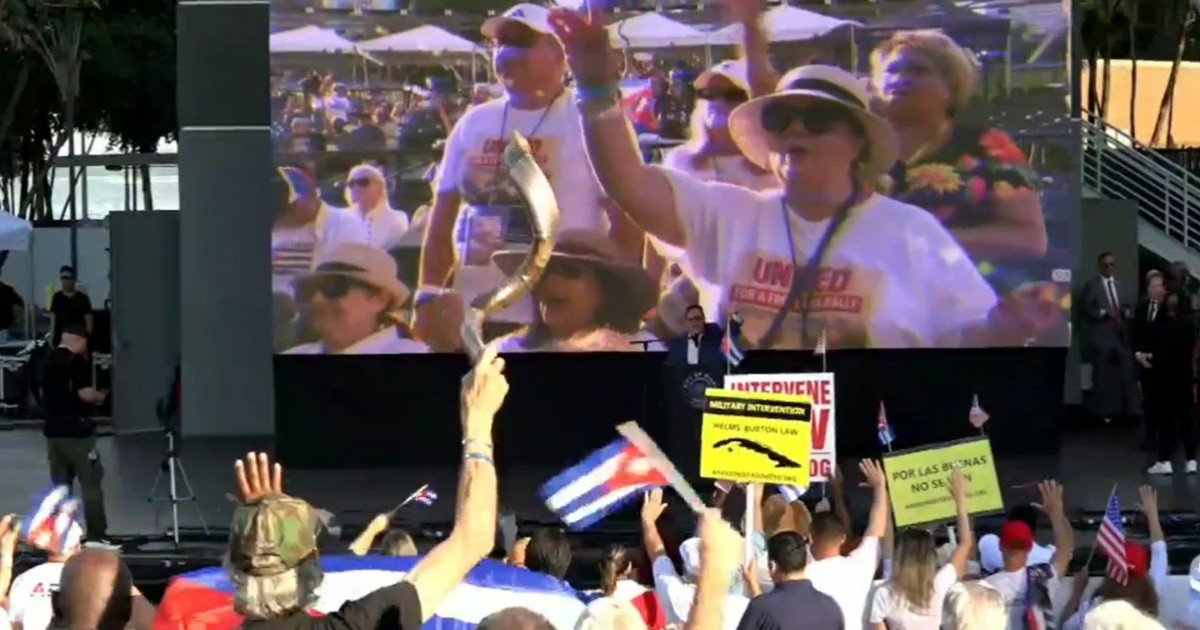
Braving the rain, Cuban exiles gathered at the FPL Solar Amphitheater in Bayfront Park, Miami, for the "United for a Free Cuba" event. The assembly, organized by the Support and Call Committee in collaboration with the Cuban Resistance Assembly (ARC), was a day dedicated to prayer, activism, and unity.
The event, held from 5:00 p.m. to 8:00 p.m. at 301 Biscayne Boulevard, brought together exile leaders, activists, religious figures, and artists. Organizers described it as a collective plea for Cuba's freedom, marking the second major exile mobilization in South Florida in less than a month, according to Telemundo.
Orlando Gutiérrez-Boronat, executive secretary of the ARC, emphasized the political stance of the gathering: "We support a strong and firm policy against the regime and seek real change. Real change means the exit of the Castro family and the Communist Party from power."
He also highlighted the spiritual and hemispheric nature of the event: "We are asking God to empower the Cuban people for the ultimate change, for the liberation of Cuba. This is being done in solidarity with our brothers and sisters in Cuba who are praying, as well as with various Latin American countries."
The official statement from the organizers encapsulated the essence of the event: "This call to prayer unites participants in a shared request for the liberation of the Cuban people from communism and the restoration of freedom, faith, and human dignity."
Notable attendees included activists Silvia Iriondo and Rosa María Payá, alongside Alex Otaola, Nissim Elnecavé, Father Juan Lázaro Vélez, and Pastor Alex Bosa.
The program also featured performances by musicians Kamankola, Raudel Escuadrón, and Amaury Gutiérrez, blending cultural expressions with moments of reflection and protest.
This demonstration was mirrored simultaneously in churches across Cuba and in other countries with Cuban diaspora communities, such as Uruguay, Costa Rica, the Dominican Republic, Chile, and Mexico.
The event received backing from Commissioner Miguel Ángel Gabela, who was described by organizers as "instrumental in coordinating and facilitating this event with community leaders, along with the City of Miami Commission."
This gathering is part of a wave of mobilizations spurred by the worsening crisis on the island. On March 24, the Free Cuba Rally brought exiles together in Hialeah with figures like José Daniel Ferrer and artists such as Yotuel and Jacob Forever.
On March 2, the ARC and Steps of Change—led by Payá—signed the "Liberation Agreement" in Miami, proposing a three-phase plan—liberation, stabilization, and democratization—for Cuba's political transition, including the immediate release of over 1,000 political prisoners and internationally supervised free elections.
Bayfront Park was also the scene of a major demonstration for Cuba's freedom in August 2021, following the historic protests of July 11 that year.
The backdrop is grim: according to Prisoners Defenders, Cuba recorded a peak of 1,250 verified political prisoners in March 2026, with a total of 2,026 since July 2021. Just two days before the event, the regime rejected a U.S. ultimatum to release political prisoners during bilateral talks.
Key Insights on Cuban Exile Mobilization
What was the purpose of the "United for a Free Cuba" event?
The event aimed to unite Cuban exiles in a collective plea for Cuba's freedom, combining activism, prayer, and cultural expressions to demand change from the current regime.
Who organized the event at Bayfront Park?
The "United for a Free Cuba" event was organized by the Support and Call Committee alongside the Cuban Resistance Assembly (ARC).
What significant message was conveyed by Orlando Gutiérrez-Boronat?
Orlando Gutiérrez-Boronat stressed the need for a firm policy against the Cuban regime and advocated for real change, including the removal of the Castro family and the Communist Party from power.