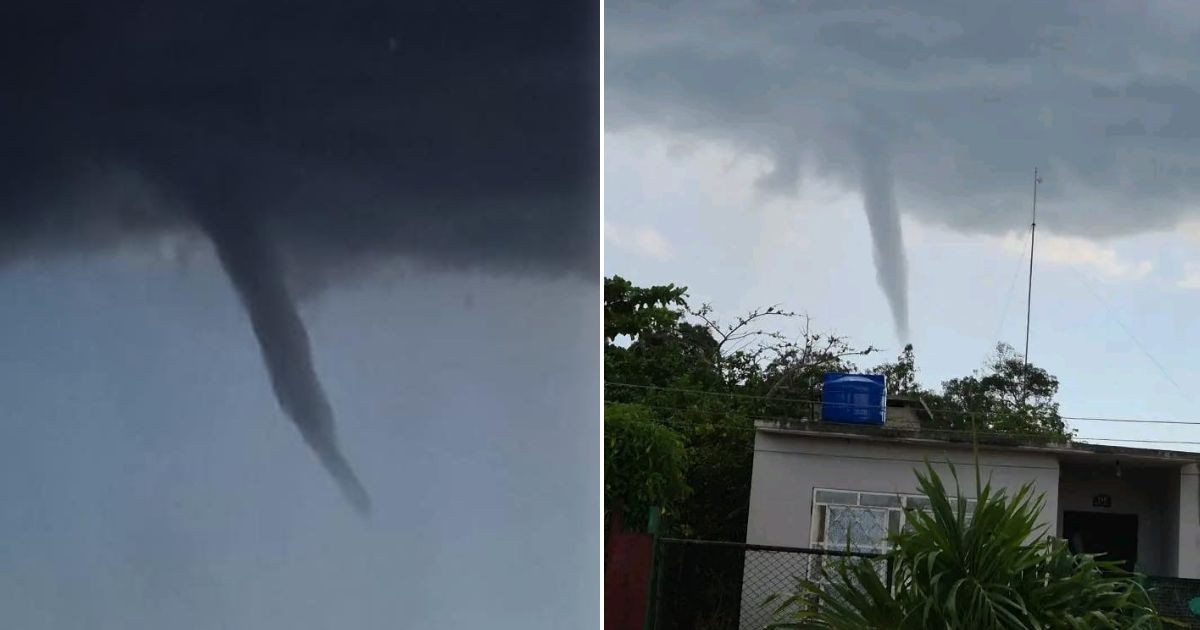
This past Sunday, funnel clouds, also referred to as elevated waterspouts or "tails of clouds," were spotted over the provinces of Ciego de Ávila and Las Tunas. This occurrence was reported on social media by meteorologist Raydel Ruisánchez.
The images, taken by meteorologists Frank Fernández Castañeda and Alexey Moreno Borges, were shared on Facebook as a weather alert to inform the public. Fortunately, these funnel formations did not make contact with the ground, posing no immediate threat to residents in the affected areas, according to the specialists' report.
Weather Alert in Ciego de Ávila
In Ciego de Ávila, the funnel cloud was observed south of the city shortly before 5:30 PM. Orelvis Peraza captured the photographs from the vicinity of Pedro Martínez Brito Park and shared them with Roberto Delgado Mejías.
Ángel Miguel Lago Torres elaborated that this phenomenon, often called a "tail of a cloud," occurs when the funnel cloud does not extend to the ground, thereby posing no danger on the surface.
Atmospheric Conditions Behind the Phenomenon
The parent cloud was identified as a cumulonimbus, a type formed through convection that can lead to rainfall and occasionally severe thunderstorms. Ruisánchez attributed the atmospheric instability to the presence of a trough, combined with daytime heating and local-scale factors.
Such events are not new to Cuba. In 2025, elevated waterspouts were recorded in several provinces, including south of Guanajay in Artemisa, south of Havana, in Mantua, Pinar del Río, and north of Güira de Melena.
Historical Context and Future Outlook
Additionally, a marine waterspout was seen at Isla de la Juventud beach, and a thunderstorm in Camagüey led to the formation of a funnel cloud in March 2025. These phenomena precede Cuba's official rainy season, starting May 1st, which accounts for approximately 80% of the nation's annual rainfall.
April 2025 had been notably dry in Ciego de Ávila, with rainfall below 30% of average levels. However, the province is now experiencing pronounced atmospheric instability. Ruisánchez cautioned that such events are likely to become more frequent in the upcoming months as the rainy season officially begins on May 1st.
Understanding Funnel Clouds in Cuba
What causes funnel clouds to form in Cuba?
Funnel clouds in Cuba are primarily caused by atmospheric instability due to troughs, daytime heating, and local-scale meteorological factors.
Are funnel clouds dangerous if they don't touch down?
If funnel clouds do not touch down, they are not dangerous, as they do not pose a threat on the ground.
When does Cuba's rainy season start?
Cuba's rainy season officially begins on May 1st and accounts for about 80% of the country's annual precipitation.