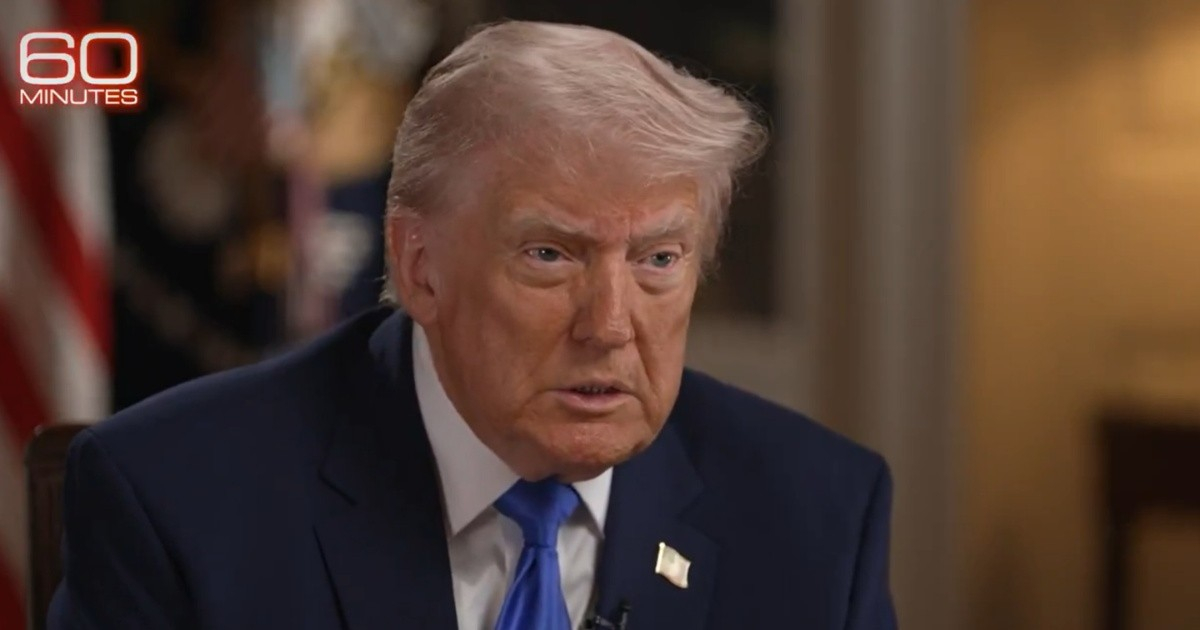
On Sunday, Donald Trump admitted that he was a hindrance to the Secret Service's response during the shooting at Saturday's White House Correspondents' Dinner because he wanted to see the situation unfold before agreeing to be evacuated.
"Well, part of what happened was my fault. I wanted to see what was going on. And I wasn't making it easy for them. I needed to see what was happening," the president stated in an excerpt from his interview with Norah O'Donnell for CBS News' 60 Minutes, broadcasted this Sunday.
The incident took place on Saturday night at the Washington Hilton hotel in Washington D.C., during the 105th Annual White House Correspondents' Dinner. Cole Tomas Allen, aged 31, stormed the security checkpoint armed with a shotgun, a pistol, and knives, firing between five and eight shots near the metal detectors.
In the aftermath, Trump responded firmly from the White House, joking, "Nobody told me this job was so dangerous."
During the interview, Trump explained that initially, he was unsure if the gunfire was serious or just "the usual ballroom noise, which you hear all the time."
"By then, we began to realize that it might be a serious issue […] and different from the usual ballroom noise," he added.
The president described how he delayed the agents by saying, "Wait a minute. Hold on. Let me see, hold on," which he acknowledged led them to act "a bit slower."
According to the data shared in the interview, the Secret Service took about 10 seconds to surround Trump and 20 seconds to escort him out of the ballroom, where between 2,000 and 2,600 people were present.
Trump recounted walking upright for much of the evacuation before agents instructed him to get down. "So I got down, and the First Lady got down too," he said.
The attacker was quickly neutralized and detained before reaching the main ballroom. A Secret Service agent was injured, struck on his bulletproof vest, but is expected to make a full recovery. There were no fatalities or civilian injuries.
Trump, First Lady Melania Trump, Vice President JD Vance, Secretary of State Marco Rubio, and other officials were evacuated unharmed. Rubio shared an iconic photo from the Oval Office after returning to the White House.
This event marked the first time Trump attended the Correspondents' Dinner as the sitting president, a gathering he had boycotted during his first term. He announced his attendance in March 2026 "in honor of the Nation's 250th anniversary."
The incident is seen as the third assassination attempt on Trump in less than two years, following those in Butler, Pennsylvania, on July 13, 2024, and West Palm Beach, Florida, on September 15, 2024.
Allen had authored a manifesto calling himself the "Friendly Federal Assassin," criticizing the Trump administration's policies, and targeting officials "from highest to lowest rank." A family member alerted authorities after receiving the document. Formal charges against Allen—assaulting a federal officer and using a firearm in a violent crime—were expected to be filed Monday.
Key Details and Questions about the White House Correspondents' Dinner Incident
What was Trump's reaction to the shooting during the Correspondents' Dinner?
Trump admitted he made it difficult for the Secret Service because he wanted to witness the situation before being evacuated. He later joked about the dangers of the job.
Who was the attacker at the White House Correspondents' Dinner?
The attacker was Cole Tomas Allen, a 31-year-old who entered armed and fired shots at the event's security checkpoint.
Were there any casualties during the shooting at the Correspondents' Dinner?
No fatalities or civilian injuries occurred. A Secret Service agent was injured, but they are expected to recover fully.