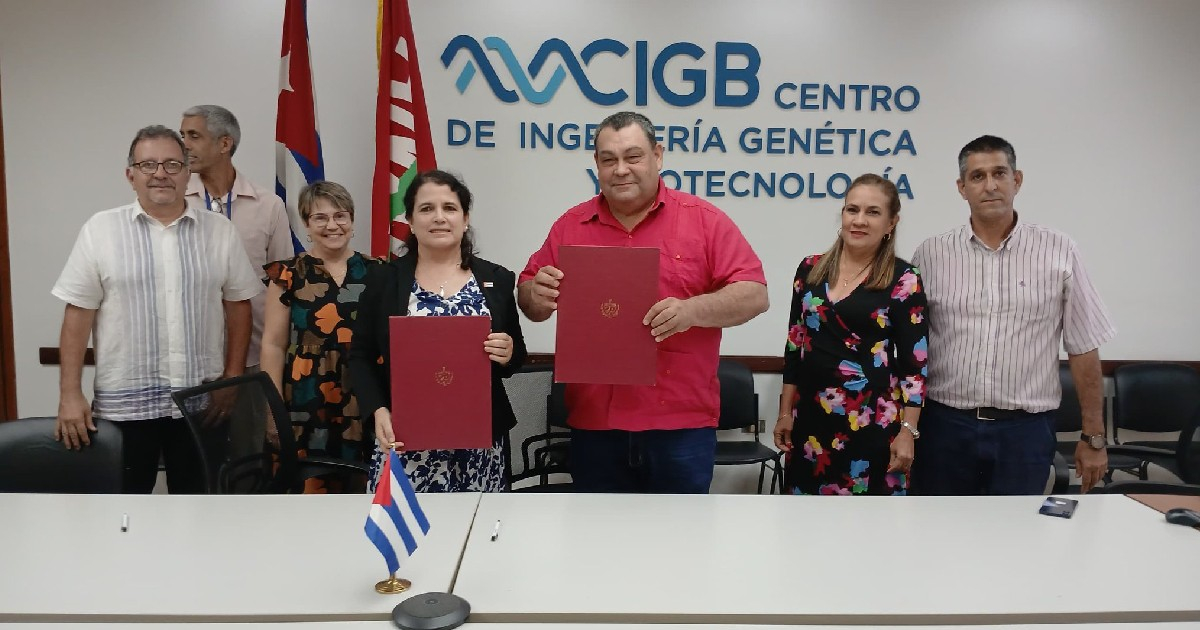
The National Association of Small Farmers (ANAP) and the Center for Genetic Engineering and Biotechnology (CIGB) formalized an updated Work Agreement last Friday in Havana. The agreement, set to last for the next five years, aims to "enhance the quality and yield of food production for the people."
The signing ceremony was led by Dr. Marta Ayala Ávila, CIGB's general director and a member of the Party's Political Bureau, along with Félix Duartes Ortega, ANAP's national president and a member of the Council of State. They signed the agreement at the scientific institution's headquarters.
According to the report from the ACN, the agreement intends to utilize biotechnological advancements in the cooperative farming sector to reduce imports, boost agricultural yields, and support veterinary work. However, Cuba has a long history of signing agreements, launching plans, and celebrating congresses, all while its food production continues to decline.
The signing event revealed a candid admission: Juan Guerra Gómez, an ANAP official, admitted that the CIGB's products "are still underutilized in the fields." In other words, while products exist and agreements are signed, the reality in the fields remains unchanged.
Historical Challenges in Cuban Agriculture
Such agreements are not novel. For decades, ANAP has been drafting strategies to strengthen ties with scientific institutions and universities in the country. The outcomes of these strategies are evident in recent official statistics: root vegetable production fell by 44% in 2023 compared to previous years, pork meat plummeted by 93.2%, egg production decreased by 43%, and cow's milk production dropped by 37.6%, according to official data.
Rice, a staple of the Cuban diet, exemplifies the gap between plans and reality. Cuba produces only 80,000 tons against an annual demand of 600,000 tons, meeting just 13% of the national demand according to 2024 data. Yield per hectare has dropped from four to six tons in the late 2010s to merely 1.7 tons in recent figures.
Economic and Social Impact
Over 80% of the food consumed in Cuba is imported, costing approximately $2 billion annually—an unsustainable amount for a collapsing economy.
The social landscape is dire. The Food Monitor Program reports critical food insecurity levels in five provinces: Havana, Matanzas, Cienfuegos, Guantánamo, and Santiago de Cuba. By August 2025, 96.91% of Cubans had lost access to food due to inflation.
Political and Strategic Responses
ANAP's recent track record does not inspire confidence. During the XIII ANAP Congress in May 2025, the disappearance of 49 Agricultural Production Cooperatives and 65 Credit and Service Cooperatives since the previous congress was acknowledged. Meanwhile, Duartes Ortega urged farmers to "grow more with less."
In that same congress, President Miguel Díaz-Canel scolded farmers, pointing out "excessive idle land," as if the lack of fertilizers, fuel, and tools were the fault of those working the land empty-handed.
The regime has addressed the agricultural crisis with a slew of empty announcements. In February 2026, Díaz-Canel reintroduced the "Zero Option," a 1990s contingency plan that relies on local self-sufficiency using animal traction. In April, the government declared the end of the Acopio company's monopoly, with governors managing local production balances. Now, a new biotechnology agreement is added to the collection.
As appointed officials from both sides prepare to "oversee the agreement's implementation" and set up "monitoring programs with indicators," millions of Cubans continue to search desperately for food. The agreement is valid until 2031, but the arrival of root vegetables, fruits, and grains remains undetermined.
Frequently Asked Questions about Cuban Agriculture and Food Security
What is the main goal of the agreement between ANAP and CIGB?
The primary objective of the agreement is to improve the quality and yield of food production in Cuba using biotechnological advancements.
How much of its food does Cuba import?
Cuba imports over 80% of its food, costing around $2 billion annually.
What are the current challenges facing Cuban agriculture?
Cuban agriculture faces challenges such as reduced food production, underutilization of biotechnological products, and a significant gap between production and demand, particularly for staple foods like rice.