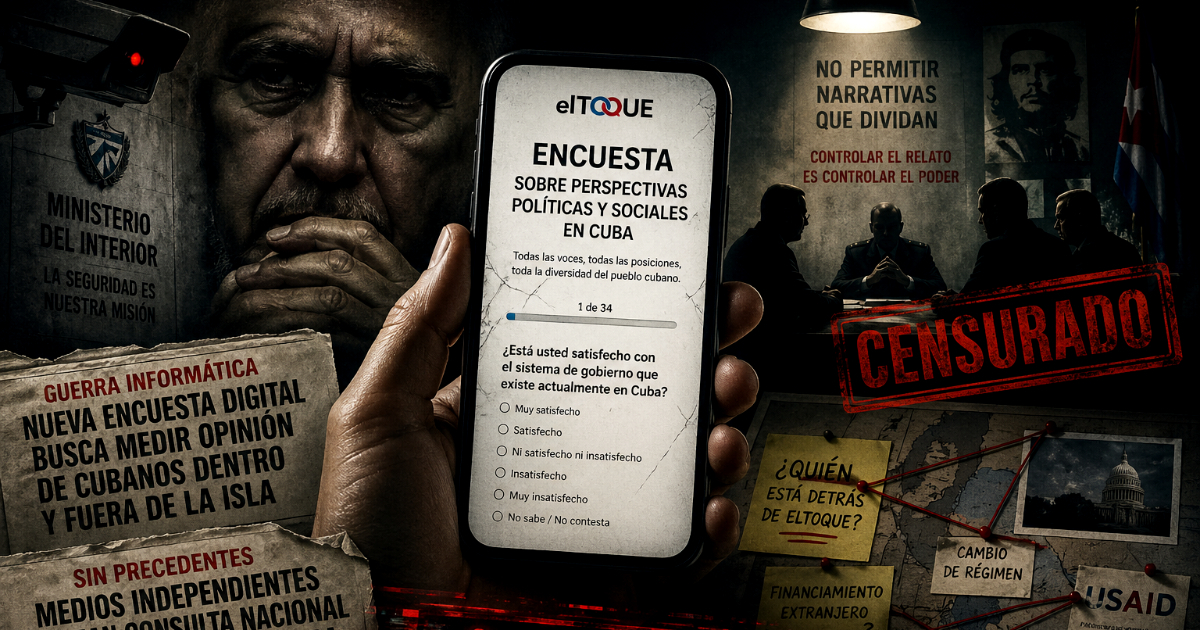
A survey launched by independent Cuban media has triggered an immediate backlash from the regime's ideological machinery, even before its initial findings have been made public.
The media offensive leaves no room for doubt: this initiative has struck a sensitive nerve in the state's control over public opinion.
The effort, led by the independent outlet elTOQUE along with over 20 civil society groups, aims to gather the perspectives of Cubans both on and off the island regarding crucial issues such as the political system, the economy, the role of the exile community, and potential transitional scenarios.
This open, digital, and participatory survey attempts to fill a noticeable gap: the lack of independent studies on what Cubans truly think.
State Information Monopoly
In a nation where the government monopolizes information and prohibits free measurements of political opinion, such exercises—although statistically imperfect—acquire significant value as a social barometer.
Nevertheless, the official response was swift. The website Razones de Cuba, linked to State Security, published an extensive article labeling the survey as a "statistical fraud," "informational warfare operation," and "propaganda stunt."
The most surprising aspect is not the tone, which is typical for such platforms, but the timing: the attack occurred before any results were released. In other words, the regime is not challenging specific data but the mere possibility that such data could influence public discourse.
Discrediting Before Measuring
The regime's central argument hinges on methodological criticisms: the survey relies on voluntary participation, internet access, and does not guarantee classical statistical representativeness. These criticisms have some basis in reality. It is neither a probabilistic sample nor a traditional study.
However, the official narrative takes a significant leap: it transforms these limitations into an outright disqualification. According to Razones de Cuba, any results will be deemed invalid by definition.
This line of reasoning is not aimed at enhancing the methodological debate but rather at shutting it down. Instead of discussing the study's scope and limitations, the regime chooses to deny its legitimacy from the outset.
The Battle for Narrative Control
Simultaneously, the article constructs a classic political narrative: it portrays elTOQUE as an entity serving foreign interests and frames the survey as part of an alleged strategy to counter an officialist mobilization called "Firma por la Patria."
The regime's reaction exposes a deeper concern: who has the right to interpret what the Cuban people think. For decades, the state has maintained an almost absolute monopoly over that narrative, supported by political control mechanisms and a lack of transparency.
In this context, an independent survey—despite its imperfections—introduces a disruptive element. It allows data, perceptions, and nuances to emerge outside official channels.
The official text insists on contrasting the "real street" with "digital manipulation." However, it omits a key factor: many public mobilizations in Cuba are organized or overseen by state structures, limiting their value as spontaneous expressions of popular will.
Between a Barometer and Propaganda
It's true that the survey faces significant challenges: self-selection bias, unequal internet access, and differences between Cubans inside and outside the country. Its results should be interpreted cautiously.
But this doesn't automatically render it propaganda. In the absence of free surveys within Cuba, such initiatives can provide valuable insights into trends, perceptions, and levels of discontent or support.
The regime's response, on the other hand, fits a propaganda logic: discredit the source, question the context, and anticipate conclusions without evidence.
Ultimately, the controversy sends a clear signal. Despite its limitations, the survey has achieved something rare in the Cuban ecosystem: opening a crack in the control of discourse over public opinion.
And the official reaction suggests that this crack, however small, generates unease.
Understanding the Cuban Regime's Reaction to Independent Surveys
Why did the Cuban regime react to the survey before results were released?
The regime reacted preemptively because the survey challenges its control over public opinion. By attacking the legitimacy of the survey before any data is released, the regime aims to maintain its narrative dominance.
What criticisms did the Cuban government have about the survey?
The government criticized the survey for relying on voluntary participation, requiring internet access, and lacking traditional statistical representativeness, which they argue undermines its validity.
How does an independent survey disrupt the Cuban government's control?
An independent survey introduces data and perspectives that bypass official channels, thus challenging the government's monopoly on information and offering alternative insights into public opinion.