Cuban economist Rolando Luis Pérez Vizcaíno voiced a harsh critique on Saturday about the political stagnation he believes defines Cuba's current regime, accusing it of clinging to rhetoric disconnected from the harsh realities faced by its citizens.
In a thought-provoking post shared on the Facebook group "Economistas libres de Cuba," Pérez recounted an anecdote from the perestroika era in the Soviet Union. He recalled asking a professor at the Plekhanov Institute of Economics in Moscow to clarify the term "stagnation."
The professor used a metaphor about a train navigating towards its destination to illustrate the evolution of Soviet socialism. Under Vladimir I. Lenin (1870-1924), whenever the tracks ended, voluntary work was organized to lay more tracks and keep the journey going.
With Joseph Stalin (1878-1953), the same issue was addressed through forced labor. However, during Leonid Brezhnev's leadership (1906-1982), when the tracks ran out, the train stopped, and passengers were told to mimic the motions of travel. "That is stagnation," the metaphor concluded.
Disconnected Narratives
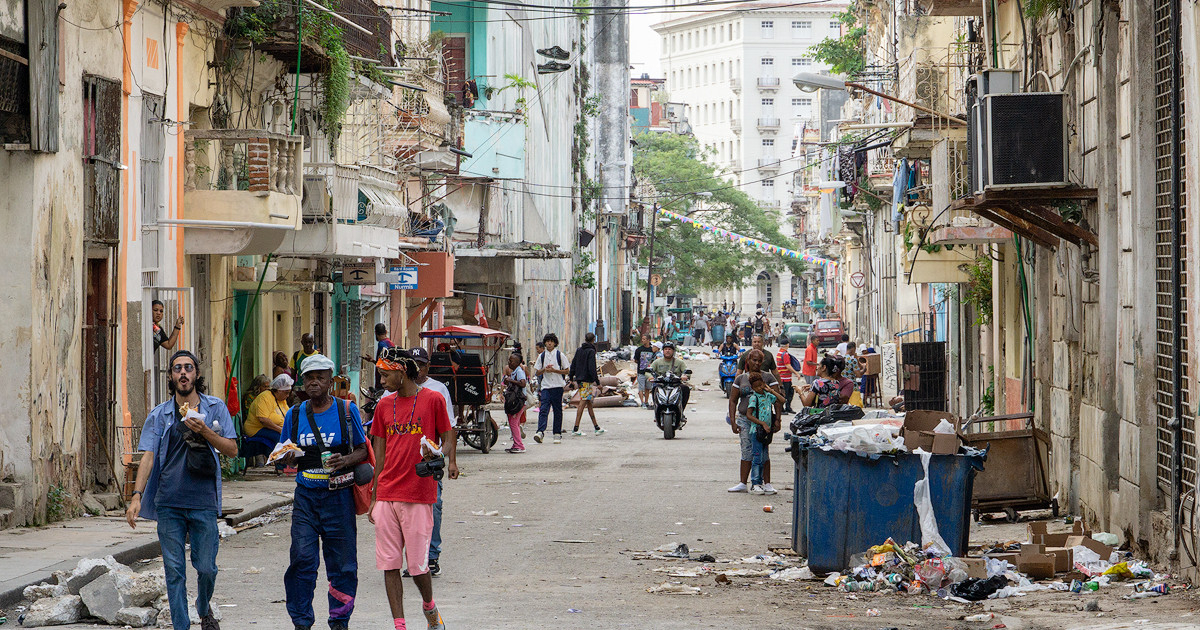
Pérez argued that this analogy aptly describes Cuba's current situation, where the regime continues to promote official narratives that do not align with the daily experiences of its people. He highlighted examples such as the regime's denial of political prisoners, the setting of long-term goals amid a deepening economic crisis, and a militaristic rhetoric that seems irrelevant to the country's real issues.
He also criticized the disconnect between state media messages and the everyday lives of Cubans, pointing out reports of scientific or technological progress while essential goods, including medications, remain in short supply.
Public Skepticism
The economist further condemned the official portrayal of political campaigns as enjoying massive public support, a claim that starkly contrasts with the observable reality. Examples included celebrating educational achievements amidst a crumbling school system, or showcasing material resources on state television that do not reflect the true state of public services.
In his conclusion, Pérez asserted that stagnation is about "projecting a virtual country that doesn't exist" while the populace grapples with economic and social deterioration.
The publication sparked numerous comments on social media, with many users echoing the criticism of the government's narrative and highlighting the disconnect between official discourse and life on the island.
One user, Juan Manuel, remarked, "Stagnation is still saying, after 67 years, that the embargo is to blame for our troubles."
Another commenter, Alexei Camejo, went further, calling it "a mummification of thought and reasoning." Meanwhile, Carlos Alberto Díaz Prieto added, "The government talks about past achievements to promise a glorious future, but the present is forgotten; it's only sacrifice, work, hunger, misery, and despair."
"Cuba's political stagnation is in its final phase. That's as far as that train goes," wrote Niuris Guerrero González, summarizing the Cuban people's true sentiment about a regime that promises a bright future decades away while the present collapses with nightly blackouts.
Energy Promises Amid Crisis
Recently, the Cuban regime unveiled an energy transition plan promising complete electrical sovereignty by 2050, despite the National Electrical System suffering at least seven collapses in the past 18 months and fuel reserves running low, only lasting until the end of April.
According to the Minister of Energy and Mines, Vicente de la O Levy, the goal is to achieve 24% renewable energy by 2030, 40% by 2035 to eliminate fuel imports, and 100% renewable energy by 2050.
This announcement was met with sarcasm and outrage reminiscent of Raúl Castro's unfulfilled promise of a glass of milk for every Cuban, made on July 26, 2007, in Camagüey, and still not realized nearly 19 years later.
Playwright Irán Capote captured the public's skepticism with irony, "What's another 25 years? Just a mere trifle! A quarter-century, no less!" He extended this logic to the plan, saying, "In 2050, we'll plan to eat and live off our salaries by 2075."
Meanwhile, President Miguel Díaz-Canel sticks to his script. In an April 21 interview with Brazilian media outlet Opera Mundi, he again blamed the U.S. embargo for all of Cuba's problems. "The blockade, I say this responsibly, is the main impact on the lives of Cubans," the president stressed, dismissing any political negotiations with Washington and labeling the embargo as "a noose around the neck" of the Cuban people.
However, the Cuban public doesn't buy this narrative. An independent survey conducted by a coalition of over 20 digital media outlets shows that 94% of respondents have no trust in the government. Díaz-Canel received the lowest individual rating, with a score of 1.11 out of five. Additionally, 75.1% support a transition to a liberal democracy with a market economy. Although the regime blocked access to the survey, Cubans managed to participate using VPNs.
Understanding Cuba's Political Stagnation
What metaphor does Rolando Luis Pérez Vizcaíno use to describe Cuba's political situation?
Pérez uses a metaphor of a train that appears to be moving but is actually stationary to illustrate Cuba's political stagnation.
How has the public reacted to the Cuban regime's narratives according to the article?
The public has reacted with skepticism and criticism, questioning the government's narratives and highlighting the gap between official discourse and the reality faced by citizens.
What are the goals of Cuba's new energy transition plan?
The plan aims for 24% renewable energy by 2030, 40% by 2035, and 100% renewable energy by 2050 to achieve complete electrical sovereignty and eliminate fuel imports.