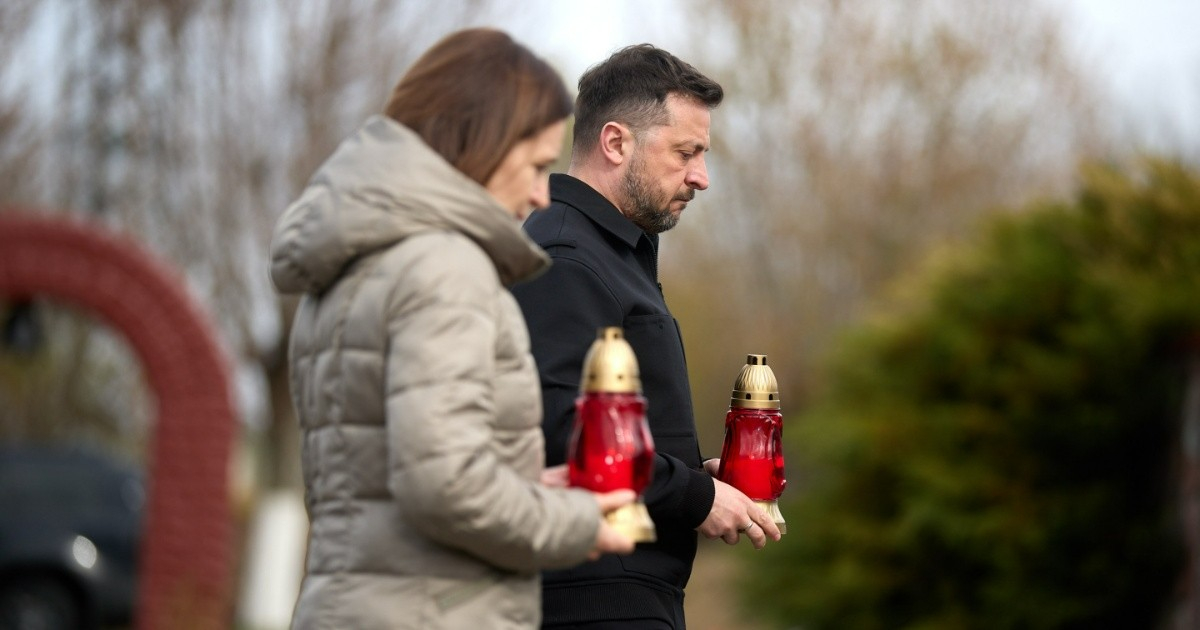
On the occasion of the 40th anniversary of the Chernobyl disaster, Ukrainian President Volodymyr Zelensky issued a stern warning about the threat of Russian "nuclear terrorism," emphasizing that Russia's ongoing war is once again bringing the world dangerously close to a man-made catastrophe.
In a Facebook post, Zelensky recalled the events of April 26, 1986, when the reactor number four at the Chernobyl nuclear plant exploded, releasing massive amounts of radioactive material into the environment. He highlighted that "hundreds of thousands of people have been grappling with the aftermath of this tragedy for years."
The Ukrainian leader condemned the persistent presence of Russian Shahed drones over the aging nuclear facility, noting that one drone crashed into the protective sarcophagus last year.
This incident occurred on February 14, 2025, when a Russian Shahed 136 drone collided with the New Safe Confinement (NCS), a steel structure erected between 2016 and 2019 at a cost of 2.1 billion euros, funded by contributions from over 40 countries. The impact created a six-meter-wide hole.
A United Nations inspection in December 2025 confirmed that the NCS had lost its primary safety functions, including its ability to contain, and experts warned that a potential collapse of the shield could release approximately four tons of highly radioactive dust across Europe.
"The world must not allow this nuclear terrorism to persist, and the best way to achieve that is by compelling Russia to stop its reckless attacks," Zelensky emphasized.
Rafael Grossi, Director General of the International Atomic Energy Agency (IAEA), traveled to Kyiv for the anniversary and called for urgent repairs: "We believe repairs should commence as soon as possible, and leaving the situation as it is now is problematic."
The estimated cost for restoring the NCS is 500 million euros, with a technical assessment projecting full functionality restoration by 2030.
The Ukrainian Ministry of Foreign Affairs issued a statement labeling the 1986 disaster as "the greatest man-made disaster in human history" and drew a direct parallel between the Soviet cover-up then and Russia's current behavior.
"Chernobyl is not just a tale of technical failure; it is a verdict on a Soviet system built on crimes and deliberate lies, a regime that current Russia seeks to revive," the ministry asserted.
The statement reminded that the Soviet regime concealed the catastrophe from the world for at least two days and that on May 1, 1986, when radiation had widely spread, thousands in Kyiv were forced to participate in a public parade.
"Today, Moscow continues this tradition of deception, using nuclear facilities as tools of blackmail. Russia has not learned the lesson; instead, it has weaponized nuclear danger," the statement argues.
The Russian invasion of Ukraine turned the nuclear zone into a battlefield from day one: Russian troops occupied the Chernobyl plant from February 24, 2022, to March 31 of that year, causing estimated damages of 100 million euros.
Russia also seized control of the Zaporizhzhia plant, Europe's largest, in March 2022, maintaining its occupation to this day.
The European Union issued a warning last Saturday about the "relentless" Russian attacks on Ukrainian nuclear facilities, demanding an immediate halt from Russia and the return of control over Zaporizhzhia.
"Our appeal on this day is straightforward: it's time to end nuclear blackmail. The international community must show that it has learned the lessons of 1986," concludes the Ukrainian Ministry of Foreign Affairs statement.
Key Questions on Nuclear Threats and Safety
What are the possible consequences of a collapse of the New Safe Confinement at Chernobyl?
If the New Safe Confinement were to collapse, it could release approximately four tons of highly radioactive dust across Europe, posing a severe environmental and health risk.
Why is the international community concerned about Russian actions at nuclear sites in Ukraine?
The international community is worried because Russian military actions at nuclear sites, such as Chernobyl and Zaporizhzhia, threaten to destabilize these facilities, potentially leading to catastrophic consequences reminiscent of past nuclear disasters.