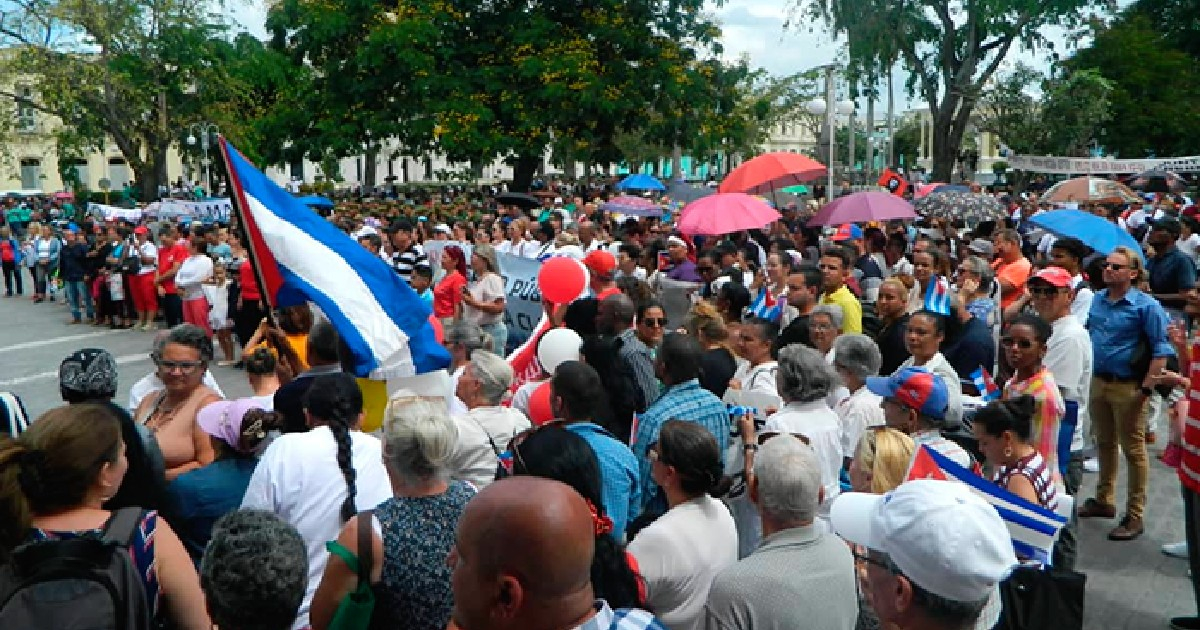
In Villa Clara, preparations are underway for the International Workers' Day with events such as meetings, awards, and so-called "revolutionary" reaffirmation ceremonies, as reported by the Cuban News Agency. A week of activities leading up to the "celebration" included gatherings at Santa Clara's Vidal Park, creating an illusion that workers have something to cheer about.
The article highlights how representatives from various unions, institutions, and mass organizations came together to pledge their participation in the May Day events, under themes of unity, commitment, and peace defense. However, it skillfully omits a glaring reality: these same workers earn an average monthly salary of 6,930 pesos, roughly 15 dollars at the informal exchange rate, while a couple needs over 45,000 pesos monthly to meet basic expenses.
The stark contrast between the official festivities and the harsh reality of everyday life is almost laughable. Cuban wages and pensions barely cover the cost of a pizza and a malt, with minimum pensions falling below 4,000 pesos—less than 10 dollars—far from enough for basic food needs, which are estimated at a minimum of 30,000 pesos per month.
Unfolding Challenges in Villa Clara
Adding to the irony, on the eve of the Cuban News Agency's festive report, Cuba experienced nearly 18 hours of continuous power outages, with a maximum impact of 1,461 MW, according to the National Electrical Union. Power outages are on the rise as officials finalize parade details. The national electrical system has collapsed at least seven times in 18 months, and five times just in 2026.
In Villa Clara specifically, the situation is disgraceful. Since February, bakery bread is only available for those under 13 and over 65, as Commerce authorities cite "complex issues" depending on ship arrivals and logistical assurances amid extreme resource, electricity, and fuel shortages. Yet, organizational energy for the parade seems plentiful.
Symbolic Medals Amidst Economic Strain
The Jesús Menéndez Medal awarded to Maricel Montero Lago, director of the INPUD factory for nearly two decades, and other honors for distinguished officials, are presented by the Cuban News Agency as a "beacon of dedication and patriotism" in the face of the intensified U.S. economic blockade. True to its style, the regime summoned May Day celebrations with a warlike tone under the national slogan "The Homeland is Defended," launched by the Cuban Workers' Central on April 12. The workers' inability to afford food is evidently blamed on the embargo.
Prime Minister Manuel Marrero Cruz has already stated that the parade will proceed "rationally" due to current restrictions—official euphemism for leveraging war rhetoric to mobilize May Day without sufficient fuel or resources for the usual spectacle. Economist Elías Amor bluntly claims that the Cuban state is the main exploiter of workers, controlling their wages and appropriating the value of their labor.
Cuba's Economic Hardships
Meanwhile, 89% of the Cuban population lives in extreme poverty, the GDP has declined by 23% since 2019, and accumulated inflation since 2021 exceeds 206%. Villa Clara's news agenda also highlighted the creation of a book on sweet potato production. Because when there's no bread in the store, sweet potatoes are the fallback. The minor issue being that there aren't any sweet potatoes either.
Understanding Villa Clara's May Day Irony
Why is the May Day celebration in Villa Clara considered ironic?
The May Day celebration is seen as ironic because, while the government organizes festive events, the reality for Cuban workers involves extremely low wages and a struggle to afford basic necessities, highlighting a disconnect between official narratives and citizens' hardships.
What are the economic challenges faced by residents in Villa Clara?
Residents face severe economic challenges including average monthly incomes that are insufficient to cover basic expenses, widespread power outages, and limited availability of essential goods like bread, compounded by inflation and declining GDP.