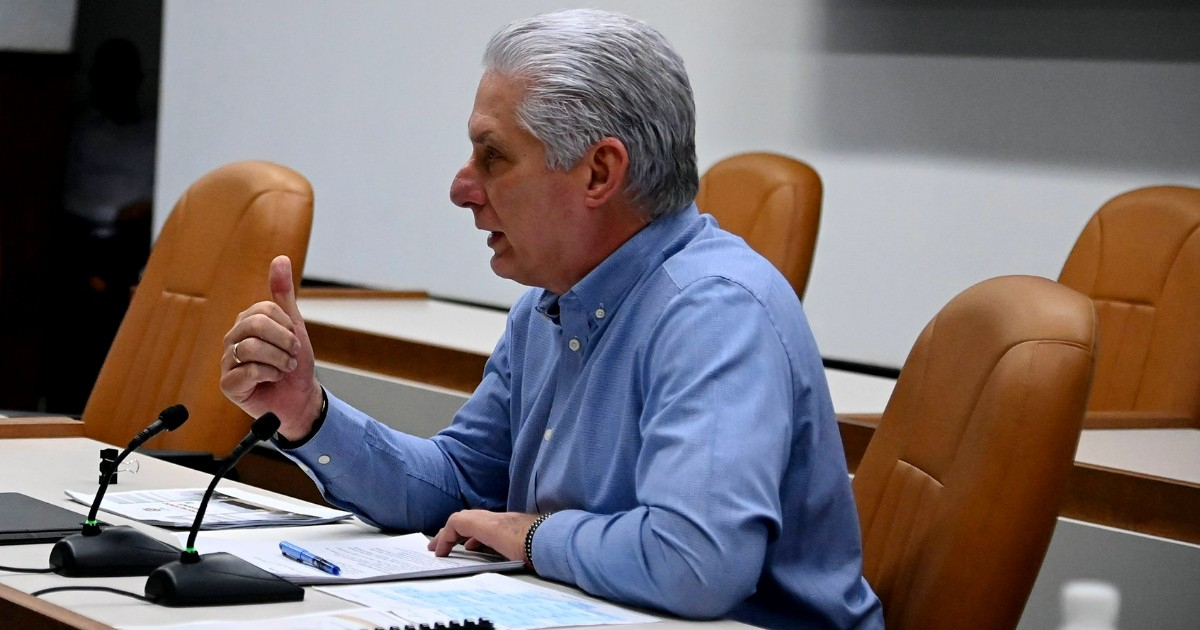
This week, Miguel Díaz-Canel hailed what he deemed a historic milestone: the refinement of Cuban crude oil. However, the Cabaiguán refinery has been processing this oil since 2010, as acknowledged by CUPET's deputy director during the April session of the National Innovation Council (CNI).
The regime's announcement centers on a thermal conversion technology developed by the Center for Petroleum Research (Ceinpet), part of the Cuban Petroleum Union (CUPET), to process the heavy crude from the northern oil belt, known for its high density, viscosity, and sulfur content.
"We broke a criterion, a taboo in the country, that the national crude could not be refined, could not be used for other purposes, and was practically condemned to be used directly in a group of thermoelectric plants," stated Díaz-Canel, unleashing propagandistic enthusiasm that starkly contrasts with the nation’s worsening energy crisis.
What the regime failed to mention is that thermal conversion—known industrially as visbreaking or thermal cracking—is a process widely used in refineries around the world for decades, with a global installed capacity of about four million barrels per day since 1996.
The Cuban regime's announcement did not even involve constructing a plant with this processing technology but rather moving toward a pilot plant yet to be built at the Sergio Soto refinery in Cabaiguán, Sancti Spíritus. The Presidency's note provided no details on costs or timelines for building the pilot plant.
So far, the results have been modest: in an initial experimental run at the Hermanos Díaz refinery in Santiago de Cuba, they produced enough naphtha to cover just 15 days of oil and gas production in Varadero, in addition to a diesel "not of special quality, but marketable" and a fuel under evaluation for power plants and the nickel industry.
Even Díaz-Canel inadvertently admitted the regime's planning failure: "To my surprise, the issue was not to start researching; the science was already there, the research was already there; it was about organizing and articulating."
In other words, the research had existed for years, but the government hadn’t implemented it while Cuba plunged into its worst energy crisis in history.
This announcement comes amid an unprecedented energy collapse. On the same day Díaz-Canel celebrated the supposed scientific advance, the electricity deficit exceeded 1,333 MW, with blackouts lasting up to 18 hours in several provinces.
Cuba produces just about 40,000 barrels of national crude daily, covering only 40% of its consumption, and needs eight fuel ships monthly without receiving even a fraction of that amount.
The regime lost its main suppliers: Venezuela, after the capture of Nicolás Maduro on January 3, 2026, and Mexico, which suspended shipments on January 9 due to U.S. sanctions. The only recent relief was a Russian donation of 100,000 tons of crude, covering just a third of the monthly demand.
In March 2026, there were at least three total collapses of the National Electric System, the seventh in 18 months. This past Saturday, a new automatic frequency-triggered outage left areas of Playa and Habana del Este without power, marking the sixth such incident in Havana in 2026 alone.
The pattern is clear: while Cubans endure nearly 18 hours of daily blackouts, the regime touts "scientific advances" based on globally known industrial technology, limited experimental results, and non-existent pilot plants, all framed within a discourse of energy sovereignty that fails to light a single bulb on the island.
Decades-Old Technology, Not a Discovery
Far from being a Cuban breakthrough, the so-called thermal conversion is part of a set of standard technologies in the international petroleum industry used since the mid-20th century to process heavy and extra-heavy crudes.
Processes such as visbreaking, thermal cracking, or coking are routinely applied in countries with large reserves of dense crude, like Venezuela, Canada, or Mexico, where they help reduce oil viscosity, improve handling, and produce marketable derivatives.
In this context, the regime's announcement doesn't represent a technological innovation globally but rather a local adaptation of well-established methods, applied under conditions of supply shortages and industrial limitations.
Moreover, acknowledging that these investigations existed years ago reinforces the notion that it is not a recent advancement but a delay in its implementation within the country's energy strategy.
Understanding Cuba's Energy Challenges
Why is Cuba facing an energy crisis?
Cuba is experiencing an energy crisis due to a combination of factors, including limited domestic crude production, loss of key international suppliers, and outdated infrastructure, leading to frequent blackouts and supply shortages.
What is thermal conversion, and why is it important?
Thermal conversion is a refining process used to break down heavy crude oils into lighter, more valuable products. It's vital for processing dense oils, making them easier to handle and increasing their market value.