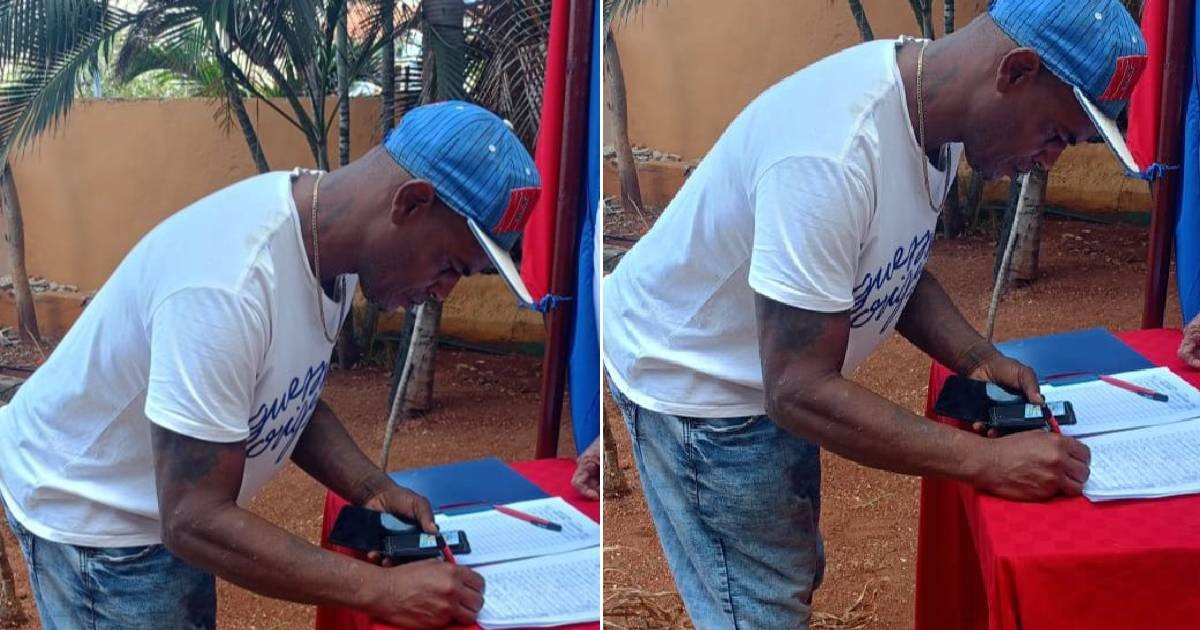
Gerardo Hernández Nordelo, the former Cuban spy and national coordinator of the Committees for the Defense of the Revolution (CDR), recently shared a photo on his Facebook page showing a man signing documents at a CDR table during the "My Signature for the Homeland" campaign. Hernández presented this as evidence of popular support for the regime's initiative.
The man in the photograph claims to be a "repatriate" who spent thirty years in the United States. He justifies his involvement by stating, "My ideology is not what matters. What matters is that I don't want bombs for my people, I ask for peace. I don't want more blockade; the suffering has been enough. That's why I sign."
The image features the individual bent over a red tablecloth, signing papers next to what appears to be an official seal, with a Cuban flag and palm trees in the backdrop of a reddish earth setting.
The Propagandistic Objective Behind the Campaign
This portrayal serves a clear propagandistic purpose: to suggest that even those who have lived in the United States support the revolution. However, the post inadvertently reveals the superficial nature of a campaign that the regime portrays as a spontaneous civil society movement.
Launch and Context of the "My Signature for the Homeland" Initiative
The "My Signature for the Homeland" campaign was initiated by the Communist Party of Cuba (PCC) on April 19 to endorse the Declaration "Girón is Today and Always," issued on April 17, marking the 65th anniversary of the socialist character of the revolution.
Organized by the Ideological Department of the Central Committee and announced by its head, Yuniasky Crespo Baquero, the campaign was framed as a constitutional obligation: "Defending ourselves is not just a right; it is, as our Constitution states, the greatest honor and supreme duty of every Cuban."
Signature books were made available in communities, workplaces, and educational centers nationwide, amid a severe energy crisis characterized by widespread blackouts and general scarcity.
Cynical Use of Social Mobilization
Even President Díaz-Canel admitted during an event on April 16 that "there is absolutely no fuel for almost anything," which starkly contrasts with the image of unity and support that the regime aims to project through the campaign.
Critics argue that these mobilizations act as mechanisms of social control and coercion, where non-participation could lead to political repercussions and professional or academic penalties.
This is not the first time the regime has used such tactics. In September 2025, a similar campaign was conducted to support Nicolás Maduro, with the Ministry of Education mobilizing students and demanding signatures from children and teenagers under threat of being labeled "counterrevolutionaries." The organization Cubalex condemned these violations of children's rights.
Hernández, who has been a member of the PCC's Political Bureau since April 2021, frequently uses his social media platforms to spread official propaganda. He has faced ongoing criticism from Cubans who highlight his detachment from the real crisis affecting the island.
Understanding Cuba's "My Signature for the Homeland" Campaign
What is the "My Signature for the Homeland" campaign?
The "My Signature for the Homeland" campaign was launched by the Communist Party of Cuba to support a declaration celebrating the socialist character of the revolution, aiming to demonstrate popular backing for the regime.
Why is the campaign considered propagandistic?
The campaign is seen as propagandistic because it presents orchestrated support as spontaneous popular endorsement, masking the coercive nature of participation and the pressures on citizens to conform.
How do critics view these mobilizations?
Critics argue that such mobilizations serve as tools for social control, where failing to participate can result in political targeting and repercussions in employment or education.