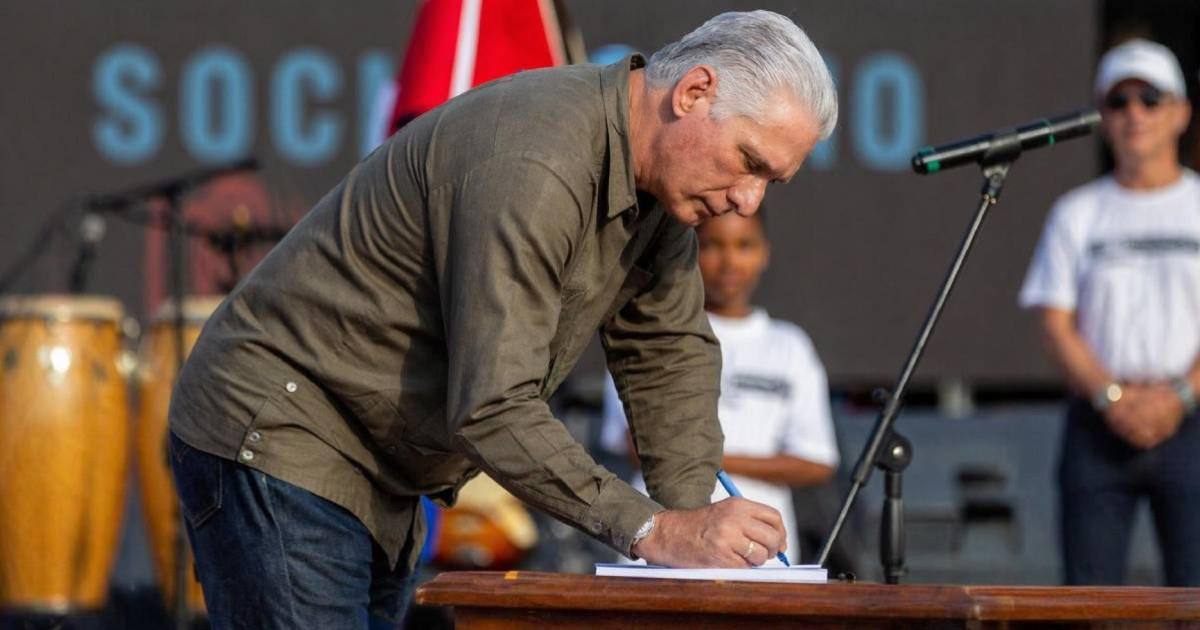
On Thursday, Miguel Díaz-Canel took to social media to promote the #MiFirmaPorLaPatria campaign with a grandiose message portraying Cuba as a free and sovereign nation, solely responsible for its destiny. He urged citizens to continue gathering signatures in support of the regime's official declaration.
The Cuban leader shared the message on his X account (@DiazCanelB), claiming that each signature is "a call to the world's conscience," while condemning what he described as the "genocidal blockade" of the U.S. embargo.
"#MiFirmaPorLaPatria is more than just a signature. It is an act of unity in defense of national sovereignty, against imperial harassment and threats," Díaz-Canel expressed in his post.
The campaign was initiated by the Communist Party of Cuba (PCC) on April 19 to gather signatures in support of the Governmental Declaration titled "Girón is today and forever," released on the 65th anniversary of Cuba's victory at Playa Girón.
Díaz-Canel was the first to sign on April 20 at the Ciénaga de Zapata Memorial Museum in Matanzas, stating, "We sign the unequivocal declaration that the Cuban Revolution will never negotiate its principles."
Roberto Morales Ojeda, Secretary of Organization of the PCC, introduced the initiative as emerging from mass organizations and civil society, although signature books were methodically distributed across communities, workplaces, and educational institutions nationwide. The stated goal is to collect millions of signatures by May 1.
Independent analysts dismiss the campaign as a "smokescreen" intended to divert attention from Cuba's internal economic crisis, marked by fuel shortages, extended blackouts, and lack of water and food.
The opposition's response was swift. José Daniel Ferrer of the Patriotic Union of Cuba (UNPACU) urged citizens not to sign, labeling the campaign as support for oppressors.
Activist Lara Crofs championed the slogan "No signatures for tyranny." Social media was awash with mockery, including phrases like "those signing for the Homeland are fugitives from folic acid."
A viral poem titled "I Won't Sign," attributed to José Martínez, also circulated widely on digital platforms this week.
Analyst Manuel Cuesta Morúa questioned the potential success of the initiative from the start, citing the regime's unpopularity and the coercive pressure on those who refuse to participate.
The declaration supported by the signatures asserts that "Cuba will never be a trophy, nor another star" in the American constellation. This rhetoric is frequently used by the regime to deflect blame for the island's issues onto external sanctions, ignoring the 67 years of dictatorial governance.
Understanding Díaz-Canel's Signature Campaign
What is the goal of the #MiFirmaPorLaPatria campaign?
The campaign aims to collect millions of signatures in support of the Governmental Declaration titled "Girón is today and forever," celebrating the 65th anniversary of Cuba's victory at Playa Girón.
How has the opposition reacted to the signature campaign?
The opposition, including José Daniel Ferrer of UNPACU, has criticized the campaign, urging people not to sign and calling it an endorsement of the oppressive regime.
What criticisms have been made about the campaign?
Critics argue that the campaign is a "smokescreen" to distract from Cuba's internal economic issues, such as fuel shortages and prolonged blackouts.