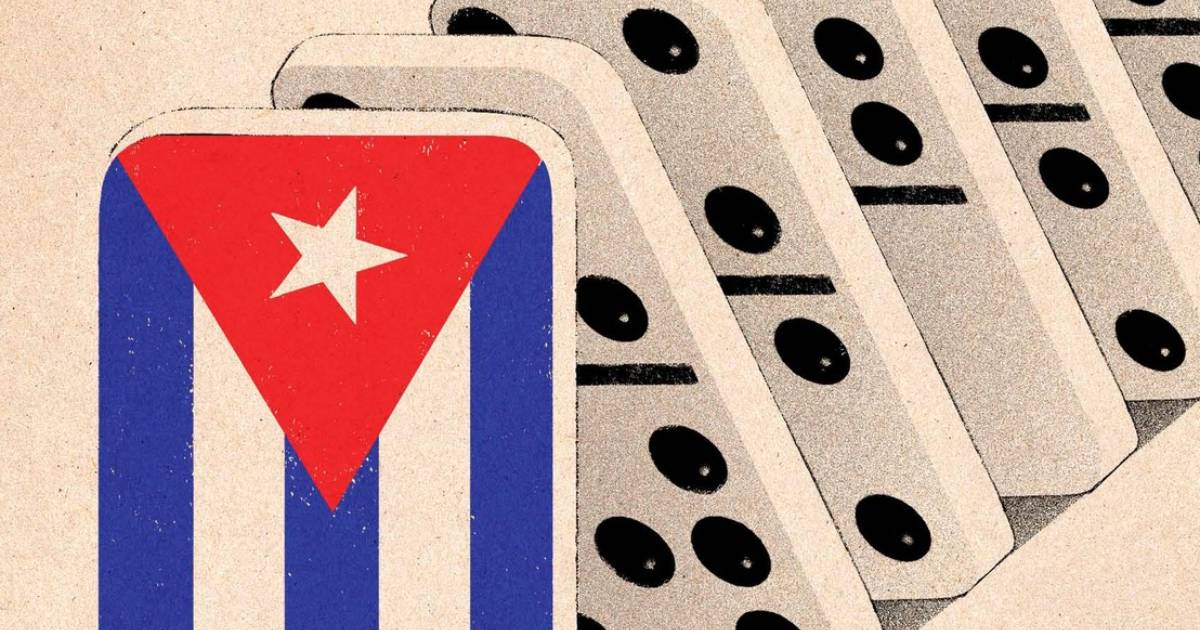
TIME magazine's latest cover story features Cuba with the headline "Before the Fall" and the subheading "Cuba Awaits Trump's Endgame," highlighting a period of significant geopolitical tension for the island not seen in decades.
The May 11, 2026, edition, released online today, follows a declaration by President Miguel Díaz-Canel, who threatened to terminate negotiations with Washington if the United States continues to push for regime change.
The cover art depicts a series of falling dominoes, the first of which is emblazoned with the Cuban flag, a striking visual metaphor for the potential geopolitical impact that a shift in Cuba could trigger following the collapse of Nicolás Maduro's Venezuelan regime.
AJ Hess's report, complemented by photographs from Magnum Photos' Moisés Saman, captures the dire conditions faced by Cuba's 11 million residents: uncollected trash due to fuel shortages, night-long power outages, a strangled economy, and preventable deaths.
After Maduro's ouster, the U.S. halted Venezuelan oil shipments to Cuba—ranging from 25,000 to 30,000 barrels per day—which constituted two-thirds of the island's energy imports and had sustained its economy for decades.
President Donald Trump announced the so-called "Donroe Doctrine"—a modern take on the 1823 Monroe Doctrine—and declared, "Cuba is next."
The article features insights from three Cuban intellectuals contemplating the island's desires and future. Novelist Leonardo Padura describes the Cuban government's official stance as one of indefinite resistance. Padura adds that some analysts believe this "indefinitely" aligns with the upcoming U.S. midterm elections, which could bring about immediate political repercussions.
Cuban-American historian Carlos Eire characterizes the Donroe Doctrine as a vague principle lacking specifics.
Economist Ricardo Torres provides a more structural perspective: "What Cuba needs is neither a foreign bailout nor another official mythology. It needs the space and institutions to rebuild itself."
The diplomatic context surrounding the cover is equally tense. On April 10, a delegation sent by Secretary of State Marco Rubio landed in Havana—the first U.S. government plane on Cuban soil since 2016—and met with Raúl Castro's grandson. Washington demanded the release of political prisoners, internet access expansion, and governance reforms.
Díaz-Canel has confirmed that negotiations are in a very preliminary stage and warned that he will break them off if U.S. pressure for a political system change in Cuba continues.
Key Questions on Cuba's Geopolitical Situation
What is the significance of TIME's cover featuring Cuba?
TIME's cover highlights a critical moment of geopolitical tension for Cuba, emphasizing the island's uncertain future amidst U.S. pressures for regime change.
How has the U.S. policy shift affected Cuba's energy imports?
The U.S. policy shift has led to the cessation of Venezuelan oil shipments to Cuba, which previously made up two-thirds of its energy imports, severely impacting its economy.
What are the potential outcomes of the current U.S.-Cuba negotiations?
The negotiations could lead to significant political and economic changes in Cuba, contingent on the U.S. demands for political prisoner releases, internet access, and governance reforms.