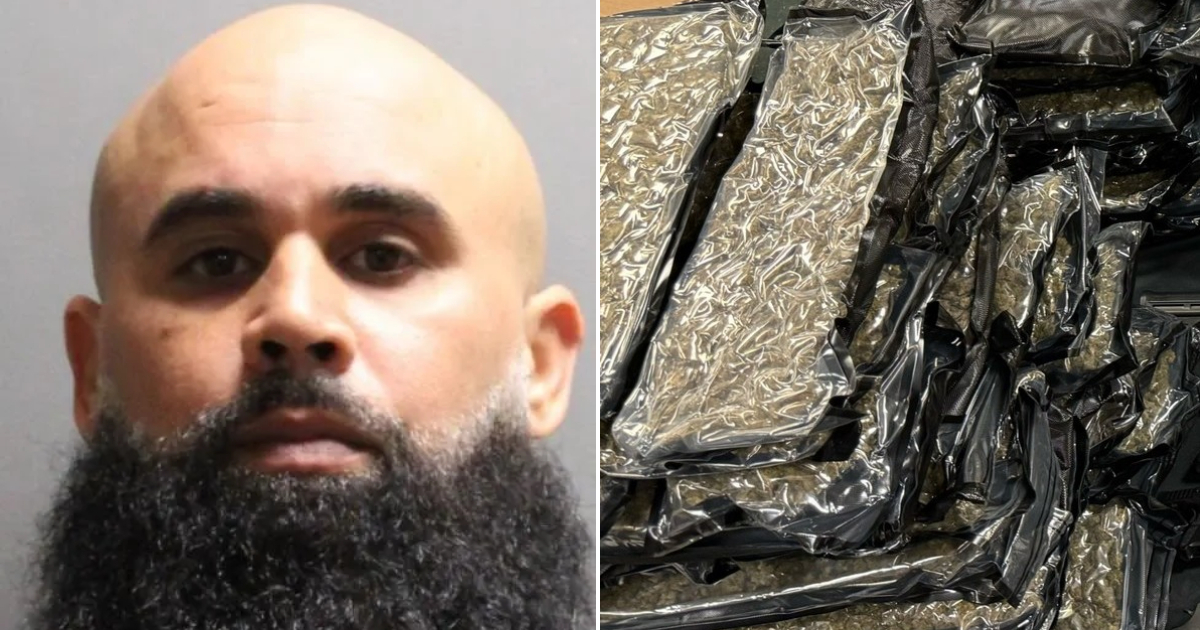
A Cuban resident of Hialeah has entered a guilty plea in a federal court for possessing—with intent to distribute—over 100 kilograms of marijuana, along with five firearms linked to drug trafficking activities in Jacksonville, as announced by the U.S. Attorney's Office for the Middle District of Florida on Tuesday.
José Rubén Curet Villa, age 41, confessed to his crimes, two years after being caught with approximately 137 kilograms (303.5 pounds) of "a mixture and substance containing a detectable amount of marijuana" and firearms used to facilitate drug trafficking offenses.
According to the federal prosecutor, Gregory W. Kehoe, Curet Villa is facing a minimum sentence of 40 years in prison, possibly extending to life imprisonment. The date for his sentencing hearing has not yet been scheduled.
The Investigation and Charges
The investigation began in 2024 when federal authorities discovered that Curet Villa and several accomplices were operating temporary marijuana shops in various locations around Jacksonville. These "pop-up shops" were a tactic designed to elude law enforcement.
The U.S. Attorney's Office detailed that in April of that year, Curet Villa illegally conspired with partners to establish provisional shops where they sold and distributed large amounts of marijuana across five locations in Jacksonville. He worked alongside others who provided venues and security for these temporary enterprises.
Key Evidence and Arrest
On two occasions, an undercover informant made controlled purchases of marijuana from Curet Villa and his associates at these shops, aiding investigators in building a case against him.
On November 15, 2024, law enforcement executed search warrants at several sites connected to Curet Villa, including his residence, where he was present during the raid.
Agents seized over 135 kilograms of marijuana, five firearms—one reported stolen—113 rounds of ammunition, a money-counting machine, vacuum sealers, plastic bags with marijuana residue, scales, and cash, as stated in the official release.
Additional Seizures and Federal Charges
The initial report from the Jacksonville Sheriff's Office also mentioned the confiscation of 37.25 pounds of cannabis wax, 12.4 pounds of THC oil (a concentrated cannabis extract), 3.3 pounds of marijuana edibles, 7.2 grams of MDMA (known as Ecstasy, Molly, or crystal), $11,530 in cash, and a total of 13 firearms.
Local media reports indicated that Curet Villa was initially arrested on state charges and released on a $60,000 bond, but federal charges significantly worsened his legal predicament. The original state charges included trafficking marijuana over 25 pounds, possession of paraphernalia for drug manufacturing or distribution, and possession of hallucinogens with intent to sell or distribute.
Federal Sentencing Implications
Now, under federal jurisdiction, Curet Villa faces a mandatory minimum sentence of 40 years in prison, which could escalate to life imprisonment due to the large-scale trafficking combined with the use of firearms in the crime.
The case was investigated by the Federal Bureau of Investigation (FBI) and the Jacksonville Sheriff's Office as part of "Operation Take Back America," a national initiative by the Department of Justice targeting organized drug trafficking and transnational criminal organizations, while also aiming to protect communities from violent offenders.
Recreational marijuana is not legalized at the state level in Florida, making such operations a top priority for both federal and local authorities.
Understanding Federal Drug Trafficking Penalties
What are the potential penalties for drug trafficking in federal court?
Federal penalties for drug trafficking can include lengthy prison sentences, substantial fines, and forfeiture of assets. The severity depends on the quantity of drugs, the presence of firearms, and prior criminal history.
Why is marijuana trafficking a priority for federal authorities in Florida?
Marijuana trafficking remains a priority in Florida because recreational marijuana is not legalized at the state level, making illegal operations a significant concern for law enforcement aiming to curb drug-related crime.