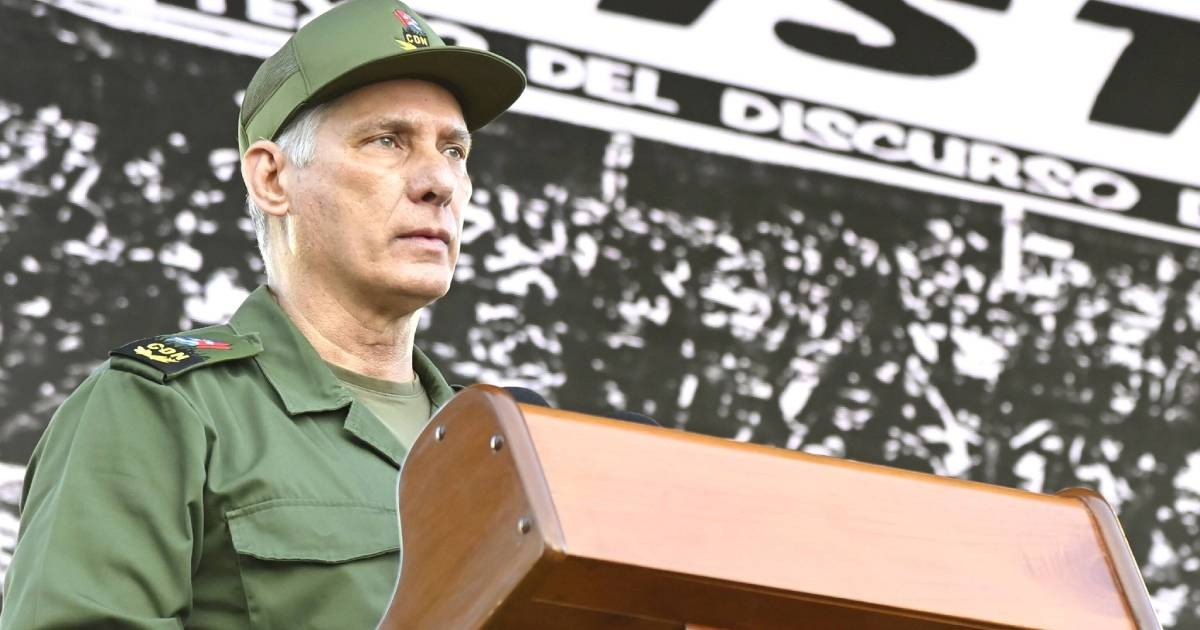
Miguel Díaz-Canel, the leader of Cuba, has openly aligned himself with Raúl Castro's aggressive military rhetoric by sharing a message on his X account. This message, a closing excerpt from a letter by the General to the Eastern Army, urges the forces to confront "any enemy aggression until victory is achieved."
This was not a minor gesture. It once again highlights who truly sets the agenda in the corridors of power.
Raúl Castro's letter, publicized by the Ministry of the Revolutionary Armed Forces (MINFAR) and broadcasted on the National News, commemorated the 65th anniversary of the Eastern Army, a crucial component of the nation's military. Although the historical figure did not attend the event held in Holguín, his words were strongly felt.
The passage chosen by Díaz-Canel leaves no room for doubt, as it is a direct call to arms in defense of the "socialist homeland."
Crucial Timing Amid National Crisis
Yet, beyond the rhetoric, the timing of this alignment is particularly significant.
Cuba is currently enduring one of its most severe crises in decades. Extended blackouts lasting up to 20 hours, food shortages, crumbling transportation systems, and a mass exodus that is draining the country are part of the daily struggles faced by millions of Cubans. In this context, the official discourse is pivoting back to war.
This is not the first indication. In recent weeks, Díaz-Canel has reiterated a narrative of extreme resistance, even invoking the notion of dying for the homeland. Now, with this action, he reinforces a message that originates not from him, but from the historical power elite.
Symbolic Command from Behind the Scenes
This episode makes it clear that, even without making public appearances, Raúl Castro still controls the political and military tone of the nation. As has happened before, his letters serve as symbolic directives, with Díaz-Canel acting more as a spokesperson than an independent leader.
The detail is significant: Raúl, now 94 and increasingly absent from public life, remains at the helm of the National Defense Council, the body that would assume total control in the event of war.
While the government continues to emphasize external threats and military preparedness, the real concern within the island is quite different: the struggle to survive each day.
Herein lies the true tension—not between Cuba and an external enemy, but between the official narrative and the harsh reality faced by a weary population.
Understanding Cuba's Political Climate
Why is Díaz-Canel aligning with Raúl Castro's military rhetoric?
Díaz-Canel's alignment with Raúl Castro's rhetoric underscores who truly controls the political agenda in Cuba, reinforcing the influence of the historical power elite amidst national crisis.
What challenges are Cubans currently facing?
Cubans are experiencing severe hardships, including prolonged blackouts, food shortages, deteriorating infrastructure, and a significant wave of emigration.
What role does Raúl Castro play in Cuba's political and military strategies?
Despite his absence from public view, Raúl Castro remains influential, setting the political and military tone and leading the National Defense Council, which would assume control in wartime.