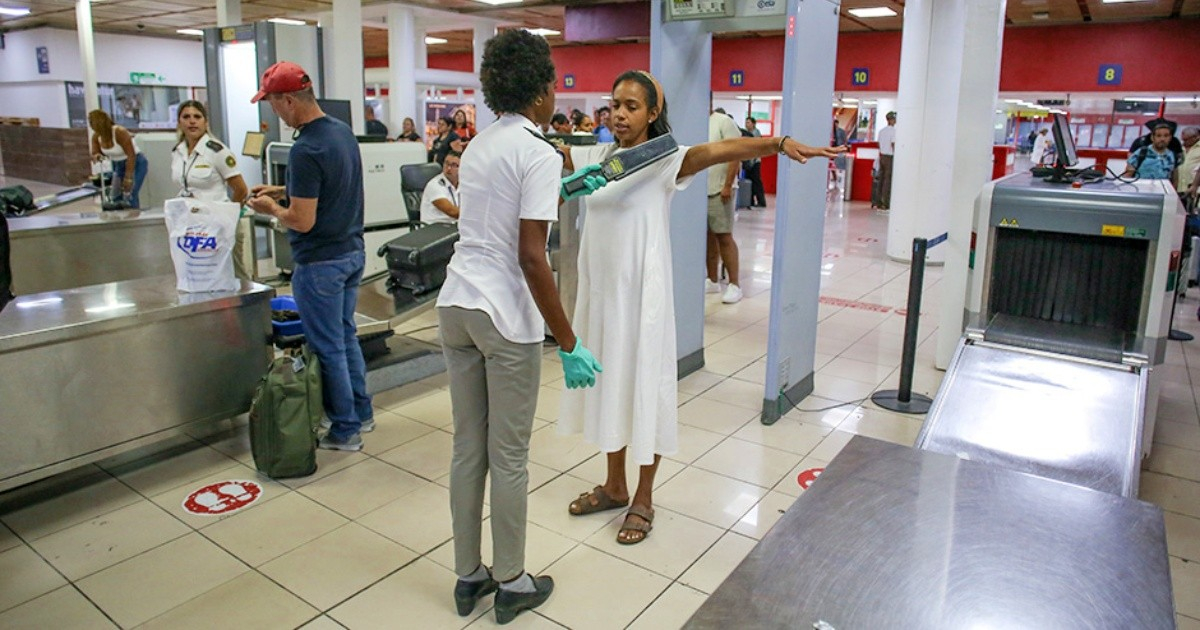
This Tuesday, Cuba awoke to a significantly tighter and more centralized customs system, granting the government increased authority to oversee individuals entering and leaving the island.
The updated legislation enhances the state's power to scrutinize baggage, monitor travelers, seize goods, and even exercise police-like powers. This happens in a context where countless Cubans rely on what they bring into the country or receive from abroad.
At the heart of this transformation is the implementation of Decree-Law No. 108 "Customs," along with its regulations (Decree No. 134) and nine additional resolutions. These were published in the Official Gazette No. 7 on January 20, 2026, and took effect exactly 90 days later.
Significant Shift in Customs Authority
This new legal framework repeals 41 previous regulations, including Decree-Law No. 162 from 1996, which served as the cornerstone of the Cuban customs system for nearly 30 years.
According to Cubadebate, the General Customs of the Republic has framed this reform as part of an "institutional improvement process and legal framework update" to fulfill its state mandate. The agency claims that these new rules align with "constitutional principles" and "international standards advocated by the World Customs Organization."
However, beyond these official statements, the decree unveils a profound redefinition of customs' role. It transitions from a primarily regulatory body to one with extensive direct control over individuals, assets, and activities.
Heightened Scrutiny at Borders
One of the most impactful changes for the public is the tightening of border controls.
The updated legal framework institutionalizes more stringent inspection procedures for travelers, luggage, and cargo at a time when importing goods from abroad is crucial for many families.
The decree highlights the customs' core mission as "ensuring the security of the socialist society," a theme that permeates the entire document, underscoring the political orientation of the system.
In practice, every person entering the country will face increased scrutiny, with limited scope to contest or evade the established checks.
Concentrated Power Within Customs
Decree-Law 108 redefines the power structure within the customs institution.
The head of the General Customs now wields much broader authority, including the ability to create or dismantle customs units, authorize special regimes, and decide the fate of goods.
This includes the power to retain, confiscate, or declare goods abandoned in favor of the state, thereby reinforcing control over inbound assets.
The reach of these powers extends even into the criminal realm, as the regulation stipulates that customs actions in cases of suspected crimes will hold the same validity as those conducted by any primary investigative body.
A pivotal clause also permits the agency to:
"Exercise customs control over premises, offices, warehouses, vehicles, and other transport means, packaging materials, people, and other goods and locations, including conducting searches."
This extensive reach significantly broadens customs' operational scope, allowing it to intervene in various areas beyond the country's entry points.
Technological Surveillance and Constant Oversight
The new customs system relies on a technological deployment that formalizes continuous surveillance at airports and ports.
The decree institutionalizes radiological checks for individuals and luggage, inspections with canine units, and the mandatory use of closed-circuit television in customs areas.
Moreover, these controls are now obligatory. The regulation empowers customs to prevent individuals from continuing their journey if they refuse to cooperate:
"Customs is authorized to prevent a person from accessing a sterile area or boarding an international transport if they decline to submit to security checks."
This measure introduces immediate repercussions for travelers and increases the discretionary power of customs officers.
Stricter Penalties and New Restrictions
The decree also intensifies the sanctioning regime.
Classified as "very serious" offenses—punishable by confiscation and fines up to three times the goods' value—are the importation of drones, satellite phones, GPS devices, propaganda against state interests, drugs, weapons, and explosives.
Particularly concerning for the Cuban diaspora is the prohibition on importing packages or goods for third parties that do not qualify as personal luggage.
This measure directly affects the informal parcel system and "mules," which are crucial for supplying many island families.
Comprehensive Regulations to Strengthen Control
The new legal framework is supported by nine complementary resolutions - from 529 to 537 of 2025 - regulating every phase of the customs process: from cargo control and provisioning of ships and aircraft to customs clearance and abandonment of goods in favor of the state.
The system also establishes the Authorized Economic Operator program, through which customs will certify companies deemed reliable, reinforcing institutional control over the business sector.
Unchanged Policies: Personal Shipments and Luggage
Despite these changes, authorities have insisted that the rules for non-commercial imports by individuals remain unchanged.
The allowances for importing food, medicine, medical supplies, and toiletries remain, as well as the benefit for bringing in electrical generators over 900 watts, a measure adopted in response to the energy crisis.
Balancing Modernization and State Control
First Deputy Head of the General Customs, William Pérez González, defended the reform as a necessary update aligning the system with international standards set by the World Customs Organization.
He explained that the drafting process took several years and incorporated around 600 criteria and proposals from various agencies.
Nevertheless, the content of Decree-Law 108 suggests a more complex reality. The repeated emphasis on "securing the socialist society" and the expansion of control powers reflect a strategy to strengthen the state's border apparatus.
In a nation plagued by prolonged blackouts, fuel shortages, and heavy reliance on family remittances, the new legislation sets the stage for heightened vigilance and control over one of the main survival channels for the population.
More than just a technical update, these new regulations redefine the relationship between the state and its citizens, cementing a model where inspection, regulation, and oversight play a much larger role in the daily lives of those who travel or depend on external supplies.
Understanding Cuba's New Customs Regulations
What is the main change in Cuba's new customs law?
The main change is the increased authority of customs to scrutinize travelers and luggage, allowing for more rigorous inspections and a greater level of control over goods and individuals entering the country.
How does the new customs system affect Cuban families?
The new system imposes stricter controls on imports, which could limit the flow of goods essential for many families who rely on items brought in from abroad for their daily needs.
Are there any exemptions under the new customs regulations?
Yes, the regulations maintain exemptions for importing food, medicine, medical supplies, and toiletries, as well as for electrical generators over 900 watts, to address the ongoing energy crisis.