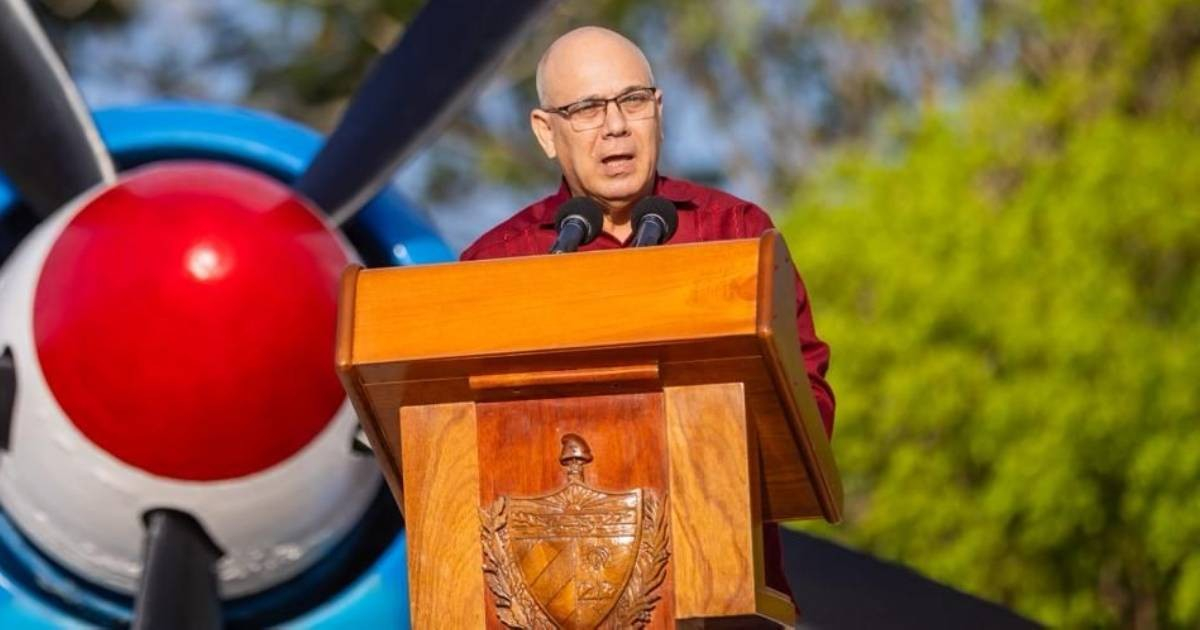
Roberto Morales Ojeda, the Organization Secretary of the Central Committee of the Communist Party of Cuba (PCC) and a member of its Political Bureau, recently claimed on Facebook that civil society organizations have initiated a signature collection campaign titled "Por la Patria." He described it as a response to the ongoing blockade, slander, media attacks, and a constant hybrid war—assertions that are directly contradicted by documented evidence.
The campaign was initially announced last Friday by Yuniasky Crespo Baquero, head of the PCC's Ideological Department, at the closing of the V International Patria Colloquium held in Havana from April 16 to 18.
Cuban leader Miguel Díaz-Canel kick-started the campaign on Sunday at the Ciénaga de Zapata Memorial Museum in Matanzas during the central event marking the 65th anniversary of the Bay of Pigs invasion.
The Contradictions within the Campaign
The contradiction in Morales Ojeda's statements is glaring: he was the keynote speaker at the Playa Girón event where the campaign was launched, yet later depicted it on social media as a grassroots initiative.
Controlled Civil Society
In reality, Cuba lacks truly independent civil society entities. The so-called mass organizations, including the Committees for the Defense of the Revolution (CDR), the Federation of Cuban Women (FMC), the Central Workers’ Union of Cuba (CTC), the Union of Young Communists (UJC), and others, are subservient to the PCC. The 2019 Constitution enshrines the PCC as the leading force of both society and the state.
Signature books were made available across communities, workplaces, and educational institutions starting this Sunday to support the Revolutionary Government's Declaration “Girón is today and always,” issued on April 17.
Opposition Voices
Opposition figures swiftly denounced the campaign. José Daniel Ferrer, leader of the Patriotic Union of Cuba (UNPACU), urged people not to sign, labeling the initiative as support for tyranny. Activist Yamilka Lafita Cancio, known on social media as Lara Crofs, also publicly refused to participate.
Manuel Cuesta Morúa questioned the actual reach of the campaign, noting that in a situation where the regime's unpopularity is extremely high, the government seeks to display popularity by compelling signatures to legitimize a revolution that has been fading in recent years.
Anthropologist Jenny Pantoja Torres cautioned that many individuals engage not out of belief but due to economic desperation and institutional coercion, as they rely on the state for their livelihood, and non-participation could lead to social and professional repercussions.
Frequently Asked Questions about Cuba's Signature Campaign
What is the "Por la Patria" signature campaign?
The "Por la Patria" signature campaign is a government-led initiative in Cuba aimed at collecting signatures to show support for the Revolutionary Government's Declaration, amid claims of external blockades and media aggression.
Why do opposition figures reject the campaign?
Opposition leaders reject the campaign because they view it as an attempt to falsely demonstrate government popularity and as a means to support an oppressive regime.
Is there genuine independent civil society in Cuba?
No, genuine independent civil society does not exist in Cuba. Organizations are largely controlled by the Communist Party of Cuba, ensuring alignment with state policies.