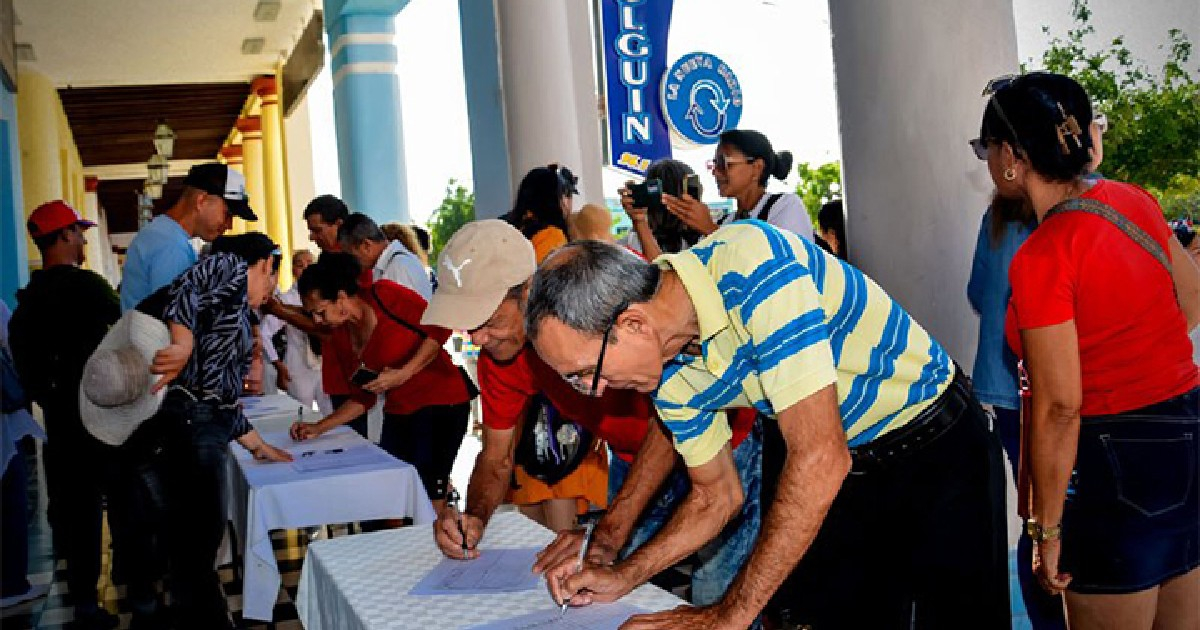
As millions of Cubans endure life without electricity, water, or adequate food, the regime launched its "My Signature for the Homeland" campaign this past Sunday in several provinces. Despite being touted as a grassroots movement, it was orchestrated by the Communist Party of Cuba (PCC) to commemorate the 65th anniversary of the Bay of Pigs invasion.
The agenda was predictable across every region: days dedicated to "voluntary work" in food production, the reading of letters denouncing the United States embargo, and events meant to "reaffirm revolutionary ideals," all overseen by top PCC officials and provincial governments. This was all carried out with the usual solemnity and absurdity typical of the Cuban government's propaganda efforts.
Patriotic Fervor in Isla de la Juventud
In Isla de la Juventud, the gathering was organized by the Municipal Committee of the Central Workers' Union of Cuba and climaxed with what the Cuban News Agency termed a "patriotic climax": the reading of a letter symbolizing the "unity and peace-loving nature of the Cuban people."
Santiago de Cuba's Commitment to History
In Santiago de Cuba, the event took place at the Guillermón Moncada Stadium, led by the PCC and provincial government leaders. A local resident from Los Hoyos neighborhood stated that signing the petition is an act of responsibility to both the country's history and its future.
Guantánamo's Revolutionary Performance
Guantánamo's display featured dozens of individuals harvesting tomatoes at El Paraíso farm in the Arroyo Hondo Productive Hub, about 12 kilometers southeast of the city. This event was presided over by Yoel Pérez García, the first PCC secretary in the province, and Governor Alis Azahares Torreblanca. Meanwhile, in Holguín, the reaffirmation ceremony occurred at Calixto García Park with the presence of Major General Eugenio Rabilero Aguilera, head of the Eastern Army, underscoring the "voluntary" nature of the event.
The campaign supports the Revolutionary Government's declaration "Girón is today and forever," issued on April 17, proclaiming that "Cuba will never be a trophy or just another star in the American constellation." President Miguel Díaz-Canel kicked off the initiative by signing first at the central event in Ciénaga de Zapata, Matanzas, confidently asserting the day before, "We will always prevail"... despite the lack of food, as quickly noted on social media.
Cuba's Dire Economic and Social Crisis
Last Wednesday, Díaz-Canel admitted to a complete lack of fuel for almost everything in the nation. Power outages impact more than half of the country daily, with blackouts lasting over 20 hours. The economy has shrunk by 23% since 2019, with a forecast of -7.2% for this year. On Sunday, the euro surpassed 600 Cuban pesos, while the minimum pension is merely 4,000 pesos, and over 200,000 Cubans lack access to potable water.
Numerous citizen protests in recent weeks highlight the public's frustration, yet the regime's repressive mechanisms, which monopolize military force, exert significant intimidation.
This is not the first time the authoritarian regime has employed this method of political propaganda and legitimacy through signatures. In September 2025, they conducted a similar campaign to gather signatures in support of allied dictator Nicolás Maduro amid potential military threats to Venezuela.
Dissident Manuel Cuesta Morúa labeled the current initiative a "farce" and questioned its success given the "extreme unpopularity" of Cuba's ruling elite. Meanwhile, intellectual Miryorly García urged against participation, warning that signing supports the government's control mechanisms.
The use of attendance lists, coerced convocations, threats, and various forms of blackmail have always been tools of the regime to secure "cooperation" from the public. Official media outlets immediately amplify the "climax" of supposedly "spontaneous" support.
Understanding Cuba's Political Campaigns and Social Challenges
What is the "My Signature for the Homeland" campaign?
The "My Signature for the Homeland" campaign is a government-orchestrated initiative presented as a grassroots movement to commemorate the 65th anniversary of the Bay of Pigs invasion, involving signature collection to express support for the regime.
How are Cubans affected by current economic conditions?
Cubans are facing severe economic challenges, including power outages, a lack of basic necessities, and a significant economic contraction of 23% since 2019. The minimum pension is only 4,000 pesos, with over 200,000 lacking access to clean water.
Why is this campaign considered propaganda?
The campaign is seen as propaganda because it is organized by the Communist Party to project an image of public support and unity, despite being driven by coercion and threats rather than genuine voluntary participation.