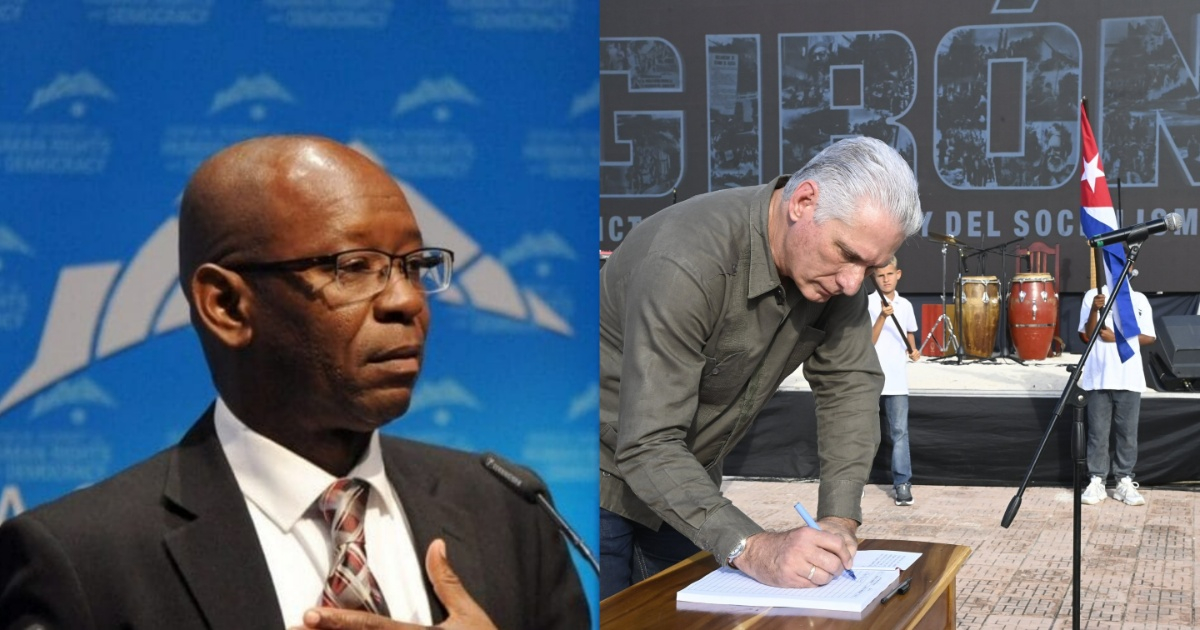
From Havana on Sunday, opposition leader Manuel Cuesta Morúa expressed doubts about the legitimacy of the Cuban regime's latest initiative, "Mi firma por la Patria." This new campaign, launched to gather signatures in workplaces, schools, and communities, aims to support the Revolutionary Government's Declaration.
The Cuban authorities have framed this effort as a demonstration of sovereignty amidst rising tensions with Washington, coinciding with the 65th anniversary of the Battle of Playa Girón. Díaz-Canel kicked off the campaign by signing himself and led the main event in Ciénaga de Zapata, Matanzas.
"At a time when the regime's unpopularity is sky-high, the government is trying to prove its popularity by forcing people to sign, asserting to the world the support it allegedly has, that the revolution retains its legitimacy, which has been dwindling and dying in recent years," said Cuesta Morúa, who leads the Council for Democratic Transition in Cuba.
Cuesta Morúa warned that the regime seeks to project an image of internal unity to the world against U.S. pressure, but he doubts the campaign's effectiveness.
The Question of Genuine Support
"It will be interesting to see how much they can truly mobilize the public, beyond those who feel coerced because, ultimately, people are signing in a different direction, for democratic change," he emphasized.
Jenny Pantoja Torres, an anthropologist and historian, was equally critical, labeling the campaign a "sham" and "manipulation," noting that participation stems not from conviction but from economic desperation and institutional coercion.
Manipulation of Public Perception
"In this time of extreme poverty and crisis in Cuba, I say there's no one obliged to participate. However, we must consider that many people rely solely on a state salary because they lack remittances or other resources," she explained.
Pantoja Torres also cautioned that the regime is likely to manipulate the figures to suit its narrative: "They used to manipulate figures with state-owned computers from the Joven Club, and all those numbers are meant to portray supposed popular support, but it's a facade."
Meanwhile, intellectual and activist Miryorly García took to Facebook on Sunday, urging Cubans to abstain from the campaign, calling for civic conscience and solidarity with the more than 1,200 political prisoners in Cuba.
"Disassociate yourself from being complicit, from giving undeserved support, from allowing them to humiliate you, do not betray those imprisoned for their bravery," García wrote.
She argued that collective abstention could shift the balance of fear: "By dissociating, you can make them fear more than the fear they try to impose through repression, shifting the fear to their side."
The campaign unfolds amid intense geopolitical tension: On Saturday, former President Donald Trump declared in Phoenix that "very soon, the great strength of the U.S. military will bring a new dawn for Cuba," hinting at the possibility of military intervention.
Cuba is also enduring its most severe crisis in decades, with power outages lasting up to 22 hours a day, monthly wages not exceeding $16, and an economic contraction of 23% since 2019.
FAQs on Cuba's Signature Campaign
What is the purpose of "Mi firma por la Patria" campaign?
The campaign aims to gather signatures in support of the Revolutionary Government's Declaration, presenting it as an act of sovereignty against U.S. tensions.
Why does Manuel Cuesta Morúa doubt the campaign's success?
Cuesta Morúa doubts the success due to the regime's high unpopularity and the coercive nature of the signature gathering, which may not reflect genuine public support.
How has the Cuban crisis impacted public participation?
Cuba's severe crisis, including economic hardships and power outages, has led to participation driven by desperation rather than conviction, as noted by Jenny Pantoja Torres.