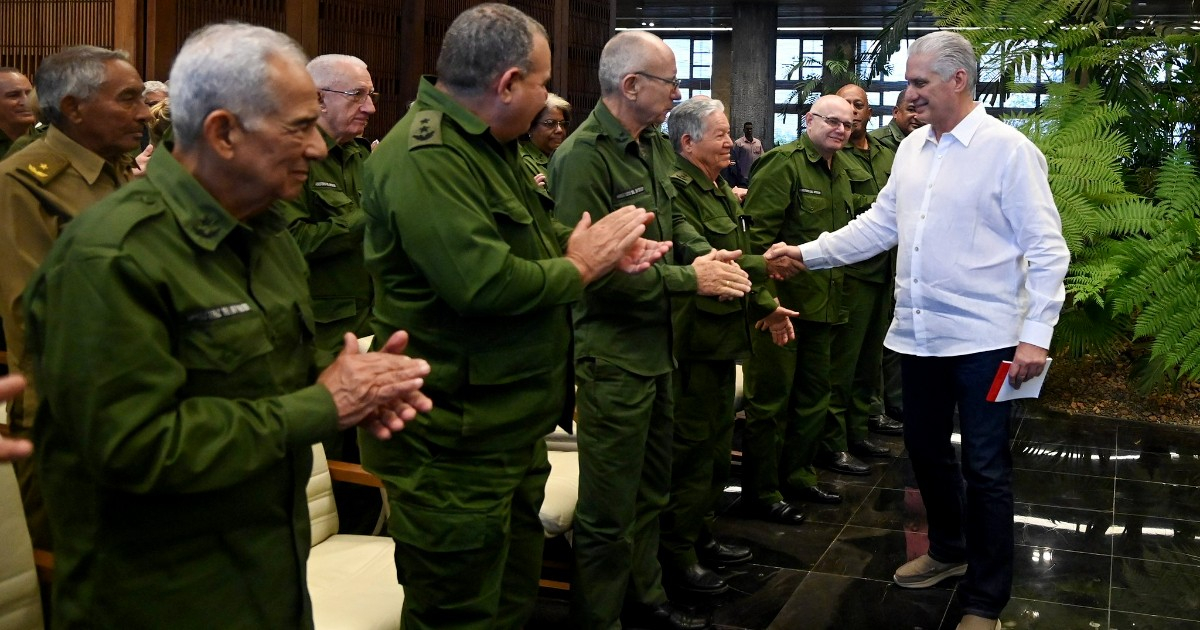
A recent report by CiberCuba on the regime's propaganda sparked a wave of reactions on Facebook, brutally exposing the mood of many Cubans both at home and abroad.
Within minutes, the post was inundated with comments ranging from outrage and mockery to the weariness borne of years of crisis. The media outlet headlined its piece "We Will Always Overcome," quoting Miguel Díaz-Canel's remarks made to members of the Cuban Revolution Fighters Association (ACRC) on Saturday.
The overwhelming response was one of outright rejection. To many users, the leader's rhetoric seemed not only out of touch with reality but also offensive.
"That's a joke," commented one user, a sentiment echoed numerous times. Others were more blunt: "The joke of the day," "What a beautiful meme," or "It makes you laugh," illustrating how the official discourse is increasingly seen as cartoonish.
Yet beneath the humor lies deep-seated frustration. Many comments pointed to a glaring contradiction between the political speeches and the living conditions in Cuba.
"There's nothing for the people to eat, but they dine in the finest places," summarized one commenter. Another, with corrected phrasing, noted, "It's easy with a full stomach, but after 67 years of hunger under this regime, it's very hard."
Life's Realities vs. Political Rhetoric
The idea that leaders live in privilege while ordinary citizens face shortages was a recurring theme. "They have food; the people don't," was repeated almost like a refrain throughout hundreds of comments.
One user questioned, "How can we win without food, electricity, or medicine? That doesn't make sense."
Messages also abounded that cast doubt on the feasibility of the official narrative. "Without food, there's no strength to fight," one respondent wrote, while another added, "If you don't eat, you can't live, much less win."
Questioning the Concept of "Victory"
Some users offered broader reflections on the concept of "victory" espoused by the official discourse. A widely shared comment read: "Victory over what? Hunger, blackouts, the lack of medicines? Because so far, the only ones defeated are the people."
Frustration also manifested through rhetorical questions: "How long will this man keep saying the same thing?" "Who can believe this?" "Did he really say that?" These doubts reflect not just disbelief but also a loss of trust in the authorities.
The Power of Social Media as a Digital Outlet
Another frequent reference was to daily hardships: power outages, food shortages, lack of medicines, and difficulty accessing basic goods. "Without food, water, or electricity, how can we possibly win?" asked one user. Another added, "The people are weakened because there's no food; you can't cover the sun with a finger."
Amid this landscape, some comments pointed to the erosion of traditional political language. "Just blah, blah, blah," wrote an internet user, while another summed it up: "Empty slogans without solutions."
Sarcasm was another constant. "We'll win on an empty stomach," joked one user, while another wrote, "Always toward famine," in a clear nod to historic slogans.
There was also room for more emotional comments, reflecting exhaustion and hopelessness. "I can't deal with this," "What sadness," "It's too much to hear," were some of the expressions captured. In several cases, the impact on children and the elderly was mentioned, highlighting the crisis's human dimension.
Many comments agreed that the issue is not only economic but also communicative. "It's not just the lack of food; it's the lack of respect," summarized one user.
Overall, the social media reaction to CiberCuba's publication served as a barometer of the social climate. Far from generating mobilization or support, the slogan "we will always overcome" seemed to provoke the opposite effect: disbelief, rejection, and, in many cases, ridicule.
The event confirms a trend that has been consolidating in recent years: the digital space has become a channel where Cubans express their discontent unfiltered, question the official narrative, and share experiences that contrast with the institutional storyline.
Beyond the tone of the comments, what emerges clearly is an implicit demand: tangible solutions to everyday problems. As long as this gap persists, statements like the one that sparked the controversy will continue to elicit similar reactions.
The publication, ultimately, did not just provoke interaction (almost a thousand comments in minutes); it exposed an uncomfortable reality for the authorities: more and more citizens not only doubt the official discourse but openly confront it.
Understanding the Social Media Backlash
What sparked the outrage on social media?
The outrage was sparked by a report from CiberCuba on the regime's propaganda, quoting Díaz-Canel's remarks, which seemed disconnected from the realities faced by many Cubans.
How did users react to Díaz-Canel's statement?
Users reacted with a mix of sarcasm, disbelief, and outright rejection, highlighting the disconnect between political rhetoric and the harsh living conditions in Cuba.
What are the main grievances voiced by the commenters?
Commenters mainly voiced grievances about food shortages, power outages, lack of medicines, and the perceived privilege of the leadership compared to the struggles of ordinary citizens.