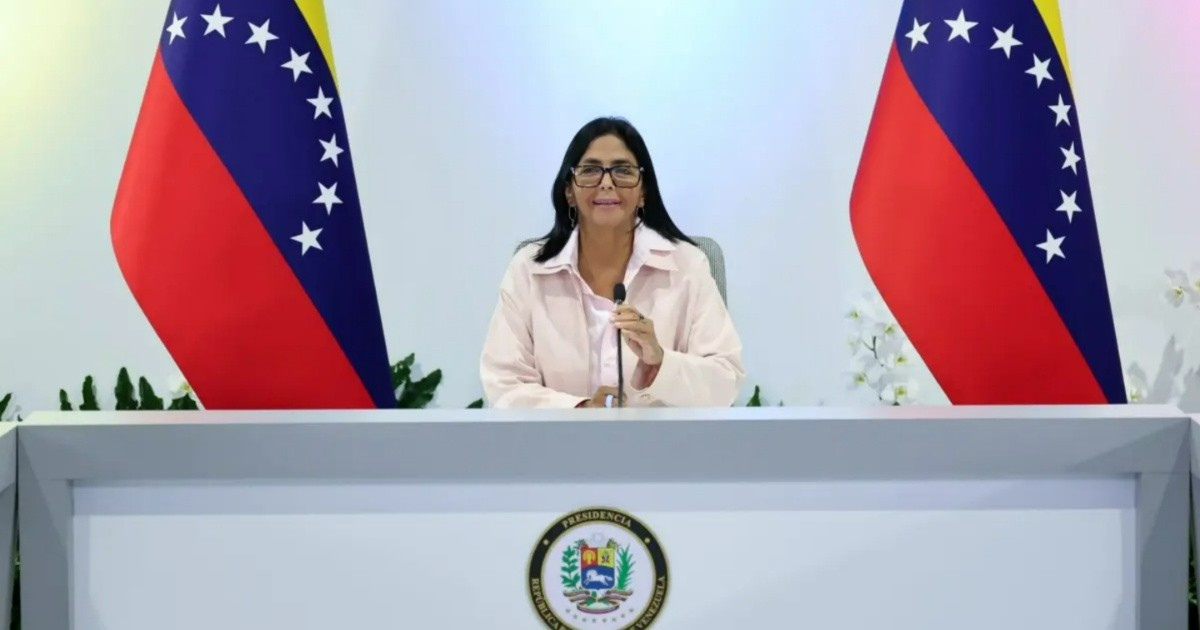
Acting President of Venezuela, Delcy Rodríguez, has called for the commencement of what she dubs the Great Pilgrimage for Peace and Without Sanctions. This nationwide 13-day journey aims to span the entire country, advocating for the complete removal of international sanctions imposed on the Chavista regime.
The irony of the event is hard to miss: Rodríguez is initiating this march just 18 days after the United States removed her from its sanction list, a gesture she publicly thanked Donald Trump for, viewing it as a step towards "normalizing" bilateral relations.
The demonstration is set to conclude on May 1, with three simultaneous routes charted from the farthest corners of Venezuela. One route will start from Zulia, a state bordering Colombia, traversing six western regions en route to Caracas. Another will begin in Táchira, cutting through seven Andean and plains states. The third will originate from Amazonas, moving through eight eastern regions before reaching the capital.
The pilgrimage will also make a point to include Guayana Esequiba, the territory contested with Guyana, which the Chavista government refers to as its "24th state."
A Call for Unity Amid Sanctions
The government has urged Venezuelans to march "hand in hand, regardless of political affiliation, raising a singular voice against the blockade and sanctions aimed at suffocating" the economy, as stated by Chavista spokespeople during a press conference.
However, the U.S. has already significantly eased certain sanctions criticized by the regime. In February, it authorized companies such as Repsol, Chevron, BP, Eni, and Shell to resume operations in the Venezuelan oil sector. Furthermore, on April 14, sanctions were lifted on the Central Bank of Venezuela and three public financial entities through a general license from the Office of Foreign Assets Control.
Economic Struggles and Public Discontent
Rodríguez acknowledged these developments but argued that a license "does not provide legal security" due to its "temporary nature," as she mentioned on Tuesday during a meeting with a U.S. Department of Energy delegation in Caracas. She also urged Trump to lift sanctions entirely to allow all investments to "fully develop."
The pilgrimage's conclusion on May 1 coincides with Rodríguez's planned announcement of a "responsible" increase in the minimum wage, which has been frozen since March 2022 at 130 bolívares per month, now equivalent to a mere 27 cents at the official exchange rate.
This figure is starkly inadequate compared to a family food basket that, according to the Center for Documentation and Social Analysis (Cendas), costs 677 dollars.
On April 9, unions, students, and public workers rallied to the Palacio de Miraflores, demanding a "fair, sufficient, and dignified" salary, yet received no concrete response from the government.
Calls for Democratic Elections
While the Chavista regime organizes its pilgrimage, Venezuelans abroad filled Madrid's Puerta del Sol this Saturday in support of María Corina Machado, who demanded swift progress towards free elections—a request that Rodríguez's regime has ignored for over three months in power without setting an election date.
The regime has been in power for 100 days without a popular mandate, offering Venezuelans a two-week walk in response.
Understanding Venezuela's Political and Economic Crisis
What is the purpose of the Great Pilgrimage for Peace and Without Sanctions?
The pilgrimage aims to advocate for the complete removal of international sanctions on the Chavista regime by marching across Venezuela for 13 days.
Why is Delcy Rodríguez organizing this event?
Delcy Rodríguez is organizing the event to push for the lifting of sanctions, which she argues are suffocating the Venezuelan economy, despite recent U.S. efforts to ease some of them.
How have Venezuelans responded to economic policies?
Venezuelans, including unions and students, have protested for better wages and economic policies, highlighting the inadequacy of current minimum wage levels compared to the cost of living.