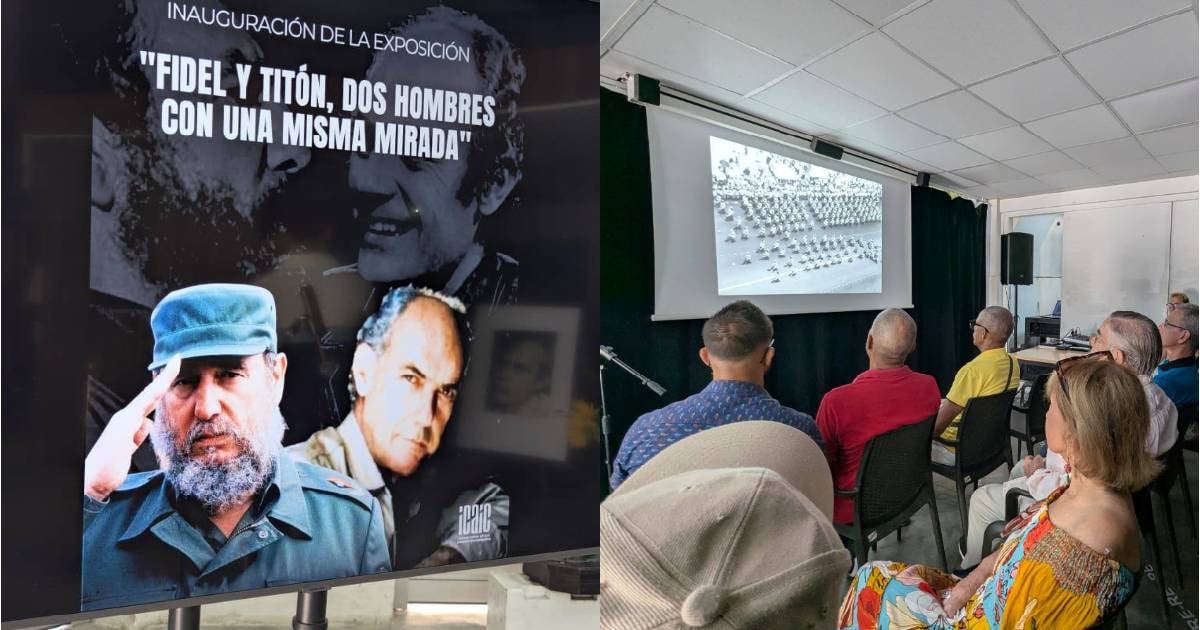
Orlando Rojas, a prominent Cuban filmmaker, launched a scathing critique this Saturday against an exhibition recently opened in the Casa de Titón y Mirta in Old Havana. The exhibit controversially suggests a supposed affinity between the dictator Fidel Castro (1926-2016) and filmmaker Tomás Gutiérrez Alea (1928-1996), a comparison Rojas denounces as "ideological sleight of hand."
In a detailed Facebook post, Rojas expressed his disapproval of the exhibit titled "Fidel and Titón: Two Men with a Shared Vision," organized by the Office of the Historian of Havana and the Cuban Institute of Cinematographic Art and Industry (Icaic).
Rojas argues that the display attempts to construct an ethical and political likeness between the Cuban revolutionary leader and the renowned filmmaker, a notion he believes doesn't align with reality.
Gutiérrez Alea's Legacy of Integrity
Rojas reminisced about his personal and professional bond with Gutiérrez Alea, whom he assisted as a director on the film Los sobrevivientes. He emphasized the intellectual integrity of the author behind Cuban cinema classics like La muerte de un burócrata (1966), Memorias del subdesarrollo (1968), and La última cena (1976).
In his account, Rojas highlighted that Gutiérrez Alea consistently maintained a critical stance towards authority, with his work and public conduct characterized by candor.
Divergent Views on the Cuban Revolution
The filmmaker contested the notion that Castro and Gutiérrez Alea shared a unified vision of the revolutionary process, asserting that over time, they interpreted Cuba's reality from opposing viewpoints.
Reflecting on his extensive dialogues with Titón over more than two decades, Rojas insisted there is no trace of ethical or political similarity between their roles.
He even recounted a phrase he heard from Titón during private cinematic grammar lessons: "Fidel's revolution was a good script but a terrible film."
Historical Tensions and Artistic Censorship
Rojas recalled the uproar in 1991 following the censorship of Alicia en el pueblo de las maravillas, when a group of 18 Icaic filmmakers held a continuous assembly to prevent the institute from being subordinated to political control structures linked to the Communist Party.
He also mentioned the challenges surrounding the release of Guantanamera (1995), Gutiérrez Alea’s last film, which faced attacks from political power sectors.
Through these personal experiences, Rojas affirmed that the exhibition's comparison ignores the differences between Castro's political leadership and the filmmaker's critical perspective.
In his statement, Rojas argued that the failure of the revolutionary project cannot solely be blamed on external factors but also on decisions made at the highest levels of power.
Critique of Current Cultural and Political Context
Rojas extended his critique to the current state of the country, describing Havana and the nation as being in ruins. He viewed the exhibit as an attempt to rewrite the cultural and political memory of Cuban cinema.
The filmmaker noted that many artists who worked within Icaic, often facing censorship, regarded Gutiérrez Alea as a champion of creative freedom. He recalled figures like Nicolás Guillén Landrián (1938-2003) and Sara Gómez (1942-1974) as examples of filmmakers who also faced tensions with cultural control structures.
Rojas concluded with a personal anecdote, recalling his own experience with censorship regarding his film Cerrado por reformas, which was banned by then Icaic president Alfredo Guevara (1925-2013). During this ordeal, he received the supportive solidarity of Gutiérrez Alea alongside other directors.
The filmmaker's publication has reignited the debate over the relationship between culture and power in Cuba and how the official narrative seeks to reinterpret the legacy of one of Latin America's most influential directors.
The exhibition, installed in the former residence of the filmmaker and his wife, actress Mirta Ibarra, has been transformed into the Tomás Gutiérrez Alea Center for Audiovisual Promotion and Research.
This unveiling coincides with the regime's amplification of propagandistic activities surrounding Castro's centennial. On Friday, President Miguel Díaz-Canel inaugurated another exhibition about Castro at the José Martí Memorial.
Additionally, the V International Patria Colloquium was held, featuring an AI-powered screen from Russia Today in Spanish for visitors to take photos with a youthful Castro.
All of this unfolds as Cuba faces a severe humanitarian crisis, with multiple collapses of the National Electric System and blackouts described by experts as worse than those during the 1990s Special Period.
Exploring the Influence and Legacy of Cuban Cinema
What is the controversy surrounding the exhibition about Fidel Castro and Tomás Gutiérrez Alea?
The controversy arises from an exhibition suggesting a shared ethical and political vision between Fidel Castro and director Tomás Gutiérrez Alea, a comparison criticized as misleading and ideologically manipulative.
How did Orlando Rojas describe his relationship with Tomás Gutiérrez Alea?
Orlando Rojas described his relationship with Gutiérrez Alea as both personal and professional, highlighting the director's intellectual integrity and consistent critical stance towards power.
What impact did Gutiérrez Alea have on Cuban cinema according to Rojas?
According to Rojas, Gutiérrez Alea was a defender of creative freedom, inspiring many artists within the Cuban Institute of Cinematographic Art and Industry, even amidst censorship challenges.