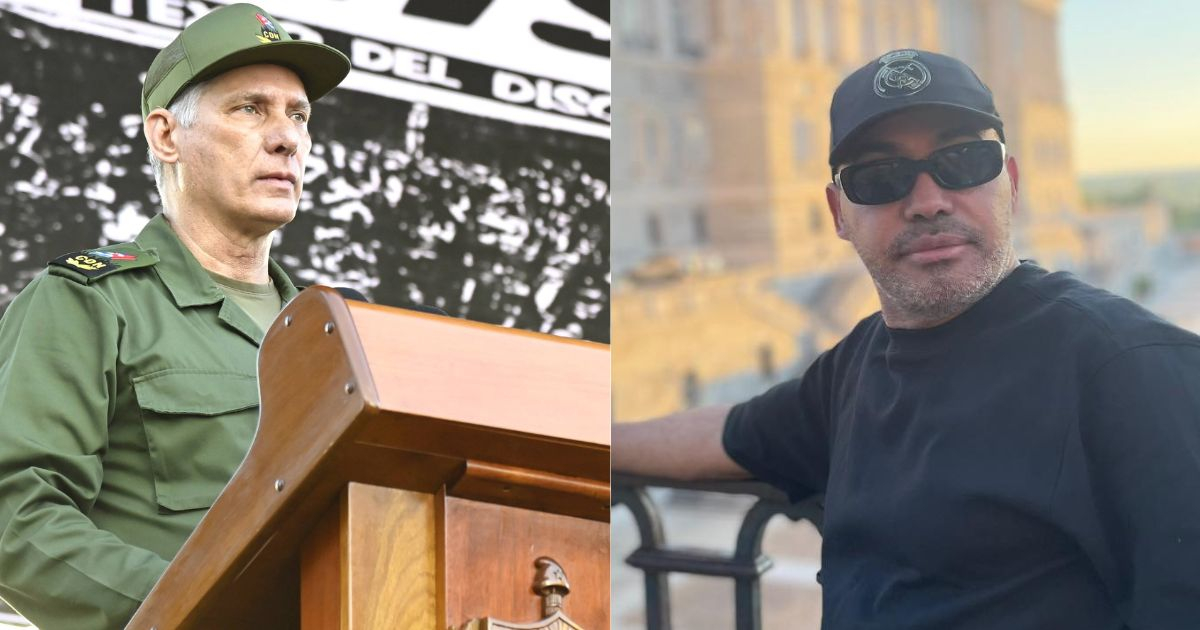
Exiled Cuban singer Manolín, known as "The Salsa Doctor," strongly criticized Cuban President Miguel Díaz-Canel's militaristic rhetoric after he urged the island's citizens to brace for potential U.S. military aggression. Manolín labeled the leaders in Havana as "a disgrace" and "buffoons."
In a forceful Facebook post, Manolín responded to the official event held on April 16, during which Díaz-Canel commemorated the 65th anniversary of the socialist proclamation of the Revolution with a call to armed resistance.
"It's always been the same; they never summon the people for anything good. Angola, war; Ethiopia, war; Venezuela, war; Grenada, war; Ukraine, war; and now Cuba, war too," Manolín wrote, highlighting a historical pattern of military mobilization imposed on the Cuban people by the regime for decades.
The salsa artist condemned the government for never inviting Cubans to discuss other issues that have been denied to them. "They never speak of democracy, freedom, forgiveness, reconciliation, releasing political prisoners, freedom of expression, coexistence, or relinquishing power for others to take over," he stated.
His critique targets the dictatorial core of the system: "They remain in power for life, and if not, it's war and we all die. Clinging to power, they offer hunger, repression, beatings, imprisonment, exile, war, and death. That’s all they offer the Cuban people," he concluded.
Díaz-Canel's speech was laced with aggressive tones. "The moment is extremely challenging and once again summons us, like that April 16, 1961, to be ready to face serious threats, including military aggression. We do not want it, but it is our duty to prepare to avoid it and if inevitable, to win it," the leader declared.
This latest call is part of a rhetorical escalation by the regime since January 2026, when it declared the "Year of Preparation for Defense" and implemented the doctrine of total war, involving civilians, students, and children in military exercises. The National Defense Council, led by Raúl Castro, even approved plans for the "transition to the State of War."
The stark contrast between such rhetoric and the everyday reality for Cubans is jarring: the island suffers 20-hour daily blackouts and more since December 2025, exacerbated by the disruption of Venezuelan oil supplies following Nicolás Maduro's fall. Hundreds of political prisoners exist, and protests erupt daily across the country.
Recent pot-banging protests in La Güinera, Luyanó, and Morón reflect a population's frustration, demanding food, water, and electricity, not war.
History supports Manolín's denunciation: for instance, tens of thousands of Cuban soldiers were sent to conflicts in Angola and other African countries between 1975 and 1991, with over 2,000 officially reported deaths.
In an interview with NBC News, Díaz-Canel stated, "if necessary to die, we will die, because as our national anthem says: to die for the homeland is to live." For millions of Cubans surviving without electricity or food, that statement rings more like a death sentence than a conviction.
Understanding Cuba's Current Political Climate
What is the current situation in Cuba regarding electricity and resources?
Cuba is experiencing severe electricity shortages, with outages lasting up to 20 hours daily. The resource scarcity has been exacerbated by the halting of Venezuelan oil supplies after the fall of Nicolás Maduro.
How has the Cuban government responded to potential external threats?
The Cuban government has declared 2026 as the "Year of Preparation for Defense," implementing a doctrine of total war involving civilians, students, and even children in military exercises, as part of their response to perceived external threats.